

0
Eh11
Eh10
H1
Eh12
H7
H6 H5
IL 1
Eh 9
KB
E h2 H2
IL 7
IL 6
IL 5
I L2
IL 3
I L 4
–20
–40
Fe(III)
mg/L
4
3
2
1
0
0
2 0
4 0
6 0
8 0
100
120
140
160
180
200
205
Reactive (Oxygen) Gas Barrier and Zone Technologies
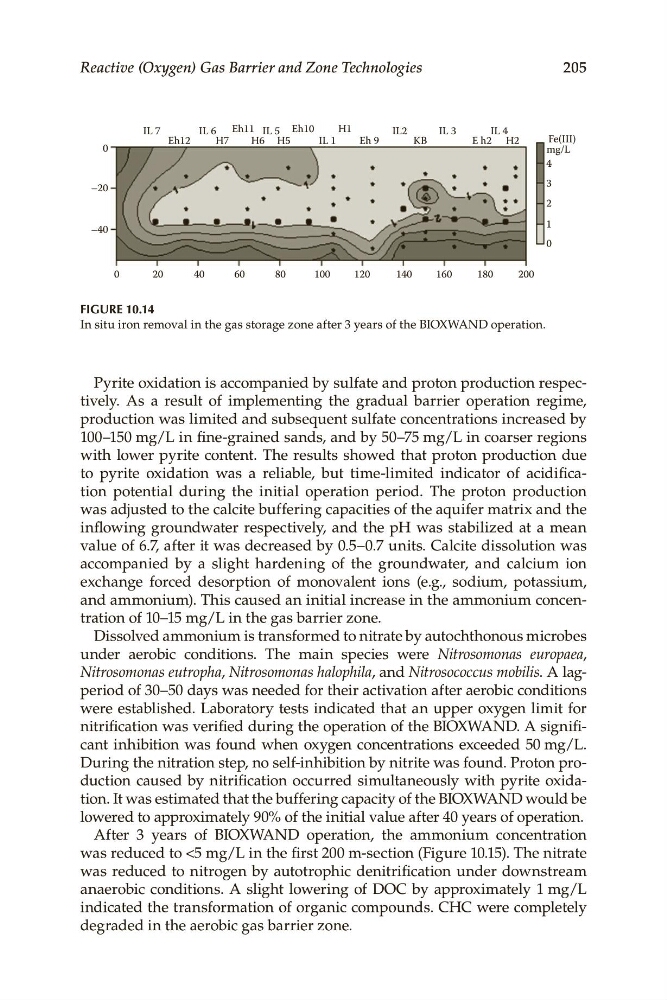
FIGURE 10.14
In situ iron removal in the gas storage zone after 3 years of the BIOXWAND operation.
Pyrite oxidation is accompanied by sulfate and proton production respectively. As a result of implementing the gradual barrier operation regime,
production was limited and subsequent sulfate concentrations increased by
100–150 mg/L in fine-grained sands, and by 50–75 mg/L in coarser regions
with lower pyrite content. The results showed that proton production due
to pyrite oxidation was a reliable, but time-limited indicator of acidification potential during the initial operation period. The proton production
was adjusted to the calcite buffering capacities of the aquifer matrix and the
inflowing groundwater respectively, and the pH was stabilized at a mean
value of 6.7, after it was decreased by 0.5–0.7 units. Calcite dissolution was
accompanied by a slight hardening of the groundwater, and calcium ion
exchange forced desorption of monovalent ions (e.g., sodium, potassium,
and ammonium). This caused an initial increase in the ammonium concentration of 10–15 mg/L in the gas barrier zone.
Dissolved ammonium is transformed to nitrate by autochthonous microbes
under aerobic conditions. The main species were Nitrosomonas europaea,
Nitrosomonas eutropha, Nitrosomonas halophila, and Nitrosococcus mobilis. A lagperiod of 30–50 days was needed for their activation after aerobic conditions
were established. Laboratory tests indicated that an upper oxygen limit for
nitrification was verified during the operation of the BIOXWAND. A significant inhibition was found when oxygen concentrations exceeded 50 mg/L.
During the nitration step, no self-inhibition by nitrite was found. Proton production caused by nitrification occurred simultaneously with pyrite oxidation. It was estimated that the buffering capacity of the BIOXWAND would be
lowered to approximately 90% of the initial value after 40 years of operation.
After 3 years of BIOXWAND operation, the ammonium concentration
was reduced to <5 mg/L in the first 200 m-section (Figure 10.15). The nitrate
was reduced to nitrogen by autotrophic denitrification under downstream
anaerobic conditions. A slight lowering of DOC by approximately 1 mg/L
indicated the transformation of organic compounds. CHC were completely
degraded in the aerobic gas barrier zone.
Eh11
Eh10
H1
Eh12
H7
H6 H5
IL 1
Eh 9
KB
E h2 H2
IL 7
IL 6
IL 5
I L2
IL 3
I L 4
–20
–40
Fe(III)
mg/L
4
3
2
1
0
0
2 0
4 0
6 0
8 0
100
120
140
160
180
200
205
Reactive (Oxygen) Gas Barrier and Zone Technologies
FIGURE 10.14
In situ iron removal in the gas storage zone after 3 years of the BIOXWAND operation.
Pyrite oxidation is accompanied by sulfate and proton production respectively. As a result of implementing the gradual barrier operation regime,
production was limited and subsequent sulfate concentrations increased by
100–150 mg/L in fine-grained sands, and by 50–75 mg/L in coarser regions
with lower pyrite content. The results showed that proton production due
to pyrite oxidation was a reliable, but time-limited indicator of acidification potential during the initial operation period. The proton production
was adjusted to the calcite buffering capacities of the aquifer matrix and the
inflowing groundwater respectively, and the pH was stabilized at a mean
value of 6.7, after it was decreased by 0.5–0.7 units. Calcite dissolution was
accompanied by a slight hardening of the groundwater, and calcium ion
exchange forced desorption of monovalent ions (e.g., sodium, potassium,
and ammonium). This caused an initial increase in the ammonium concentration of 10–15 mg/L in the gas barrier zone.
Dissolved ammonium is transformed to nitrate by autochthonous microbes
under aerobic conditions. The main species were Nitrosomonas europaea,
Nitrosomonas eutropha, Nitrosomonas halophila, and Nitrosococcus mobilis. A lagperiod of 30–50 days was needed for their activation after aerobic conditions
were established. Laboratory tests indicated that an upper oxygen limit for
nitrification was verified during the operation of the BIOXWAND. A significant inhibition was found when oxygen concentrations exceeded 50 mg/L.
During the nitration step, no self-inhibition by nitrite was found. Proton production caused by nitrification occurred simultaneously with pyrite oxidation. It was estimated that the buffering capacity of the BIOXWAND would be
lowered to approximately 90% of the initial value after 40 years of operation.
After 3 years of BIOXWAND operation, the ammonium concentration
was reduced to <5 mg/L in the first 200 m-section (Figure 10.15). The nitrate
was reduced to nitrogen by autotrophic denitrification under downstream
anaerobic conditions. A slight lowering of DOC by approximately 1 mg/L
indicated the transformation of organic compounds. CHC were completely
degraded in the aerobic gas barrier zone.