

Meat processing and animal by-products 137
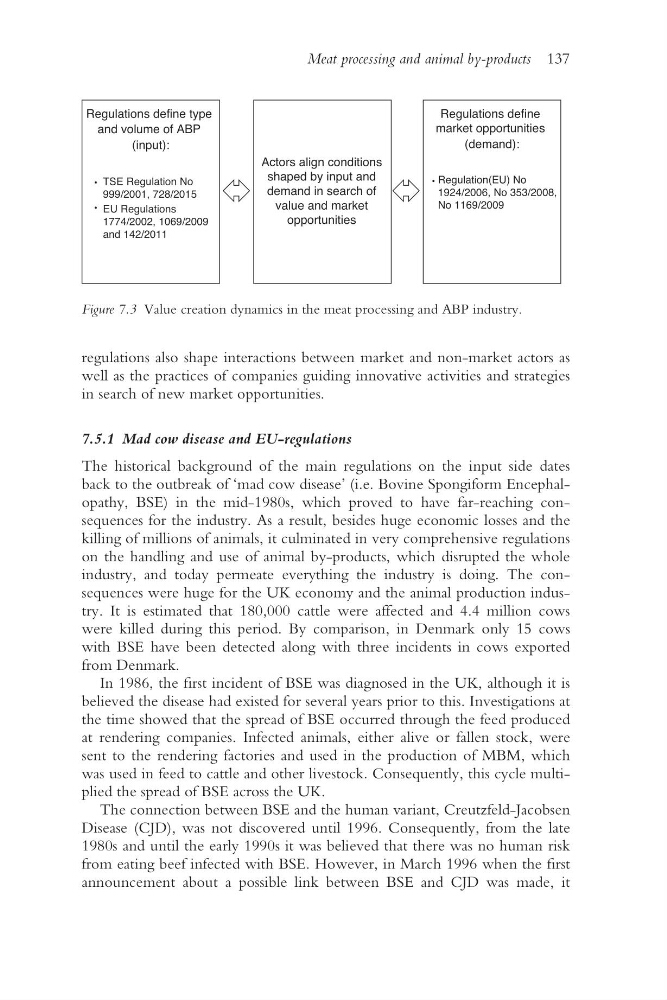
regulations also shape interactions between market and non- market actors as
well as the practices of companies guiding innovative activities and strategies
in search of new market opportunities.
7.5.1 Mad cow disease and EU- regulations
The historical background of the main regulations on the input side dates
back to the outbreak of ‘mad cow disease’ (i.e. Bovine Spongiform Encephalopathy, BSE) in the mid- 1980s, which proved to have far- reaching consequences for the industry. As a result, besides huge economic losses and the
killing of millions of animals, it culminated in very comprehensive regulations
on the handling and use of animal by- products, which disrupted the whole
industry, and today permeate everything the industry is doing. The consequences were huge for the UK economy and the animal production industry. It is estimated that 180,000 cattle were affected and 4.4 million cows
were killed during this period. By comparison, in Denmark only 15 cows
with BSE have been detected along with three incidents in cows exported
from Denmark.
In 1986, the first incident of BSE was diagnosed in the UK, although it is
believed the disease had existed for several years prior to this. Investigations at
the time showed that the spread of BSE occurred through the feed produced
at rendering companies. Infected animals, either alive or fallen stock, were
sent to the rendering factories and used in the production of MBM, which
was used in feed to cattle and other livestock. Consequently, this cycle multiplied the spread of BSE across the UK.
The connection between BSE and the human variant, Creutzfeld- Jacobsen
Disease (CJD), was not discovered until 1996. Consequently, from the late
1980s and until the early 1990s it was believed that there was no human risk
from eating beef infected with BSE. However, in March 1996 when the first
announcement about a possible link between BSE and CJD was made, it
Regulations define type
and volume of ABP
(input):
TSE Regulation No
999/2001, 728/2015
EU Regulations
1774/2002, 1069/2009
and 142/2011
Regulations define
market opportunities
(demand):
Regulation(EU) No
1924/2006, No 353/2008,
No 1169/2009
Actors align conditions
shaped by input and
demand in search of
value and market
opportunities
•
•
•
Figure 7.3 Value creation dynamics in the meat processing and ABP industry.
regulations also shape interactions between market and non- market actors as
well as the practices of companies guiding innovative activities and strategies
in search of new market opportunities.
7.5.1 Mad cow disease and EU- regulations
The historical background of the main regulations on the input side dates
back to the outbreak of ‘mad cow disease’ (i.e. Bovine Spongiform Encephalopathy, BSE) in the mid- 1980s, which proved to have far- reaching consequences for the industry. As a result, besides huge economic losses and the
killing of millions of animals, it culminated in very comprehensive regulations
on the handling and use of animal by- products, which disrupted the whole
industry, and today permeate everything the industry is doing. The consequences were huge for the UK economy and the animal production industry. It is estimated that 180,000 cattle were affected and 4.4 million cows
were killed during this period. By comparison, in Denmark only 15 cows
with BSE have been detected along with three incidents in cows exported
from Denmark.
In 1986, the first incident of BSE was diagnosed in the UK, although it is
believed the disease had existed for several years prior to this. Investigations at
the time showed that the spread of BSE occurred through the feed produced
at rendering companies. Infected animals, either alive or fallen stock, were
sent to the rendering factories and used in the production of MBM, which
was used in feed to cattle and other livestock. Consequently, this cycle multiplied the spread of BSE across the UK.
The connection between BSE and the human variant, Creutzfeld- Jacobsen
Disease (CJD), was not discovered until 1996. Consequently, from the late
1980s and until the early 1990s it was believed that there was no human risk
from eating beef infected with BSE. However, in March 1996 when the first
announcement about a possible link between BSE and CJD was made, it
Regulations define type
and volume of ABP
(input):
TSE Regulation No
999/2001, 728/2015
EU Regulations
1774/2002, 1069/2009
and 142/2011
Regulations define
market opportunities
(demand):
Regulation(EU) No
1924/2006, No 353/2008,
No 1169/2009
Actors align conditions
shaped by input and
demand in search of
value and market
opportunities
•
•
•
Figure 7.3 Value creation dynamics in the meat processing and ABP industry.