

Vibro compaction of granular soils 63
3.3.3 Mitigation of seismic risks
3.3.3.1 Evaluation of the liquefaction potential
It is well-known that saturated medium-to-fine-grained sand may lose
its strength during an earthquake. The phenomenon is called soil liquefaction and occurs primarily in saturated, cohesionless, fine-to-medium
grained soils. In an attempt to explain liquefaction of sand, Casagrande
(1936) used the concept of the critical void ratio—dense sand tends to
dilate under shear, whereas loose sand undergoes a volume decrease
under the same loading condition. The density at which no volume
change occurs in the sand under shear load is called the critical density
(critical void ratio).
Sands having a density below the critical density will therefore settle
when subjected to earthquake motions. If drainage is prohibited, the pore
water pressure u will increase until it equals the overburden pressure and
the resulting effective stress σ′ becomes zero. At this point, the sand has lost
its strength completely and has become a liquid.
′ = −
σ σ u
(3.6)
where:
σ′ is the effective stress
σ is the total stress
u is the pore water pressure
The disastrous earthquakes at Niigata, Japan, and in Alaska, both in
1964, triggered studies and investigations on liquefaction caused by earthquakes to better understand the principles and parameters controlling this
phenomenon.
Today, the state of the art is best described in the publications of the
National Center for Earthquake Engineering Research (NCEER) at the State
University of New York.
The simplified procedure to assess the liquefaction potential of soils
was first developed by Seed and Idriss (1971) and was subsequently periodically corrected and updated with new developments and findings. It
deals with level or gently sloping sites over Holocene alluvial or fluvial
sediments at relatively shallow depths not exceeding 15 m. The procedure defines the cyclic stress ratio (CSR) that would result from a design
seismic event and compares it with the cyclic resistance ratio (CRR), also
called liquefaction resistance, which the soil is able to mobilize during
the earthquake.
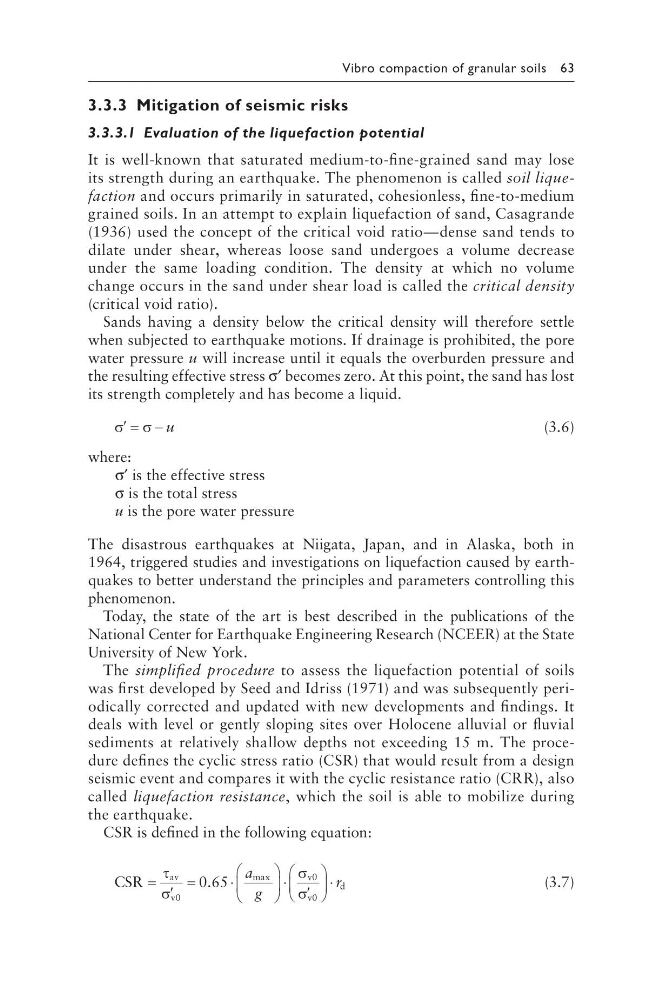
CSR is defined in the following equation:
CSR
av
v0
max
v 0
v0
d
= ′
=
⋅
⋅ ′
⋅
τ
σ
σ
σ
0 65
.
a
g
r
(3.7)
3.3.3 Mitigation of seismic risks
3.3.3.1 Evaluation of the liquefaction potential
It is well-known that saturated medium-to-fine-grained sand may lose
its strength during an earthquake. The phenomenon is called soil liquefaction and occurs primarily in saturated, cohesionless, fine-to-medium
grained soils. In an attempt to explain liquefaction of sand, Casagrande
(1936) used the concept of the critical void ratio—dense sand tends to
dilate under shear, whereas loose sand undergoes a volume decrease
under the same loading condition. The density at which no volume
change occurs in the sand under shear load is called the critical density
(critical void ratio).
Sands having a density below the critical density will therefore settle
when subjected to earthquake motions. If drainage is prohibited, the pore
water pressure u will increase until it equals the overburden pressure and
the resulting effective stress σ′ becomes zero. At this point, the sand has lost
its strength completely and has become a liquid.
′ = −
σ σ u
(3.6)
where:
σ′ is the effective stress
σ is the total stress
u is the pore water pressure
The disastrous earthquakes at Niigata, Japan, and in Alaska, both in
1964, triggered studies and investigations on liquefaction caused by earthquakes to better understand the principles and parameters controlling this
phenomenon.
Today, the state of the art is best described in the publications of the
National Center for Earthquake Engineering Research (NCEER) at the State
University of New York.
The simplified procedure to assess the liquefaction potential of soils
was first developed by Seed and Idriss (1971) and was subsequently periodically corrected and updated with new developments and findings. It
deals with level or gently sloping sites over Holocene alluvial or fluvial
sediments at relatively shallow depths not exceeding 15 m. The procedure defines the cyclic stress ratio (CSR) that would result from a design
seismic event and compares it with the cyclic resistance ratio (CRR), also
called liquefaction resistance, which the soil is able to mobilize during
the earthquake.
CSR is defined in the following equation:
CSR
av
v0
max
v 0
v0
d
= ′
=
⋅
⋅ ′
⋅
τ
σ
σ
σ
0 65
.
a
g
r
(3.7)