

62 Ground improvement by deep vibratory methods
overall permeability of the soil mass. To this end, permeable granular vibro
replacement stone columns can be installed which shorten the drainage
paths considerably, leading to an accelerated pore water pressure relief (see
Section 4.3.4).
The above-mentioned effect of permeability reduction by vibro compaction is occasionally used for groundwater control by reducing seepage through existing flood protection dykes or for reducing the ingress of
groundwater into deep excavation pits. Sidak (2000) reports on interesting
case histories that indicate that vibro compaction reduced the permeability of sand by up to two orders of magnitude, an effect that can often be
achieved only by less environmentally acceptable methods.
In addition to the usual application of decreasing the void ratio of granular soils to allow higher bearing pressures and reducing settlement, vibro
compaction methods are well-suited to resolving a large variety of geotechnical problems. For the design of retaining structures, vibro compaction
can be used to reduce the lateral earth pressure acting on them. The method
can also be used below and around piles and caissons to increase their
load-bearing capacity, and as the method can also be effectively executed
offshore, it is particularly important in construction of harbors and similar
work (Kirsch, 1985, and Section 3.6).
As we have seen, density represents the key characteristic of sand, which
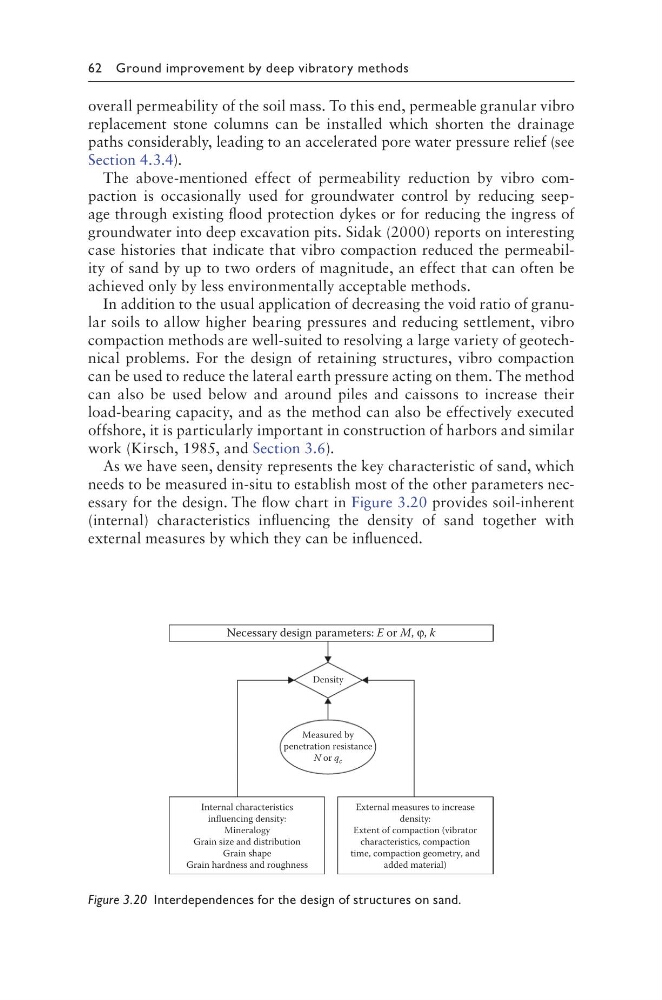
needs to be measured in-situ to establish most of the other parameters necessary for the design. The flow chart in Figure 3.20 provides soil- inherent
(internal) characteristics influencing the density of sand together with
external measures by which they can be influenced.
Necessary design parameters: E or M, φ, k
Density
Measured by
penetration resistance
N or q c
Internal characteristics
influencing density:
Mineralogy
Grain size and distribution
Grain shape
Grain hardness and roughness
External measures to increase
density:
Extent of compaction (vibrator
characteristics, compaction
time, compaction geometry, and
added material)
Figure 3.20 Interdependences for the design of structures on sand.
overall permeability of the soil mass. To this end, permeable granular vibro
replacement stone columns can be installed which shorten the drainage
paths considerably, leading to an accelerated pore water pressure relief (see
Section 4.3.4).
The above-mentioned effect of permeability reduction by vibro compaction is occasionally used for groundwater control by reducing seepage through existing flood protection dykes or for reducing the ingress of
groundwater into deep excavation pits. Sidak (2000) reports on interesting
case histories that indicate that vibro compaction reduced the permeability of sand by up to two orders of magnitude, an effect that can often be
achieved only by less environmentally acceptable methods.
In addition to the usual application of decreasing the void ratio of granular soils to allow higher bearing pressures and reducing settlement, vibro
compaction methods are well-suited to resolving a large variety of geotechnical problems. For the design of retaining structures, vibro compaction
can be used to reduce the lateral earth pressure acting on them. The method
can also be used below and around piles and caissons to increase their
load-bearing capacity, and as the method can also be effectively executed
offshore, it is particularly important in construction of harbors and similar
work (Kirsch, 1985, and Section 3.6).
As we have seen, density represents the key characteristic of sand, which
needs to be measured in-situ to establish most of the other parameters necessary for the design. The flow chart in Figure 3.20 provides soil- inherent
(internal) characteristics influencing the density of sand together with
external measures by which they can be influenced.
Necessary design parameters: E or M, φ, k
Density
Measured by
penetration resistance
N or q c
Internal characteristics
influencing density:
Mineralogy
Grain size and distribution
Grain shape
Grain hardness and roughness
External measures to increase
density:
Extent of compaction (vibrator
characteristics, compaction
time, compaction geometry, and
added material)
Figure 3.20 Interdependences for the design of structures on sand.