

Vibro compaction of granular soils 61
As we have seen, correlations between in-situ measured penetration resistances and relative density provide well-established means for the design
where silica sands are concerned. However, special care is necessary where
sands with high carbonate content are concerned. Calcareous soils with carbonate contents below 50%–70% generally behave similar to noncalcareous
soils. Where higher carbonate contents are encountered, these soils often
contain up to 100% CaCO 3 , and the engineering properties are much more
difficult to assess. Their coarse grains all derive from shell particles which
are subject to grain fracturing during cone penetration and, in addition, very
often high cone penetration resistances above the water table are the result
of particle cementation due to precipitation, a phenomenon which predominantly occurs in arid countries.
It has been observed that an increasing shell content at first leads to
an increase of the cone penetration resistance q c until grain fracturing
becomes a dominant mechanism and the q c values start to decrease again.
Grain fracturing during testing will increase in these sands with increasing
shell content, effective overburden pressure, and density. For these sands,
measured q c values tend to grossly underestimate relative density when
compared with the results in silica sands which can be up to three times
higher at the same density (University Karlsruhe, 2006; Wehr, 2007).
When conditions prevail as described above, the performance of load tests
or direct density measurements and their evaluation and correlation with
CPT values are more appropriate and therefore recommended (see also
Section 3.5).
We will see later, in Section 3.3.3, that densification of saturated loose
sand represents the key improvement measure to prevent liquefaction during an earthquake, although it is accompanied by a certain decrease in
permeability. Consequently, this is apparently counterproductive; however,
with density playing the prime role in controlling liquefaction, the method
is very effective for this purpose. Conversely in saturated fine-grained
sand and silty sands in which densification is difficult to achieve, if at all
possible, liquefaction can most effectively be controlled by increasing the
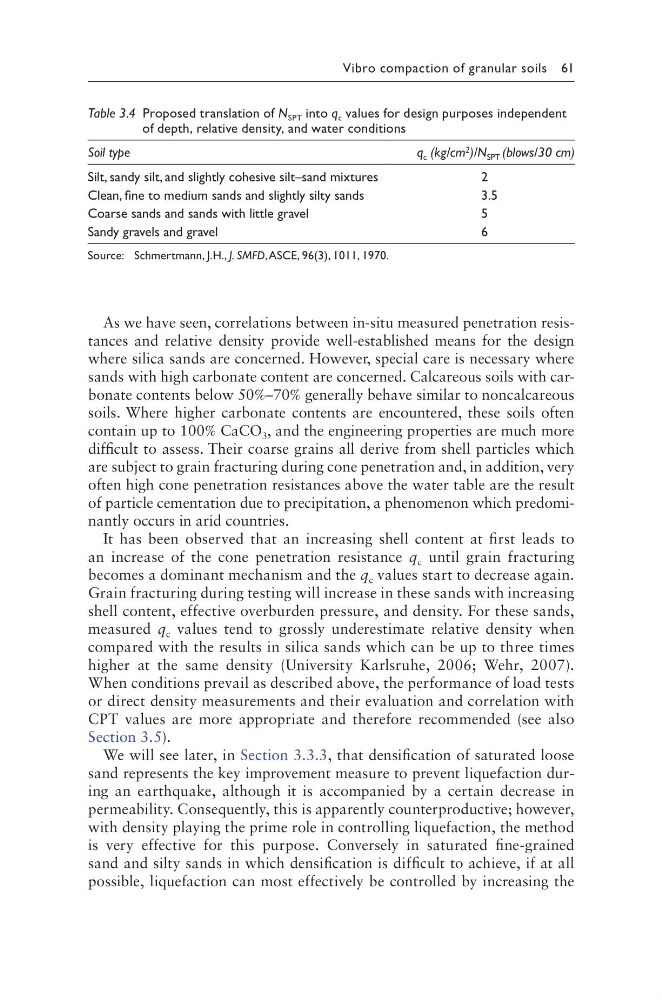
Table 3.4 Proposed translation of N SPT into q c values for design purposes independent
of depth, relative density, and water conditions
Soil type
q c (kg/cm 2 )/N SPT (blows/30 cm)
Silt, sandy silt, and slightly cohesive silt–sand mixtures
2
Clean, fine to medium sands and slightly silty sands
3.5
Coarse sands and sands with little gravel
5
Sandy gravels and gravel
6
Source: Schmertmann, J.H., J. SMFD, ASCE, 96(3), 1011, 1970.
As we have seen, correlations between in-situ measured penetration resistances and relative density provide well-established means for the design
where silica sands are concerned. However, special care is necessary where
sands with high carbonate content are concerned. Calcareous soils with carbonate contents below 50%–70% generally behave similar to noncalcareous
soils. Where higher carbonate contents are encountered, these soils often
contain up to 100% CaCO 3 , and the engineering properties are much more
difficult to assess. Their coarse grains all derive from shell particles which
are subject to grain fracturing during cone penetration and, in addition, very
often high cone penetration resistances above the water table are the result
of particle cementation due to precipitation, a phenomenon which predominantly occurs in arid countries.
It has been observed that an increasing shell content at first leads to
an increase of the cone penetration resistance q c until grain fracturing
becomes a dominant mechanism and the q c values start to decrease again.
Grain fracturing during testing will increase in these sands with increasing
shell content, effective overburden pressure, and density. For these sands,
measured q c values tend to grossly underestimate relative density when
compared with the results in silica sands which can be up to three times
higher at the same density (University Karlsruhe, 2006; Wehr, 2007).
When conditions prevail as described above, the performance of load tests
or direct density measurements and their evaluation and correlation with
CPT values are more appropriate and therefore recommended (see also
Section 3.5).
We will see later, in Section 3.3.3, that densification of saturated loose
sand represents the key improvement measure to prevent liquefaction during an earthquake, although it is accompanied by a certain decrease in
permeability. Consequently, this is apparently counterproductive; however,
with density playing the prime role in controlling liquefaction, the method
is very effective for this purpose. Conversely in saturated fine-grained
sand and silty sands in which densification is difficult to achieve, if at all
possible, liquefaction can most effectively be controlled by increasing the
Table 3.4 Proposed translation of N SPT into q c values for design purposes independent
of depth, relative density, and water conditions
Soil type
q c (kg/cm 2 )/N SPT (blows/30 cm)
Silt, sandy silt, and slightly cohesive silt–sand mixtures
2
Clean, fine to medium sands and slightly silty sands
3.5
Coarse sands and sands with little gravel
5
Sandy gravels and gravel
6
Source: Schmertmann, J.H., J. SMFD, ASCE, 96(3), 1011, 1970.