

Vibro compaction of granular soils 55
the broadly accepted range of grading suitable for vibro compaction as
will be further discussed in Section 3.5.
Compressibility, shear strength, and, to some extent, permeability
depend primarily on the density of the sand, which is generally described by
its relative density D r in terms of the void ratio or of the dry unit weight of
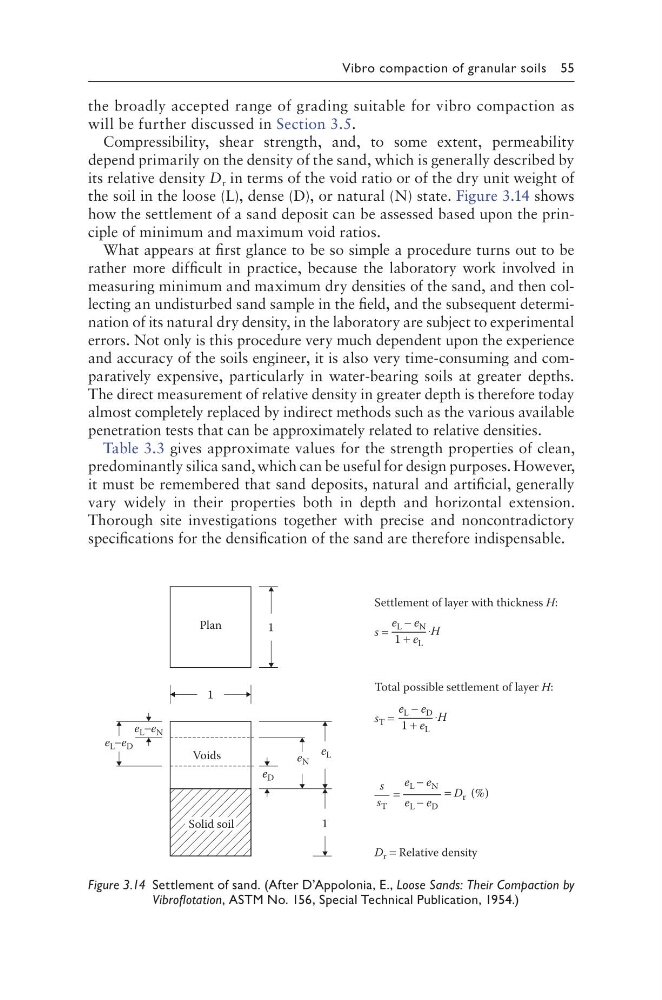
the soil in the loose (L), dense (D), or natural (N) state. Figure 3.14 shows
how the settlement of a sand deposit can be assessed based upon the principle of minimum and maximum void ratios.
What appears at first glance to be so simple a procedure turns out to be
rather more difficult in practice, because the laboratory work involved in
measuring minimum and maximum dry densities of the sand, and then collecting an undisturbed sand sample in the field, and the subsequent determination of its natural dry density, in the laboratory are subject to experimental
errors. Not only is this procedure very much dependent upon the experience
and accuracy of the soils engineer, it is also very time-consuming and comparatively expensive, particularly in water-bearing soils at greater depths.
The direct measurement of relative density in greater depth is therefore today
almost completely replaced by indirect methods such as the various available
penetration tests that can be approximately related to relative densities.
Table 3.3 gives approximate values for the strength properties of clean,
predominantly silica sand, which can be useful for design purposes. However,
it must be remembered that sand deposits, natural and artificial, generally
vary widely in their properties both in depth and horizontal extension.
Thorough site investigations together with precise and noncontradictory
specifications for the densification of the sand are therefore indispensable.
1
1
1
Plan
Voids
Solid soil
e D
e N
e L
e L −e N
e L −e D
e L − e N
1 + e L
⋅H
s =
e L − e D
1 + e L
⋅H
s T =
s
s T
e L − e N
e L − e D
= D r (%)
=
Settlement of layer with thickness H:
Total possible settlement of layer H:
D r = Relative density
Figure 3.14 Settlement of sand. (After D’Appolonia, E., Loose Sands: Their Compaction by
Vibroflotation, ASTM No. 156, Special Technical Publication, 1954.)
the broadly accepted range of grading suitable for vibro compaction as
will be further discussed in Section 3.5.
Compressibility, shear strength, and, to some extent, permeability
depend primarily on the density of the sand, which is generally described by
its relative density D r in terms of the void ratio or of the dry unit weight of
the soil in the loose (L), dense (D), or natural (N) state. Figure 3.14 shows
how the settlement of a sand deposit can be assessed based upon the principle of minimum and maximum void ratios.
What appears at first glance to be so simple a procedure turns out to be
rather more difficult in practice, because the laboratory work involved in
measuring minimum and maximum dry densities of the sand, and then collecting an undisturbed sand sample in the field, and the subsequent determination of its natural dry density, in the laboratory are subject to experimental
errors. Not only is this procedure very much dependent upon the experience
and accuracy of the soils engineer, it is also very time-consuming and comparatively expensive, particularly in water-bearing soils at greater depths.
The direct measurement of relative density in greater depth is therefore today
almost completely replaced by indirect methods such as the various available
penetration tests that can be approximately related to relative densities.
Table 3.3 gives approximate values for the strength properties of clean,
predominantly silica sand, which can be useful for design purposes. However,
it must be remembered that sand deposits, natural and artificial, generally
vary widely in their properties both in depth and horizontal extension.
Thorough site investigations together with precise and noncontradictory
specifications for the densification of the sand are therefore indispensable.
1
1
1
Plan
Voids
Solid soil
e D
e N
e L
e L −e N
e L −e D
e L − e N
1 + e L
⋅H
s =
e L − e D
1 + e L
⋅H
s T =
s
s T
e L − e N
e L − e D
= D r (%)
=
Settlement of layer with thickness H:
Total possible settlement of layer H:
D r = Relative density
Figure 3.14 Settlement of sand. (After D’Appolonia, E., Loose Sands: Their Compaction by
Vibroflotation, ASTM No. 156, Special Technical Publication, 1954.)