

54 Ground improvement by deep vibratory methods
permeability—necessary for design. The direct or indirect measurement of
the density therefore plays a decisive role in determining the need or otherwise for sand compaction and in any quality control measures.
3.3.2 Stability and settlement control
Natural sand deposits and artificially placed sand fill are likely to have
a considerable variation of their key characteristics depending on the
nature or method of placement, geological history and, as already
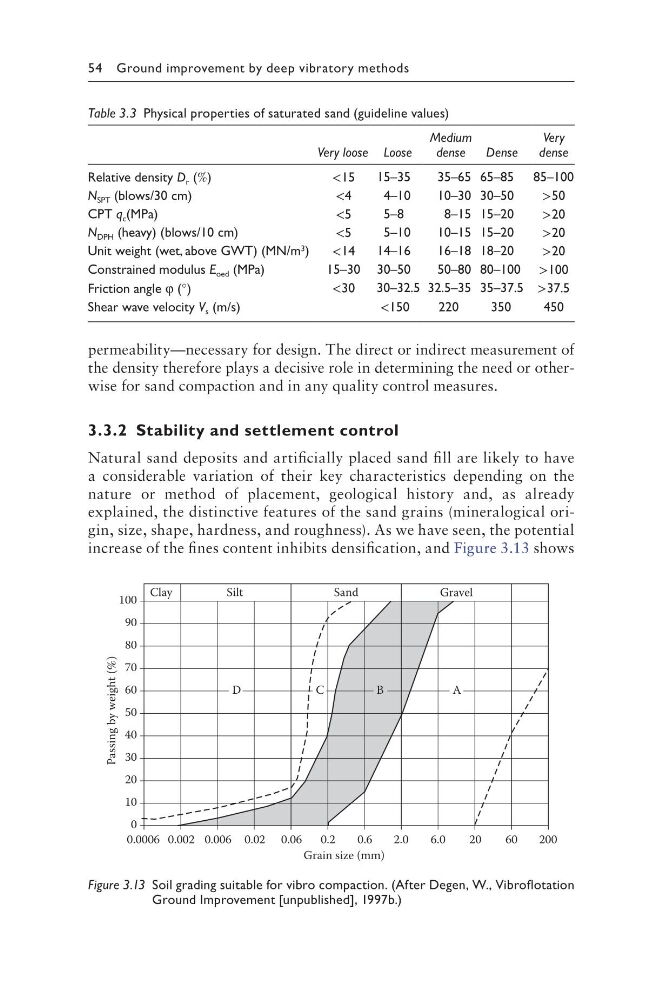
explained, the distinctive features of the sand grains (mineralogical origin, size, shape, hardness, and roughness). As we have seen, the potential
increase of the fines content inhibits densification, and Figure 3.13 shows
Table 3.3 Physical properties of saturated sand (guideline values)
Very loose Loose
Medium
dense
Dense
Very
dense
Relative density D r (%)
<15
15–35
35–65 65–85 85–100
N SPT (blows/30 cm)
<4
4–10
10–30 30–50
>50
CPT q c (MPa)
<5
5–8
8–15 15–20
>20
N DPH (heavy) (blows/10 cm)
<5
5–10
10–15 15–20
>20
Unit weight (wet, above GWT) (MN/m 3 )
<14
14–16
16–18 18–20
>20
Constrained modulus E oed (MPa)
15–30 30–50
50–80 80–100 >100
Friction angle φ (°)
<30
30–32.5 32.5–35 35–37.5 >37.5
Shear wave velocity V s (m/s)
<150
220
350
450
100
80
60
40
20
0
90
70
50
30
10
Clay
S ilt
Sand
D
C
B
A
Grain size (mm)
Passing by weight (%)
Gravel
0.6
0.002
200
60
20
6.0
0.06
0.02
0.006
0.0006
0.2
2.0
Figure 3.13 Soil grading suitable for vibro compaction. (After Degen, W., Vibroflotation
Ground Improvement [unpublished], 1997b.)
permeability—necessary for design. The direct or indirect measurement of
the density therefore plays a decisive role in determining the need or otherwise for sand compaction and in any quality control measures.
3.3.2 Stability and settlement control
Natural sand deposits and artificially placed sand fill are likely to have
a considerable variation of their key characteristics depending on the
nature or method of placement, geological history and, as already
explained, the distinctive features of the sand grains (mineralogical origin, size, shape, hardness, and roughness). As we have seen, the potential
increase of the fines content inhibits densification, and Figure 3.13 shows
Table 3.3 Physical properties of saturated sand (guideline values)
Very loose Loose
Medium
dense
Dense
Very
dense
Relative density D r (%)
<15
15–35
35–65 65–85 85–100
N SPT (blows/30 cm)
<4
4–10
10–30 30–50
>50
CPT q c (MPa)
<5
5–8
8–15 15–20
>20
N DPH (heavy) (blows/10 cm)
<5
5–10
10–15 15–20
>20
Unit weight (wet, above GWT) (MN/m 3 )
<14
14–16
16–18 18–20
>20
Constrained modulus E oed (MPa)
15–30 30–50
50–80 80–100 >100
Friction angle φ (°)
<30
30–32.5 32.5–35 35–37.5 >37.5
Shear wave velocity V s (m/s)
<150
220
350
450
100
80
60
40
20
0
90
70
50
30
10
Clay
S ilt
Sand
D
C
B
A
Grain size (mm)
Passing by weight (%)
Gravel
0.6
0.002
200
60
20
6.0
0.06
0.02
0.006
0.0006
0.2
2.0
Figure 3.13 Soil grading suitable for vibro compaction. (After Degen, W., Vibroflotation
Ground Improvement [unpublished], 1997b.)