

Vibro compaction of granular soils 53
occurs without rearrangement of the grains and with considerably reduced
reversed (elastic) deformations. Since this grain rearrangement requires the
contact forces between the grains to be overcome, this process can be supported by the lubrication effect of water and by vibrations.
Whenever granular soils are subjected to shear stresses—and practically
all loading contains a certain amount of shearing—the grains are forced to
rearrange and to find a new stage of equilibrium that is best characterized
by their relative density. Depending on the initial density, the applied shear
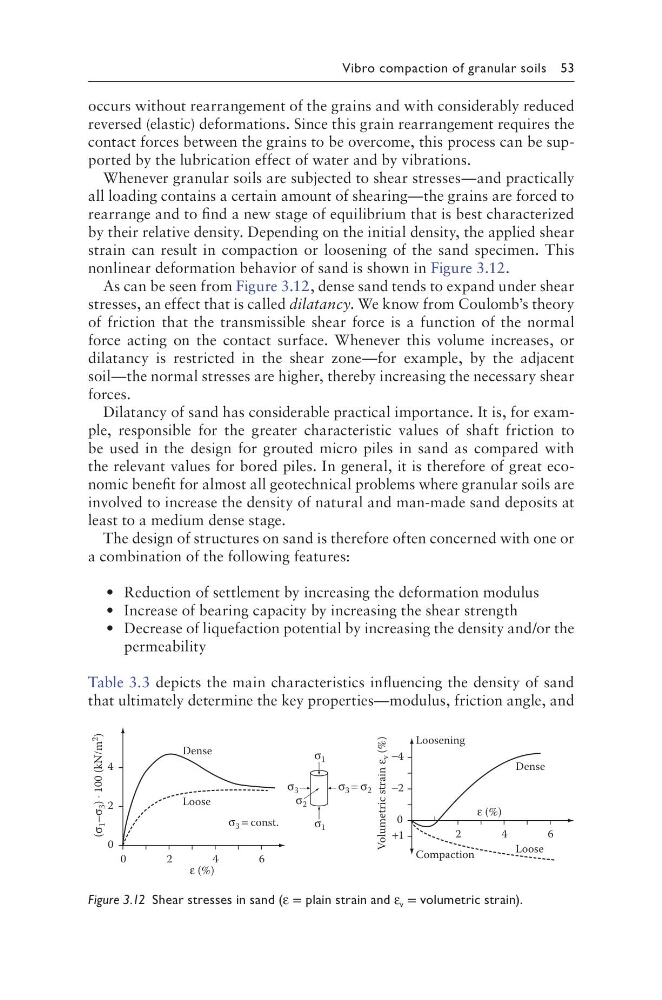
strain can result in compaction or loosening of the sand specimen. This
nonlinear deformation behavior of sand is shown in Figure 3.12.
As can be seen from Figure 3.12, dense sand tends to expand under shear
stresses, an effect that is called dilatancy. We know from Coulomb’s theory
of friction that the transmissible shear force is a function of the normal
force acting on the contact surface. Whenever this volume increases, or
dilatancy is restricted in the shear zone—for example, by the adjacent
soil—the normal stresses are higher, thereby increasing the necessary shear
forces.
Dilatancy of sand has considerable practical importance. It is, for example, responsible for the greater characteristic values of shaft friction to
be used in the design for grouted micro piles in sand as compared with
the relevant values for bored piles. In general, it is therefore of great economic benefit for almost all geotechnical problems where granular soils are
involved to increase the density of natural and man-made sand deposits at
least to a medium dense stage.
The design of structures on sand is therefore often concerned with one or
a combination of the following features:
• Reduction of settlement by increasing the deformation modulus
• Increase of bearing capacity by increasing the shear strength
• Decrease of liquefaction potential by increasing the density and/or the
permeability
Table 3.3 depicts the main characteristics influencing the density of sand
that ultimately determine the key properties—modulus, friction angle, and
σ 3
σ 3 = σ 2
σ 2
σ 1
σ 1
2
2
4
4
6
0
0
ε (%)
ε (%)
(σ
1 –σ
3 ) ⋅
100 (kN/m
2
)
σ 3 = const.
Dense
Loose
2
−2
+1
4
−4
6
0
Volumetric strain ε
v (%)
Dense
Loosening
Loose
Compaction
Figure 3.12 Shear stresses in sand (ε = plain strain and ε v = volumetric strain).
occurs without rearrangement of the grains and with considerably reduced
reversed (elastic) deformations. Since this grain rearrangement requires the
contact forces between the grains to be overcome, this process can be supported by the lubrication effect of water and by vibrations.
Whenever granular soils are subjected to shear stresses—and practically
all loading contains a certain amount of shearing—the grains are forced to
rearrange and to find a new stage of equilibrium that is best characterized
by their relative density. Depending on the initial density, the applied shear
strain can result in compaction or loosening of the sand specimen. This
nonlinear deformation behavior of sand is shown in Figure 3.12.
As can be seen from Figure 3.12, dense sand tends to expand under shear
stresses, an effect that is called dilatancy. We know from Coulomb’s theory
of friction that the transmissible shear force is a function of the normal
force acting on the contact surface. Whenever this volume increases, or
dilatancy is restricted in the shear zone—for example, by the adjacent
soil—the normal stresses are higher, thereby increasing the necessary shear
forces.
Dilatancy of sand has considerable practical importance. It is, for example, responsible for the greater characteristic values of shaft friction to
be used in the design for grouted micro piles in sand as compared with
the relevant values for bored piles. In general, it is therefore of great economic benefit for almost all geotechnical problems where granular soils are
involved to increase the density of natural and man-made sand deposits at
least to a medium dense stage.
The design of structures on sand is therefore often concerned with one or
a combination of the following features:
• Reduction of settlement by increasing the deformation modulus
• Increase of bearing capacity by increasing the shear strength
• Decrease of liquefaction potential by increasing the density and/or the
permeability
Table 3.3 depicts the main characteristics influencing the density of sand
that ultimately determine the key properties—modulus, friction angle, and
σ 3
σ 3 = σ 2
σ 2
σ 1
σ 1
2
2
4
4
6
0
0
ε (%)
ε (%)
(σ
1 –σ
3 ) ⋅
100 (kN/m
2
)
σ 3 = const.
Dense
Loose
2
−2
+1
4
−4
6
0
Volumetric strain ε
v (%)
Dense
Loosening
Loose
Compaction
Figure 3.12 Shear stresses in sand (ε = plain strain and ε v = volumetric strain).