

50 Ground improvement by deep vibratory methods
with the improvement of the mechanical characteristics of sand. According
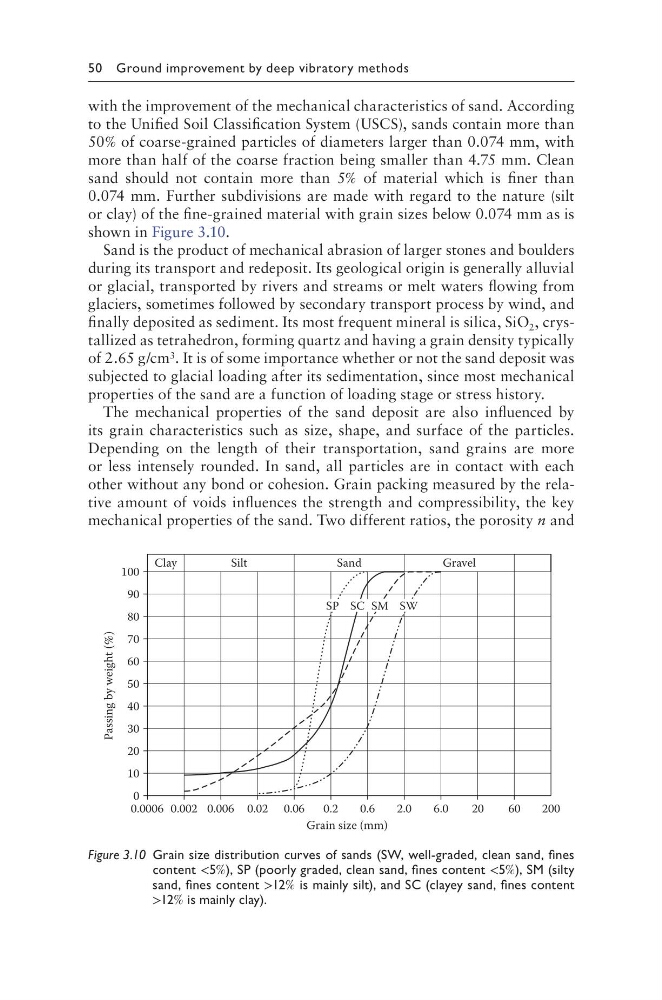
to the Unified Soil Classification System (USCS), sands contain more than
50% of coarse-grained particles of diameters larger than 0.074 mm, with
more than half of the coarse fraction being smaller than 4.75 mm. Clean
sand should not contain more than 5% of material which is finer than
0.074 mm. Further subdivisions are made with regard to the nature (silt
or clay) of the fine-grained material with grain sizes below 0.074 mm as is
shown in Figure 3.10.
Sand is the product of mechanical abrasion of larger stones and boulders
during its transport and redeposit. Its geological origin is generally alluvial
or glacial, transported by rivers and streams or melt waters flowing from
glaciers, sometimes followed by secondary transport process by wind, and
finally deposited as sediment. Its most frequent mineral is silica, SiO 2 , crystallized as tetrahedron, forming quartz and having a grain density typically
of 2.65 g/cm 3 . It is of some importance whether or not the sand deposit was
subjected to glacial loading after its sedimentation, since most mechanical
properties of the sand are a function of loading stage or stress history.
The mechanical properties of the sand deposit are also influenced by
its grain characteristics such as size, shape, and surface of the particles.
Depending on the length of their transportation, sand grains are more
or less intensely rounded. In sand, all particles are in contact with each
other without any bond or cohesion. Grain packing measured by the relative amount of voids influences the strength and compressibility, the key
mechanical properties of the sand. Two different ratios, the porosity n and
100
80
60
40
20
0
90
70
50
30
10
Clay
Silt
Sand
SP SC SM SW
Grain size (mm)
Passing by weight (%)
Gravel
0.6
0.002
200
60
20
6.0
0.06
0.02
0.006
0.0006
0.2
2.0
Figure 3.10 Grain size distribution curves of sands (SW, well-graded, clean sand, fines
content <5%), SP (poorly graded, clean sand, fines content <5%), SM (silty
sand, fines content >12% is mainly silt), and SC (clayey sand, fines content
>12% is mainly clay).
with the improvement of the mechanical characteristics of sand. According
to the Unified Soil Classification System (USCS), sands contain more than
50% of coarse-grained particles of diameters larger than 0.074 mm, with
more than half of the coarse fraction being smaller than 4.75 mm. Clean
sand should not contain more than 5% of material which is finer than
0.074 mm. Further subdivisions are made with regard to the nature (silt
or clay) of the fine-grained material with grain sizes below 0.074 mm as is
shown in Figure 3.10.
Sand is the product of mechanical abrasion of larger stones and boulders
during its transport and redeposit. Its geological origin is generally alluvial
or glacial, transported by rivers and streams or melt waters flowing from
glaciers, sometimes followed by secondary transport process by wind, and
finally deposited as sediment. Its most frequent mineral is silica, SiO 2 , crystallized as tetrahedron, forming quartz and having a grain density typically
of 2.65 g/cm 3 . It is of some importance whether or not the sand deposit was
subjected to glacial loading after its sedimentation, since most mechanical
properties of the sand are a function of loading stage or stress history.
The mechanical properties of the sand deposit are also influenced by
its grain characteristics such as size, shape, and surface of the particles.
Depending on the length of their transportation, sand grains are more
or less intensely rounded. In sand, all particles are in contact with each
other without any bond or cohesion. Grain packing measured by the relative amount of voids influences the strength and compressibility, the key
mechanical properties of the sand. Two different ratios, the porosity n and
100
80
60
40
20
0
90
70
50
30
10
Clay
Silt
Sand
SP SC SM SW
Grain size (mm)
Passing by weight (%)
Gravel
0.6
0.002
200
60
20
6.0
0.06
0.02
0.006
0.0006
0.2
2.0
Figure 3.10 Grain size distribution curves of sands (SW, well-graded, clean sand, fines
content <5%), SP (poorly graded, clean sand, fines content <5%), SM (silty
sand, fines content >12% is mainly silt), and SC (clayey sand, fines content
>12% is mainly clay).