

Vibro compaction of granular soils 51
the void ratio e, describe the volume of voids, (V − V s ), in relation to the
total volume, V, and to the volume of solids, V s , respectively. Equation 3.2
describes this relationship.
n
V V
V
e
V V
V
n
e
e
e
n
n
=
−
=
−
= +
= −
s
s
s
(
)
(
)
(
)
(
)
1
1
(3.2)
An idealized sand material consisting of spherical grains of equal diameter can be deposited in two extreme arrangements having a porosity of
between n min = 0.259 and n max = 0.476 or void ratios of e min = 0.352 and
e max = 0.924. These boundaries mark what is called the densest and the
loosest packing stage of the deposit. All intermediate stages with porosities
n or void ratios e are characterized by their density D or relative density D r :
D
n
n
n
n
D
e
e
e
e
=
−
−
=
−
−
max
max
m in
r
max
max
m in
(3.3)
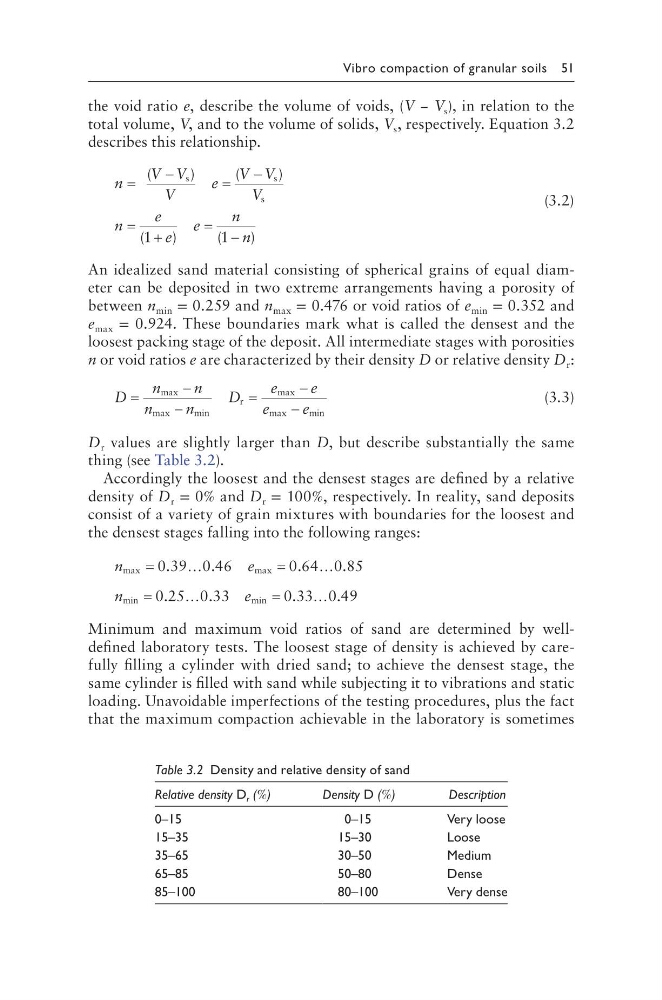
D r values are slightly larger than D, but describe substantially the same
thing (see Table 3.2).
Accordingly the loosest and the densest stages are defined by a relative
density of D r = 0% and D r = 100%, respectively. In reality, sand deposits
consist of a variety of grain mixtures with boundaries for the loosest and
the densest stages falling into the following ranges:
n
e
n
e
max
m ax
min
m in
.
.
.
.
.
.
.
.
= =
= =
0 39 0 46
0 64 0 85
0 25 0 33
0 33 0 49
Minimum and maximum void ratios of sand are determined by welldefined laboratory tests. The loosest stage of density is achieved by carefully filling a cylinder with dried sand; to achieve the densest stage, the
same cylinder is filled with sand while subjecting it to vibrations and static
loading. Unavoidable imperfections of the testing procedures, plus the fact
that the maximum compaction achievable in the laboratory is sometimes
Table 3.2 Density and relative density of sand
Relative density D r (%)
Density D (%)
Description
0–15
0–15
Very loose
15–35
15–30
Loose
35–65
30–50
Medium
65–85
50–80
Dense
85–100
80–100
Very dense
the void ratio e, describe the volume of voids, (V − V s ), in relation to the
total volume, V, and to the volume of solids, V s , respectively. Equation 3.2
describes this relationship.
n
V V
V
e
V V
V
n
e
e
e
n
n
=
−
=
−
= +
= −
s
s
s
(
)
(
)
(
)
(
)
1
1
(3.2)
An idealized sand material consisting of spherical grains of equal diameter can be deposited in two extreme arrangements having a porosity of
between n min = 0.259 and n max = 0.476 or void ratios of e min = 0.352 and
e max = 0.924. These boundaries mark what is called the densest and the
loosest packing stage of the deposit. All intermediate stages with porosities
n or void ratios e are characterized by their density D or relative density D r :
D
n
n
n
n
D
e
e
e
e
=
−
−
=
−
−
max
max
m in
r
max
max
m in
(3.3)
D r values are slightly larger than D, but describe substantially the same
thing (see Table 3.2).
Accordingly the loosest and the densest stages are defined by a relative
density of D r = 0% and D r = 100%, respectively. In reality, sand deposits
consist of a variety of grain mixtures with boundaries for the loosest and
the densest stages falling into the following ranges:
n
e
n
e
max
m ax
min
m in
.
.
.
.
.
.
.
.
= =
= =
0 39 0 46
0 64 0 85
0 25 0 33
0 33 0 49
Minimum and maximum void ratios of sand are determined by welldefined laboratory tests. The loosest stage of density is achieved by carefully filling a cylinder with dried sand; to achieve the densest stage, the
same cylinder is filled with sand while subjecting it to vibrations and static
loading. Unavoidable imperfections of the testing procedures, plus the fact
that the maximum compaction achievable in the laboratory is sometimes
Table 3.2 Density and relative density of sand
Relative density D r (%)
Density D (%)
Description
0–15
0–15
Very loose
15–35
15–30
Loose
35–65
30–50
Medium
65–85
50–80
Dense
85–100
80–100
Very dense