

Vibro compaction of granular soils 49
for vibrators, extension tubes, and attachments is therefore very important.
When restrictive working conditions on-site require special solutions, the
vibro compaction method often proves its flexibility: in a recent case, the
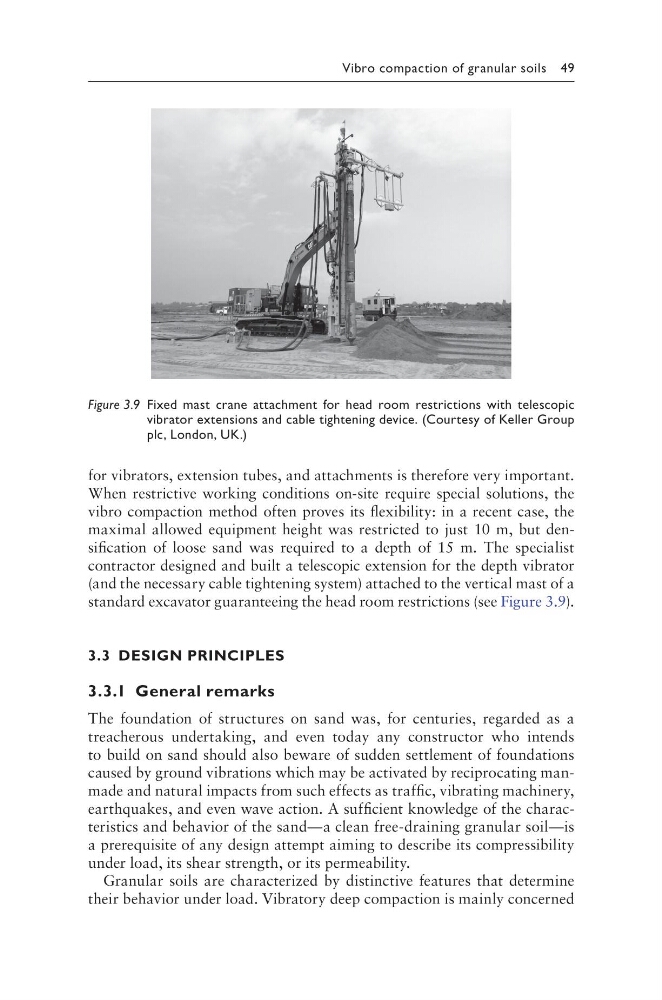
maximal allowed equipment height was restricted to just 10 m, but densification of loose sand was required to a depth of 15 m. The specialist
contractor designed and built a telescopic extension for the depth vibrator
(and the necessary cable tightening system) attached to the vertical mast of a
standard excavator guaranteeing the head room restrictions (see Figure 3.9).
3.3 DESIGN PRINCIPLES
3.3.1 General remarks
The foundation of structures on sand was, for centuries, regarded as a
treacherous undertaking, and even today any constructor who intends
to build on sand should also beware of sudden settlement of foundations
caused by ground vibrations which may be activated by reciprocating manmade and natural impacts from such effects as traffic, vibrating machinery,
earthquakes, and even wave action. A sufficient knowledge of the characteristics and behavior of the sand—a clean free-draining granular soil—is
a prerequisite of any design attempt aiming to describe its compressibility
under load, its shear strength, or its permeability.
Granular soils are characterized by distinctive features that determine
their behavior under load. Vibratory deep compaction is mainly concerned
Figure 3.9 Fixed mast crane attachment for head room restrictions with telescopic
vibrator extensions and cable tightening device. (Courtesy of Keller Group
plc, London, UK.)
for vibrators, extension tubes, and attachments is therefore very important.
When restrictive working conditions on-site require special solutions, the
vibro compaction method often proves its flexibility: in a recent case, the
maximal allowed equipment height was restricted to just 10 m, but densification of loose sand was required to a depth of 15 m. The specialist
contractor designed and built a telescopic extension for the depth vibrator
(and the necessary cable tightening system) attached to the vertical mast of a
standard excavator guaranteeing the head room restrictions (see Figure 3.9).
3.3 DESIGN PRINCIPLES
3.3.1 General remarks
The foundation of structures on sand was, for centuries, regarded as a
treacherous undertaking, and even today any constructor who intends
to build on sand should also beware of sudden settlement of foundations
caused by ground vibrations which may be activated by reciprocating manmade and natural impacts from such effects as traffic, vibrating machinery,
earthquakes, and even wave action. A sufficient knowledge of the characteristics and behavior of the sand—a clean free-draining granular soil—is
a prerequisite of any design attempt aiming to describe its compressibility
under load, its shear strength, or its permeability.
Granular soils are characterized by distinctive features that determine
their behavior under load. Vibratory deep compaction is mainly concerned
Figure 3.9 Fixed mast crane attachment for head room restrictions with telescopic
vibrator extensions and cable tightening device. (Courtesy of Keller Group
plc, London, UK.)