

186 Ground improvement by deep vibratory methods
under the shells of the dam would liquefy and loose strength when subjected to shaking from the maximum credible earthquake (MCE).” The
MCE had to be increased to a magnitude 7 and represented a significantly
higher ground motion than used for the original design. Since an MCE
event could lead to damage of the dam, accompanied by uncontrolled water
releases and downstream flooding, the authorities responsible for the safety
of the dam decided to upgrade the dam’s safety to current standards.
To better understand the alternatives which were evaluated, the principal soil characteristics of the alluvial river deposits are given in Table 4.15.
The above publications give details of the design, safety, and operational
criteria forming the basis of the remedial design studies. Most important
was that the reservoir had to remain in service during construction with
a lowered pool elevation from 158.5 to 155.6 m. The following alternate
approaches were actually investigated and considered:
• Construction of buttresses on one or both sides of the dam founded
on the river alluvium
• Foundation improvement of the downstream buttress
• Remediation of the upstream shell of the dam
• Construction of a new dam downstream of the existing dam
• Minimum necessary construction and measures to obtain regulatory
acceptance (permanent reservoir lowering)
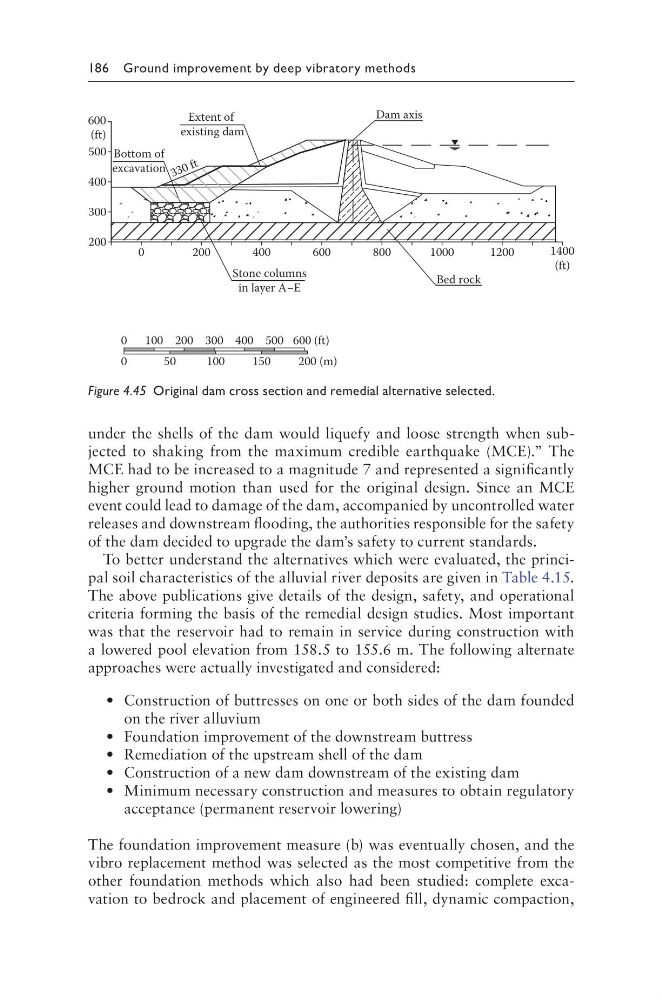
The foundation improvement measure (b) was eventually chosen, and the
vibro replacement method was selected as the most competitive from the
other foundation methods which also had been studied: complete excavation to bedrock and placement of engineered fill, dynamic compaction,
0
200
400
600
8 00
1000
1200
1400
(ft)
200
300
400
500
600
(ft)
Extent of
existing dam
Dam axis
Bottom of
excavation 3 3 0 ft
Stone columns
in layer A−E
Bed rock
0 100 200 300 400 500 600 (ft)
0
5 0
100
150
200 (m)
Figure 4.45 Original dam cross section and remedial alternative selected.
under the shells of the dam would liquefy and loose strength when subjected to shaking from the maximum credible earthquake (MCE).” The
MCE had to be increased to a magnitude 7 and represented a significantly
higher ground motion than used for the original design. Since an MCE
event could lead to damage of the dam, accompanied by uncontrolled water
releases and downstream flooding, the authorities responsible for the safety
of the dam decided to upgrade the dam’s safety to current standards.
To better understand the alternatives which were evaluated, the principal soil characteristics of the alluvial river deposits are given in Table 4.15.
The above publications give details of the design, safety, and operational
criteria forming the basis of the remedial design studies. Most important
was that the reservoir had to remain in service during construction with
a lowered pool elevation from 158.5 to 155.6 m. The following alternate
approaches were actually investigated and considered:
• Construction of buttresses on one or both sides of the dam founded
on the river alluvium
• Foundation improvement of the downstream buttress
• Remediation of the upstream shell of the dam
• Construction of a new dam downstream of the existing dam
• Minimum necessary construction and measures to obtain regulatory
acceptance (permanent reservoir lowering)
The foundation improvement measure (b) was eventually chosen, and the
vibro replacement method was selected as the most competitive from the
other foundation methods which also had been studied: complete excavation to bedrock and placement of engineered fill, dynamic compaction,
0
200
400
600
8 00
1000
1200
1400
(ft)
200
300
400
500
600
(ft)
Extent of
existing dam
Dam axis
Bottom of
excavation 3 3 0 ft
Stone columns
in layer A−E
Bed rock
0 100 200 300 400 500 600 (ft)
0
5 0
100
150
200 (m)
Figure 4.45 Original dam cross section and remedial alternative selected.