

Improvement of fine-grained and cohesive soils 187
vibro compaction, and deep soil mixing. Figure 4.45 shows the ground
improvement solution with stone columns representing the most economical and environmentally friendly foundation alternative providing the
required protection against liquefaction.
Prior to construction and to better understand and evaluate the effectiveness of the vibro replacement stone columns in the existing alluvial soils, a
full-scale field test was carried out. Three different triangular patterns with
2.60, 2.90, and 3.20 m probe distances were installed and tested using the
SPT and Becker Penetration Test methods. As was expected the relatively
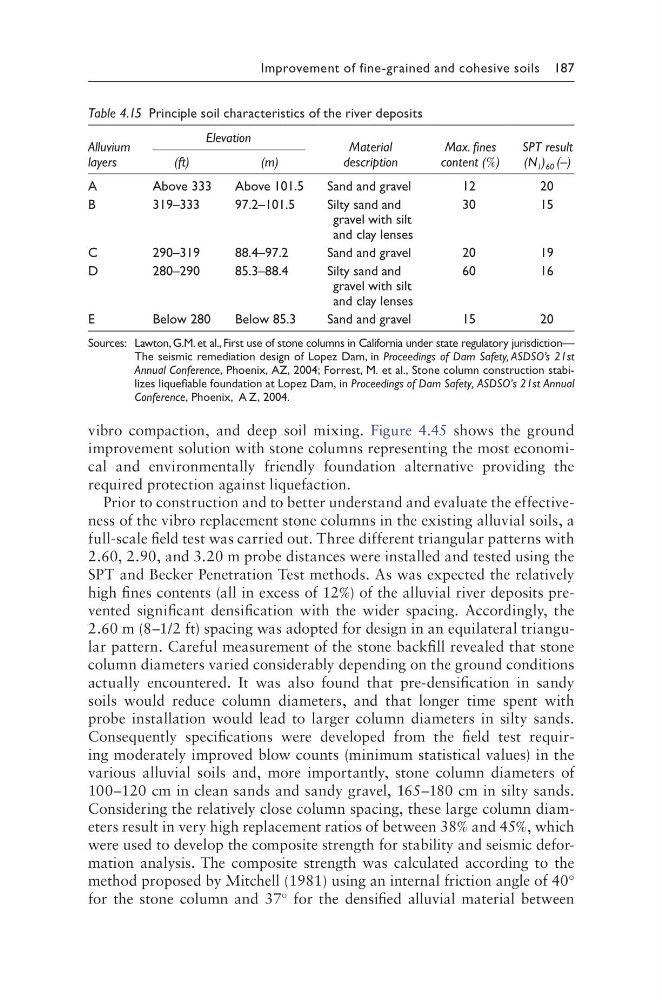
high fines contents (all in excess of 12%) of the alluvial river deposits prevented significant densification with the wider spacing. Accordingly, the
2.60 m (8–1/2 ft) spacing was adopted for design in an equilateral triangular pattern. Careful measurement of the stone backfill revealed that stone
column diameters varied considerably depending on the ground conditions
actually encountered. It was also found that pre-densification in sandy
soils would reduce column diameters, and that longer time spent with
probe installation would lead to larger column diameters in silty sands.
Consequently specifications were developed from the field test requiring moderately improved blow counts (minimum statistical values) in the
various alluvial soils and, more importantly, stone column diameters of
100–120 cm in clean sands and sandy gravel, 165–180 cm in silty sands.
Considering the relatively close column spacing, these large column diameters result in very high replacement ratios of between 38% and 45%, which
were used to develop the composite strength for stability and seismic deformation analysis. The composite strength was calculated according to the
method proposed by Mitchell (1981) using an internal friction angle of 40°
for the stone column and 37° for the densified alluvial material between
Table 4.15 Principle soil characteristics of the river deposits
Alluvium
layers
Elevation
Material
description
Max. fines
content (%)
SPT result
(N 1 ) 60 (–)
(ft)
(m)
A
Above 333
Above 101.5
Sand and gravel
12
20
B
319–333
97.2–101.5
Silty sand and
gravel with silt
and clay lenses
30
15
C
290–319
88.4–97.2
Sand and gravel
20
19
D
280–290
85.3–88.4
Silty sand and
gravel with silt
and clay lenses
60
16
E
Below 280
Below 85.3
Sand and gravel
15
20
Sources: Lawton, G.M. et al., First use of stone columns in California under state regulatory jurisdiction—
The seismic remediation design of Lopez Dam, in Proceedings of Dam Safety, ASDSO’s 21st
Annual Conference, Phoenix, AZ, 2004; Forrest, M. et al., Stone column construction stabilizes liquefiable foundation at Lopez Dam, in Proceedings of Dam Safety, ASDSO’s 21st Annual
Conference, Phoenix, A Z, 2004.
vibro compaction, and deep soil mixing. Figure 4.45 shows the ground
improvement solution with stone columns representing the most economical and environmentally friendly foundation alternative providing the
required protection against liquefaction.
Prior to construction and to better understand and evaluate the effectiveness of the vibro replacement stone columns in the existing alluvial soils, a
full-scale field test was carried out. Three different triangular patterns with
2.60, 2.90, and 3.20 m probe distances were installed and tested using the
SPT and Becker Penetration Test methods. As was expected the relatively
high fines contents (all in excess of 12%) of the alluvial river deposits prevented significant densification with the wider spacing. Accordingly, the
2.60 m (8–1/2 ft) spacing was adopted for design in an equilateral triangular pattern. Careful measurement of the stone backfill revealed that stone
column diameters varied considerably depending on the ground conditions
actually encountered. It was also found that pre-densification in sandy
soils would reduce column diameters, and that longer time spent with
probe installation would lead to larger column diameters in silty sands.
Consequently specifications were developed from the field test requiring moderately improved blow counts (minimum statistical values) in the
various alluvial soils and, more importantly, stone column diameters of
100–120 cm in clean sands and sandy gravel, 165–180 cm in silty sands.
Considering the relatively close column spacing, these large column diameters result in very high replacement ratios of between 38% and 45%, which
were used to develop the composite strength for stability and seismic deformation analysis. The composite strength was calculated according to the
method proposed by Mitchell (1981) using an internal friction angle of 40°
for the stone column and 37° for the densified alluvial material between
Table 4.15 Principle soil characteristics of the river deposits
Alluvium
layers
Elevation
Material
description
Max. fines
content (%)
SPT result
(N 1 ) 60 (–)
(ft)
(m)
A
Above 333
Above 101.5
Sand and gravel
12
20
B
319–333
97.2–101.5
Silty sand and
gravel with silt
and clay lenses
30
15
C
290–319
88.4–97.2
Sand and gravel
20
19
D
280–290
85.3–88.4
Silty sand and
gravel with silt
and clay lenses
60
16
E
Below 280
Below 85.3
Sand and gravel
15
20
Sources: Lawton, G.M. et al., First use of stone columns in California under state regulatory jurisdiction—
The seismic remediation design of Lopez Dam, in Proceedings of Dam Safety, ASDSO’s 21st
Annual Conference, Phoenix, AZ, 2004; Forrest, M. et al., Stone column construction stabilizes liquefiable foundation at Lopez Dam, in Proceedings of Dam Safety, ASDSO’s 21st Annual
Conference, Phoenix, A Z, 2004.