

Improvement of fine-grained and cohesive soils 185
Should the safety factor η fall below the specified value drain spacing or
drain diameter have to be altered until the specified η is met. A specially
composed gravel backfill with a maximal grain diameter of 25 mm was
chosen for the stone column construction with its D 15 grain diameter being
established with the Saito criterion according to Equation 4.46 in order to
safeguard its filter stability over time (see Figure 4.44).
The foundations for the project were completed in 2013. In addition to
the 80 and 100 cm diameter bored piles, approximately 9000 nos., 20 m
deep vibro stone columns with a diameter of 80 cm were carried out.
4.7.8 Seismic remediation of an earthfill
dam by vibro stone columns
An instructive example of the use of stone columns to improve the safety
of an earth embankment dam sealing a reservoir with a hydraulic height
of 50 m and founded on alluvial deposits was published by Lawton et al.
(2004) together with a companion paper by Forrest et al. (2004). The dam
is situated in California and was completed in 1968. The dam as shown
in Figure 4.45 was built as a zoned earthfill dam with a central clay core
founded through 36.6 m of alluvial material on bedrock. Both the upstream
and downstream shells with slopes of 3:1 rest on the river alluvium.
A re-evaluation of the dam’s stability carried out with updated seismic
hazard studies in the early 1990s revealed that the “foundation alluvium
0%
20%
40%
60%
80%
100%
0.001
0.010
0.100
1.000
10.000
100.000
%
Finer by weight
Grain diameter (mm)
Clay
Silty sand
Sand
Stone column material
Gravel
Sand
Fines
Coarse
Coarse
Fine
Medium
Fine
d 85 = 0.035 mm
d 15 = 0.095 mm
D 15 = 3 mm
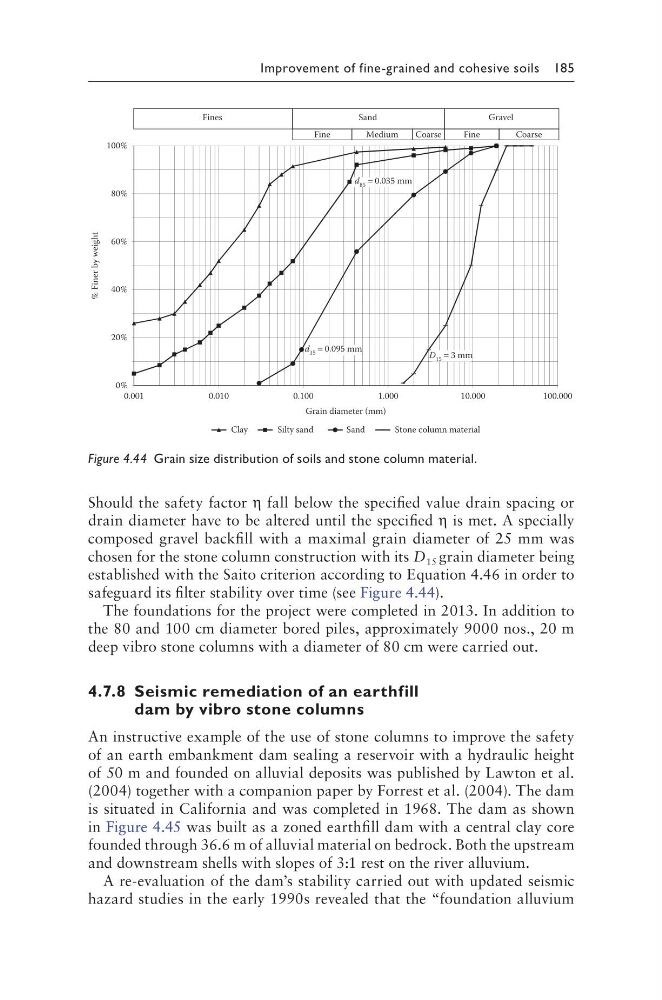
Figure 4.44 Grain size distribution of soils and stone column material.
Should the safety factor η fall below the specified value drain spacing or
drain diameter have to be altered until the specified η is met. A specially
composed gravel backfill with a maximal grain diameter of 25 mm was
chosen for the stone column construction with its D 15 grain diameter being
established with the Saito criterion according to Equation 4.46 in order to
safeguard its filter stability over time (see Figure 4.44).
The foundations for the project were completed in 2013. In addition to
the 80 and 100 cm diameter bored piles, approximately 9000 nos., 20 m
deep vibro stone columns with a diameter of 80 cm were carried out.
4.7.8 Seismic remediation of an earthfill
dam by vibro stone columns
An instructive example of the use of stone columns to improve the safety
of an earth embankment dam sealing a reservoir with a hydraulic height
of 50 m and founded on alluvial deposits was published by Lawton et al.
(2004) together with a companion paper by Forrest et al. (2004). The dam
is situated in California and was completed in 1968. The dam as shown
in Figure 4.45 was built as a zoned earthfill dam with a central clay core
founded through 36.6 m of alluvial material on bedrock. Both the upstream
and downstream shells with slopes of 3:1 rest on the river alluvium.
A re-evaluation of the dam’s stability carried out with updated seismic
hazard studies in the early 1990s revealed that the “foundation alluvium
0%
20%
40%
60%
80%
100%
0.001
0.010
0.100
1.000
10.000
100.000
%
Finer by weight
Grain diameter (mm)
Clay
Silty sand
Sand
Stone column material
Gravel
Sand
Fines
Coarse
Coarse
Fine
Medium
Fine
d 85 = 0.035 mm
d 15 = 0.095 mm
D 15 = 3 mm
Figure 4.44 Grain size distribution of soils and stone column material.