

168 Ground improvement by deep vibratory methods
and β = 1.9 for φ c = 50° when the column is floating. For the same a c value,
the improvement factor drops further with λ = 0.5 to β = 1.3 for φ c = 35°
and β = 1.7 for φ c = 50°.
The study also revealed that the improvement factor β is—within the
limits—invariable for different foundation dimensions but equal foundation stiffness K S .
K
E
E
H
B
T
B
s
S
F
=
⋅
12
3
(4.99)
where:
E F is the modulus of elasticity of footing in kPa
E s is the modulus of soil to be improved in kPa
H is the thickness of footing in m
B is the width of footing in m
T is the thickness of soil layer to be improved in m
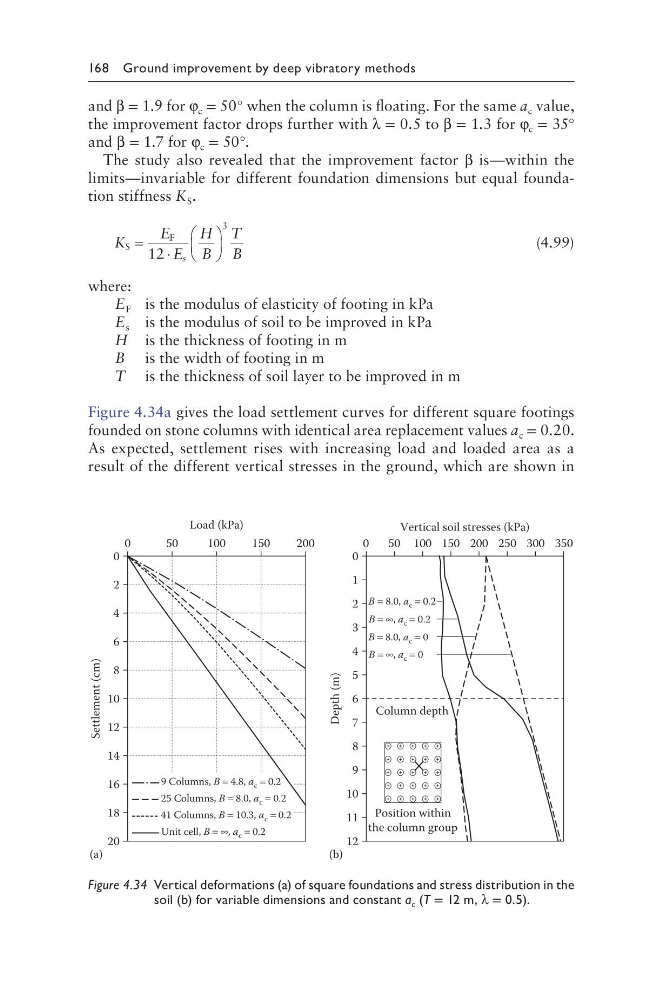
Figure 4.34a gives the load settlement curves for different square footings
founded on stone columns with identical area replacement values a c = 0.20.
As expected, settlement rises with increasing load and loaded area as a
result of the different vertical stresses in the ground, which are shown in
6
8
10
14
16
18
20
2
4
12
0
0
5 0
150
200
3
4
5
7
8
9
12
1
2
6
0
0
300 350
250
200
150
100
50
10
11
Load (kPa)
(a)
(b)
Settlement (cm)
9 Columns, B = 4.8, a c = 0.2
25 Columns, B = 8.0, a c = 0.2
41 Columns, B = 10.3, a c = 0.2
Unit cell, B = ∞, a c = 0.2
Vertical soil stresses (kPa)
Depth (m)
Column depth
Position within
the column group
B = 8.0, a c = 0.2
B = ∞, a c = 0.2
B = 8.0, a c = 0
B = ∞, a c = 0
100
Figure 4.34 Vertical deformations (a) of square foundations and stress distribution in the
soil (b) for variable dimensions and constant a c (T = 12 m, λ = 0.5).
and β = 1.9 for φ c = 50° when the column is floating. For the same a c value,
the improvement factor drops further with λ = 0.5 to β = 1.3 for φ c = 35°
and β = 1.7 for φ c = 50°.
The study also revealed that the improvement factor β is—within the
limits—invariable for different foundation dimensions but equal foundation stiffness K S .
K
E
E
H
B
T
B
s
S
F
=
⋅
12
3
(4.99)
where:
E F is the modulus of elasticity of footing in kPa
E s is the modulus of soil to be improved in kPa
H is the thickness of footing in m
B is the width of footing in m
T is the thickness of soil layer to be improved in m
Figure 4.34a gives the load settlement curves for different square footings
founded on stone columns with identical area replacement values a c = 0.20.
As expected, settlement rises with increasing load and loaded area as a
result of the different vertical stresses in the ground, which are shown in
6
8
10
14
16
18
20
2
4
12
0
0
5 0
150
200
3
4
5
7
8
9
12
1
2
6
0
0
300 350
250
200
150
100
50
10
11
Load (kPa)
(a)
(b)
Settlement (cm)
9 Columns, B = 4.8, a c = 0.2
25 Columns, B = 8.0, a c = 0.2
41 Columns, B = 10.3, a c = 0.2
Unit cell, B = ∞, a c = 0.2
Vertical soil stresses (kPa)
Depth (m)
Column depth
Position within
the column group
B = 8.0, a c = 0.2
B = ∞, a c = 0.2
B = 8.0, a c = 0
B = ∞, a c = 0
100
Figure 4.34 Vertical deformations (a) of square foundations and stress distribution in the
soil (b) for variable dimensions and constant a c (T = 12 m, λ = 0.5).