

Improvement of fine-grained and cohesive soils 167
area replacement ratio a c (for column groups defined as the ratio between the
total area of stone columns ΣA c to the footing area A F according to Equation
4.90), foundation stiffness, and relative column length λ (ratio of column
length l and depth T of the soft soil layer according to Equation 4.91); on
the improvement factor β; and on the stress concentration factor n. The
study allowed computing groups of between 4 and 81 columns supporting a
square foundation with a maximum width of B = 20 m. The friction angle
φ c of the stone column material varied between 35° and 50°.
a
A
A
c
c
F
=
∑
(4.97)
λ =
l
T
(4.98)
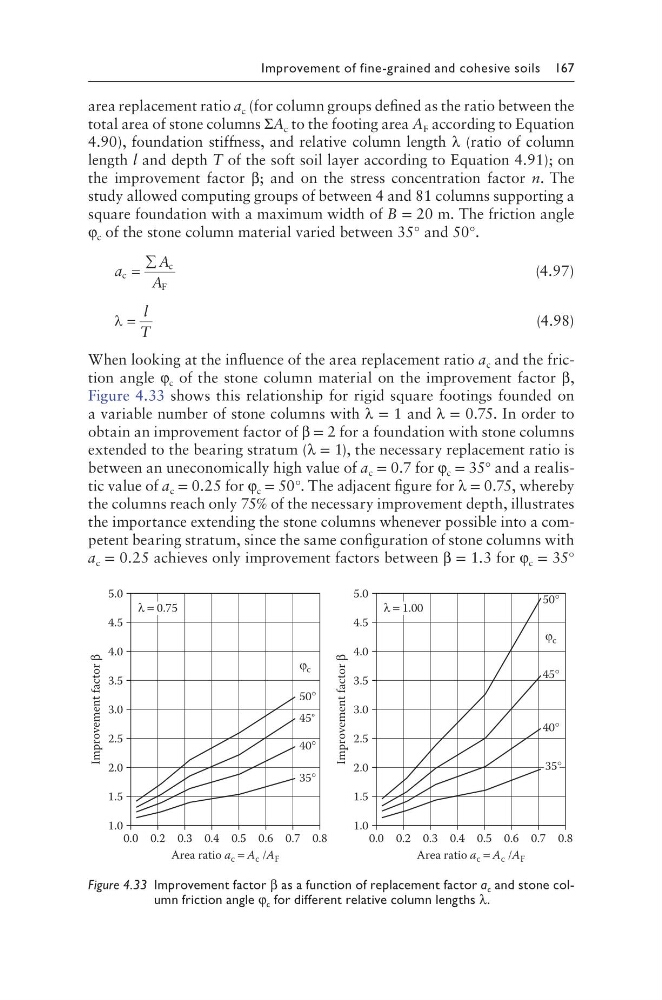
When looking at the influence of the area replacement ratio a c and the friction angle φ c of the stone column material on the improvement factor β,
Figure 4.33 shows this relationship for rigid square footings founded on
a variable number of stone columns with λ = 1 and λ = 0.75. In order to
obtain an improvement factor of β = 2 for a foundation with stone columns
extended to the bearing stratum (λ = 1), the necessary replacement ratio is
between an uneconomically high value of a c = 0.7 for φ c = 35° and a realistic value of a c = 0.25 for φ c = 50°. The adjacent figure for λ = 0.75, whereby
the columns reach only 75% of the necessary improvement depth, illustrates
the importance extending the stone columns whenever possible into a competent bearing stratum, since the same configuration of stone columns with
a c = 0.25 achieves only improvement factors between β = 1.3 for φ c = 35°
3.5
3.0
2.5
1.5
1.0
4.5
4.0
2.0
5.0
0.0 0.2 0.3 0.4 0.5 0.6 0.7 0.8
Area ratio a c = A c /A F
0.0 0.2 0.3 0.4 0.5 0.6 0.7 0.8
Area ratio a c = A c /A F
λ = 0.75
λ = 1.00
Improvement factor β
3.5
3.0
2.5
1.5
1.0
4.5
4.0
2.0
5.0
Improvement factor β
50°
φ c
φ c
45°
40°
35°
35°
50°
45°
40°
Figure 4.33 Improvement factor β as a function of replacement factor a c and stone column friction angle φ c for different relative column lengths λ.
area replacement ratio a c (for column groups defined as the ratio between the
total area of stone columns ΣA c to the footing area A F according to Equation
4.90), foundation stiffness, and relative column length λ (ratio of column
length l and depth T of the soft soil layer according to Equation 4.91); on
the improvement factor β; and on the stress concentration factor n. The
study allowed computing groups of between 4 and 81 columns supporting a
square foundation with a maximum width of B = 20 m. The friction angle
φ c of the stone column material varied between 35° and 50°.
a
A
A
c
c
F
=
∑
(4.97)
λ =
l
T
(4.98)
When looking at the influence of the area replacement ratio a c and the friction angle φ c of the stone column material on the improvement factor β,
Figure 4.33 shows this relationship for rigid square footings founded on
a variable number of stone columns with λ = 1 and λ = 0.75. In order to
obtain an improvement factor of β = 2 for a foundation with stone columns
extended to the bearing stratum (λ = 1), the necessary replacement ratio is
between an uneconomically high value of a c = 0.7 for φ c = 35° and a realistic value of a c = 0.25 for φ c = 50°. The adjacent figure for λ = 0.75, whereby
the columns reach only 75% of the necessary improvement depth, illustrates
the importance extending the stone columns whenever possible into a competent bearing stratum, since the same configuration of stone columns with
a c = 0.25 achieves only improvement factors between β = 1.3 for φ c = 35°
3.5
3.0
2.5
1.5
1.0
4.5
4.0
2.0
5.0
0.0 0.2 0.3 0.4 0.5 0.6 0.7 0.8
Area ratio a c = A c /A F
0.0 0.2 0.3 0.4 0.5 0.6 0.7 0.8
Area ratio a c = A c /A F
λ = 0.75
λ = 1.00
Improvement factor β
3.5
3.0
2.5
1.5
1.0
4.5
4.0
2.0
5.0
Improvement factor β
50°
φ c
φ c
45°
40°
35°
35°
50°
45°
40°
Figure 4.33 Improvement factor β as a function of replacement factor a c and stone column friction angle φ c for different relative column lengths λ.