

166 Ground improvement by deep vibratory methods
and the design check prevails as
V
R
d
d
MN
MN
=
≤
=
10 1
14 5
.
.
(4.96)
4.6.4 Some results of a parametric study
of stone column group behavior
Field measurements to study the group behavior by investigating the
interaction of load application, stone columns, and soil for variable
foundation stiffness, column pattern, and length are almost prohibitive
in view of the practical difficulties and costs. Alternatively, finite-element-based numerical analyses that are properly adjusted by accompanying field measurements can provide an interesting insight into vibro
stone column behavior under load.
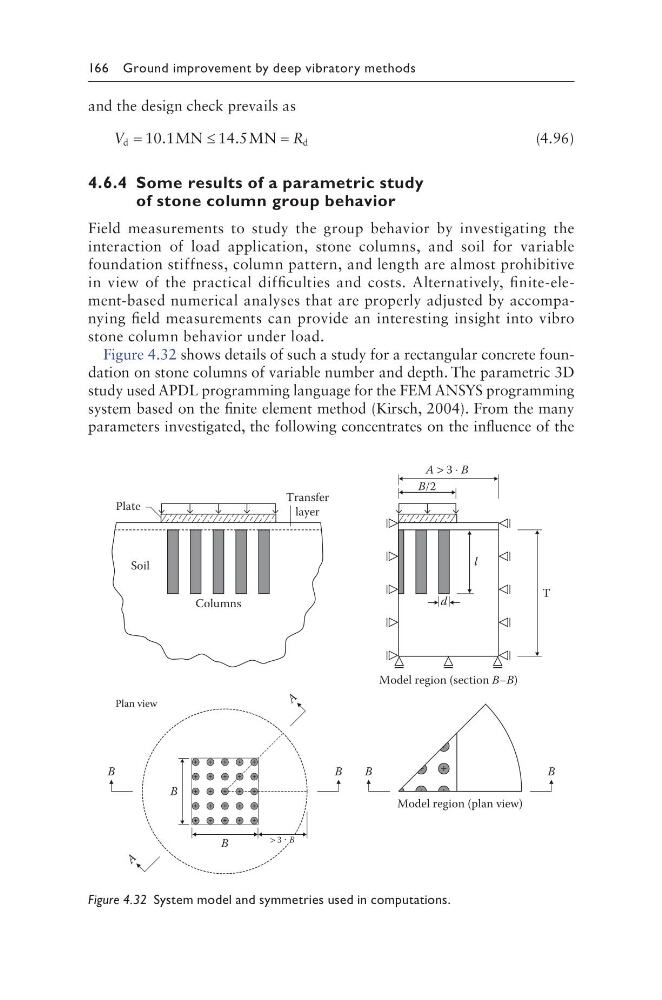
Figure 4.32 shows details of such a study for a rectangular concrete foundation on stone columns of variable number and depth. The parametric 3D
study used APDL programming language for the FEM ANSYS programming
system based on the finite element method (Kirsch, 2004). From the many
parameters investigated, the following concentrates on the influence of the
B
B
A
A
B
B
Soil
Columns
Model region (section B–B)
Transfer
layer
Plate
l
B/2
A > 3 ⋅ B
> 3 ⋅ B
d
T
B
B
Model region (plan view)
Plan view
Figure 4.32 System model and symmetries used in computations.
and the design check prevails as
V
R
d
d
MN
MN
=
≤
=
10 1
14 5
.
.
(4.96)
4.6.4 Some results of a parametric study
of stone column group behavior
Field measurements to study the group behavior by investigating the
interaction of load application, stone columns, and soil for variable
foundation stiffness, column pattern, and length are almost prohibitive
in view of the practical difficulties and costs. Alternatively, finite-element-based numerical analyses that are properly adjusted by accompanying field measurements can provide an interesting insight into vibro
stone column behavior under load.
Figure 4.32 shows details of such a study for a rectangular concrete foundation on stone columns of variable number and depth. The parametric 3D
study used APDL programming language for the FEM ANSYS programming
system based on the finite element method (Kirsch, 2004). From the many
parameters investigated, the following concentrates on the influence of the
B
B
A
A
B
B
Soil
Columns
Model region (section B–B)
Transfer
layer
Plate
l
B/2
A > 3 ⋅ B
> 3 ⋅ B
d
T
B
B
Model region (plan view)
Plan view
Figure 4.32 System model and symmetries used in computations.