

154 Ground improvement by deep vibratory methods
considered in the stone column design in the first place. The stone backfill
may be replaced by concrete over the thickness of the soft organic layer
while below and above the normal method of stone column construction is
applied (see Chapter 5).
4.6 COMPUTATIONAL EXAMPLES
4.6.1 Analysis of settlement reduction
The following analytical example is based on geometrical and material
properties, which were slightly idealized from an existing ground improvement project for the foundation of a road embankment. The soil is characterized by very soft alluvial deposits. These soils make vibro stone columns
for infrastructural measures a very common technology, in order to reduce
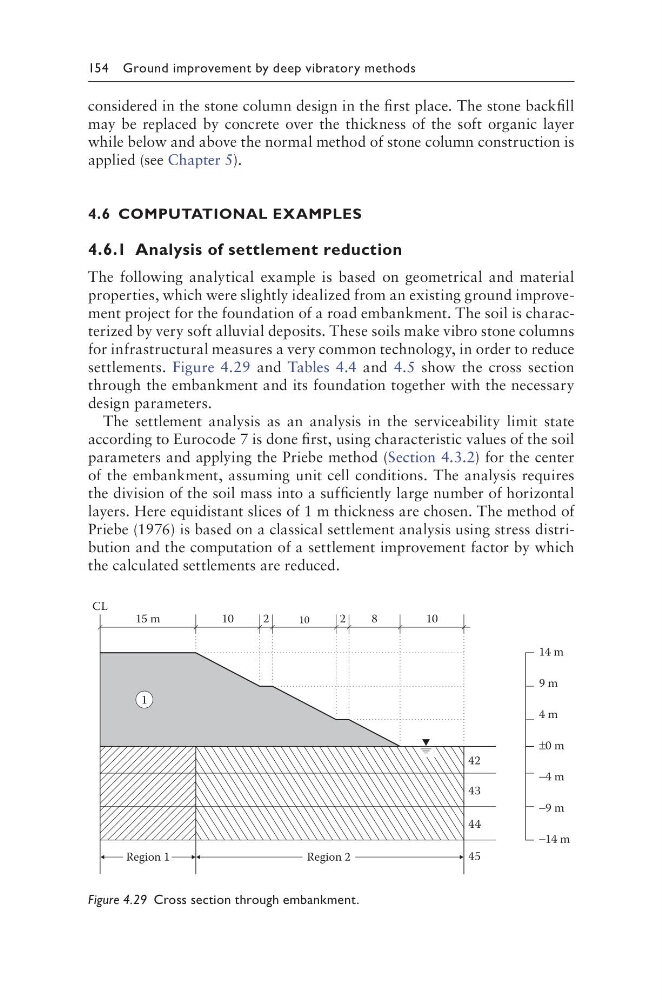
settlements. Figure 4.29 and Tables 4.4 and 4.5 show the cross section
through the embankment and its foundation together with the necessary
design parameters.
The settlement analysis as an analysis in the serviceability limit state
according to Eurocode 7 is done first, using characteristic values of the soil
parameters and applying the Priebe method (Section 4.3.2) for the center
of the embankment, assuming unit cell conditions. The analysis requires
the division of the soil mass into a sufficiently large number of horizontal
layers. Here equidistant slices of 1 m thickness are chosen. The method of
Priebe (1976) is based on a classical settlement analysis using stress distribution and the computation of a settlement improvement factor by which
the calculated settlements are reduced.
15 m
1 0
2
2
1 0
10
8
−4 m
±0 m
−14 m
−9 m
4 m
14 m
9 m
42
43
44
45
CL
Region 2
Region 1
1
Figure 4.29 Cross section through embankment.
considered in the stone column design in the first place. The stone backfill
may be replaced by concrete over the thickness of the soft organic layer
while below and above the normal method of stone column construction is
applied (see Chapter 5).
4.6 COMPUTATIONAL EXAMPLES
4.6.1 Analysis of settlement reduction
The following analytical example is based on geometrical and material
properties, which were slightly idealized from an existing ground improvement project for the foundation of a road embankment. The soil is characterized by very soft alluvial deposits. These soils make vibro stone columns
for infrastructural measures a very common technology, in order to reduce
settlements. Figure 4.29 and Tables 4.4 and 4.5 show the cross section
through the embankment and its foundation together with the necessary
design parameters.
The settlement analysis as an analysis in the serviceability limit state
according to Eurocode 7 is done first, using characteristic values of the soil
parameters and applying the Priebe method (Section 4.3.2) for the center
of the embankment, assuming unit cell conditions. The analysis requires
the division of the soil mass into a sufficiently large number of horizontal
layers. Here equidistant slices of 1 m thickness are chosen. The method of
Priebe (1976) is based on a classical settlement analysis using stress distribution and the computation of a settlement improvement factor by which
the calculated settlements are reduced.
15 m
1 0
2
2
1 0
10
8
−4 m
±0 m
−14 m
−9 m
4 m
14 m
9 m
42
43
44
45
CL
Region 2
Region 1
1
Figure 4.29 Cross section through embankment.