

Improvement of fine-grained and cohesive soils 153
their installation. It is important in these circumstances to avoid neighboring columns causing mutual damage during construction. Should excessive heave be unavoidable, partial pre-boring can assist. After removal of
the upper 0.5 m of surface soil following stone column installation, the site
surface and stone column heads need to be recompacted before the load
distribution layer is installed on top.
The practical depth range of vibro stone columns is 2–25 m. Exceptional
cases may necessitate the installation of very deep stone columns, for example, if stability or liquefaction requirements dictate. For these cases, cranehung bottom feed systems have been developed with depth capability, both
on and offshore, in excess of 50 m. These not only need careful planning
and thorough site investigations but also execution should only be by very
experienced contractors.
The vibro stone column method is often used to treat heterogeneous
strata, sometimes with successive layers of very different characteristics
or with imbedded lenses of soft, organic soil of inconsistent extent and
thickness. Site investigation will not always detect these ground conditions.
Although the method is no substitute for a site investigation, the regular and
well- documented installation method is likely to detect unexpected ground
irregularities. The Engineer and contractor will then have to define ways
and means of coping with the changed soil conditions, either by additional
stone columns at closer spacing or by increasing the stone column diameter.
In these circumstances stone columns may be able to bridge the soft layers if
their thickness is not greater than about two column diameters. Any thicker
layers will almost certainly have been detected by the site investigation and
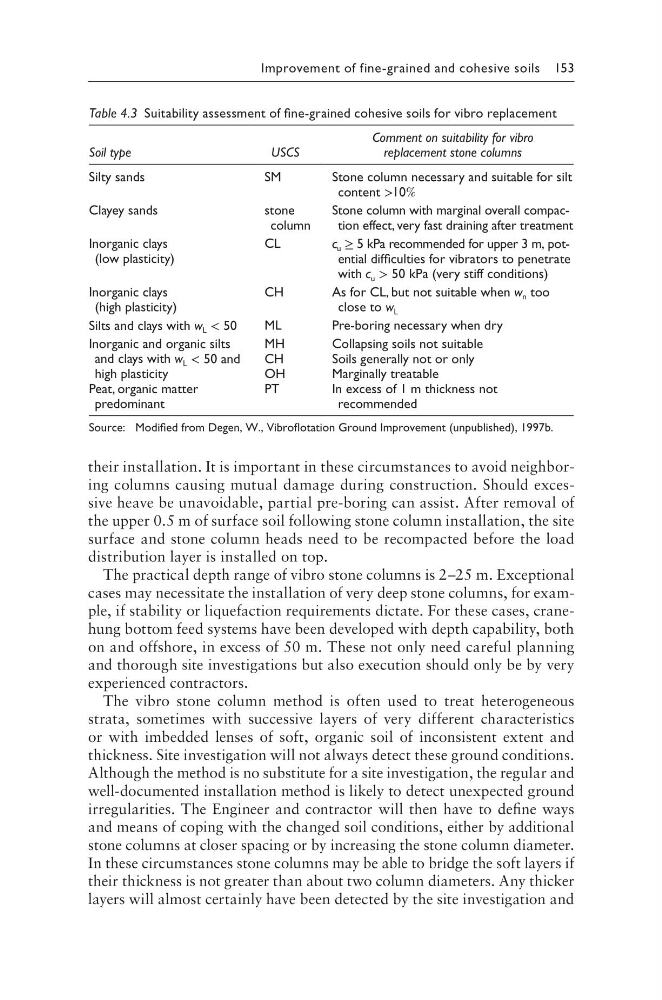
Table 4.3 Suitability assessment of fine-grained cohesive soils for vibro replacement
Soil type
USCS
Comment on suitability for vibro
replacement stone columns
Silty sands
SM
Stone column necessary and suitable for silt
content >10%
Clayey sands
stone
column
Stone column with marginal overall compaction effect, very fast draining after treatment
Inorganic clays
(low plasticity)
CL
c u ≥ 5 kPa recommended for upper 3 m, poten tial difficulties for vibrators to penetrate
with c u > 50 kPa (very stiff conditions)
Inorganic clays
(high plasticity)
CH
As for CL, but not suitable when w n too
close to w L
Silts and clays with w L < 50
ML
Pre-boring necessary when dry
Inorganic and organic silts
and clays with w L < 50 and
high plasticity
Peat, organic matter
predominant
MH
CH
OH
PT
Collapsing soils not suitable
Soils generally not or only
Marginally treatable
In excess of 1 m thickness not
recommended
Source: Modified from Degen, W., Vibroflotation Ground Improvement (unpublished), 1997b.
their installation. It is important in these circumstances to avoid neighboring columns causing mutual damage during construction. Should excessive heave be unavoidable, partial pre-boring can assist. After removal of
the upper 0.5 m of surface soil following stone column installation, the site
surface and stone column heads need to be recompacted before the load
distribution layer is installed on top.
The practical depth range of vibro stone columns is 2–25 m. Exceptional
cases may necessitate the installation of very deep stone columns, for example, if stability or liquefaction requirements dictate. For these cases, cranehung bottom feed systems have been developed with depth capability, both
on and offshore, in excess of 50 m. These not only need careful planning
and thorough site investigations but also execution should only be by very
experienced contractors.
The vibro stone column method is often used to treat heterogeneous
strata, sometimes with successive layers of very different characteristics
or with imbedded lenses of soft, organic soil of inconsistent extent and
thickness. Site investigation will not always detect these ground conditions.
Although the method is no substitute for a site investigation, the regular and
well- documented installation method is likely to detect unexpected ground
irregularities. The Engineer and contractor will then have to define ways
and means of coping with the changed soil conditions, either by additional
stone columns at closer spacing or by increasing the stone column diameter.
In these circumstances stone columns may be able to bridge the soft layers if
their thickness is not greater than about two column diameters. Any thicker
layers will almost certainly have been detected by the site investigation and
Table 4.3 Suitability assessment of fine-grained cohesive soils for vibro replacement
Soil type
USCS
Comment on suitability for vibro
replacement stone columns
Silty sands
SM
Stone column necessary and suitable for silt
content >10%
Clayey sands
stone
column
Stone column with marginal overall compaction effect, very fast draining after treatment
Inorganic clays
(low plasticity)
CL
c u ≥ 5 kPa recommended for upper 3 m, poten tial difficulties for vibrators to penetrate
with c u > 50 kPa (very stiff conditions)
Inorganic clays
(high plasticity)
CH
As for CL, but not suitable when w n too
close to w L
Silts and clays with w L < 50
ML
Pre-boring necessary when dry
Inorganic and organic silts
and clays with w L < 50 and
high plasticity
Peat, organic matter
predominant
MH
CH
OH
PT
Collapsing soils not suitable
Soils generally not or only
Marginally treatable
In excess of 1 m thickness not
recommended
Source: Modified from Degen, W., Vibroflotation Ground Improvement (unpublished), 1997b.