

Improvement of fine-grained and cohesive soils 155
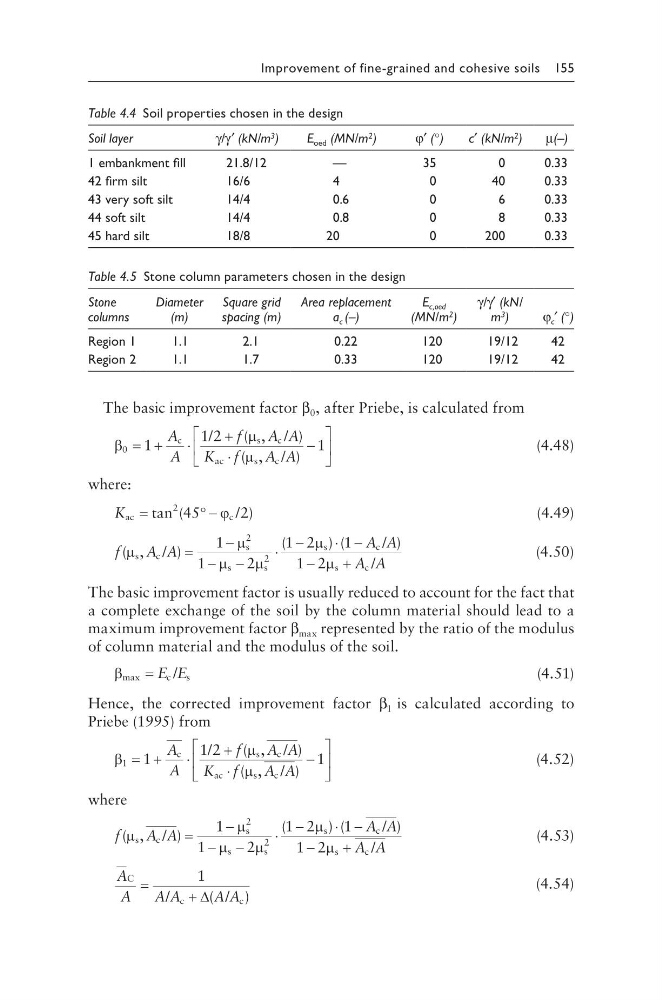
The basic improvement factor β 0 , after Priebe, is calculated from
β
µ
µ
0
1
1 2
1
= +
⋅
+
⋅
−
A
A
f
A A
K f
A A
c
s
c
ac
s
c
/
/
/
( ,
)
( ,
)
(4.48)
where:
K ac
/
=
−
tan (
)
2
45
2
° ϕ c
(4.49)
f
A A
A A
A A
( ,
)
(
) (
)
µ
µ
µ
µ
µ
µ
s
c
s
s
s
s
c
s
c
/
/
/
=
−
− −
⋅
−
⋅ −
−
+
1
1
2
1 2
1
1 2
2
2
(4.50)
The basic improvement factor is usually reduced to account for the fact that
a complete exchange of the soil by the column material should lead to a
maximum improvement factor β max represented by the ratio of the modulus
of column material and the modulus of the soil.
β max
c
s
/
= E E
(4.51)
Hence, the corrected improvement factor β 1 is calculated according to
Priebe (1995) from
β
µ
µ
1
c
s
c
ac
s
c
/
/
/
= +
⋅
+
⋅
−
1
1 2
1
A
A
f
A A
K f
A A
( ,
)
( ,
)
(4.52)
where
f
A A
A A
A A
( ,
)
(
) (
)
µ
µ
µ
µ
µ
µ
s
c
s
s
s
s
c
s
c
/
/
/
=
−
− −
⋅
−
⋅ −
−
+
1
1
2
1 2
1
1 2
2
2
(4.53)
A
A
C
c
c
/
/
=
+ ∆
1
A A
A A
(
)
(4.54)
Table 4.4 Soil properties chosen in the design
Soil layer
γ/γ′ (kN/m 3 )
E oed (MN/m 2 )
φ′ (°)
c′ (kN/m 2 )
µ(–)
1 embankment fill
21.8/12
—
35
0
0.33
42 firm silt
16/6
4
0
40
0.33
43 very soft silt
14/4
0.6
0
6
0.33
44 soft silt
14/4
0.8
0
8
0.33
45 hard silt
18/8
20
0
200
0.33
Table 4.5 Stone column parameters chosen in the design
Stone
columns
Diameter
(m)
Square grid
spacing (m)
Area replacement
a c (–)
E c,oed
(MN/m 2 )
γ/γ′ (kN/
m 3 )
φ c ′ (°)
Region 1
1.1
2.1
0.22
120
19/12
42
Region 2
1.1
1.7
0.33
120
19/12
42
The basic improvement factor β 0 , after Priebe, is calculated from
β
µ
µ
0
1
1 2
1
= +
⋅
+
⋅
−
A
A
f
A A
K f
A A
c
s
c
ac
s
c
/
/
/
( ,
)
( ,
)
(4.48)
where:
K ac
/
=
−
tan (
)
2
45
2
° ϕ c
(4.49)
f
A A
A A
A A
( ,
)
(
) (
)
µ
µ
µ
µ
µ
µ
s
c
s
s
s
s
c
s
c
/
/
/
=
−
− −
⋅
−
⋅ −
−
+
1
1
2
1 2
1
1 2
2
2
(4.50)
The basic improvement factor is usually reduced to account for the fact that
a complete exchange of the soil by the column material should lead to a
maximum improvement factor β max represented by the ratio of the modulus
of column material and the modulus of the soil.
β max
c
s
/
= E E
(4.51)
Hence, the corrected improvement factor β 1 is calculated according to
Priebe (1995) from
β
µ
µ
1
c
s
c
ac
s
c
/
/
/
= +
⋅
+
⋅
−
1
1 2
1
A
A
f
A A
K f
A A
( ,
)
( ,
)
(4.52)
where
f
A A
A A
A A
( ,
)
(
) (
)
µ
µ
µ
µ
µ
µ
s
c
s
s
s
s
c
s
c
/
/
/
=
−
− −
⋅
−
⋅ −
−
+
1
1
2
1 2
1
1 2
2
2
(4.53)
A
A
C
c
c
/
/
=
+ ∆
1
A A
A A
(
)
(4.54)
Table 4.4 Soil properties chosen in the design
Soil layer
γ/γ′ (kN/m 3 )
E oed (MN/m 2 )
φ′ (°)
c′ (kN/m 2 )
µ(–)
1 embankment fill
21.8/12
—
35
0
0.33
42 firm silt
16/6
4
0
40
0.33
43 very soft silt
14/4
0.6
0
6
0.33
44 soft silt
14/4
0.8
0
8
0.33
45 hard silt
18/8
20
0
200
0.33
Table 4.5 Stone column parameters chosen in the design
Stone
columns
Diameter
(m)
Square grid
spacing (m)
Area replacement
a c (–)
E c,oed
(MN/m 2 )
γ/γ′ (kN/
m 3 )
φ c ′ (°)
Region 1
1.1
2.1
0.22
120
19/12
42
Region 2
1.1
1.7
0.33
120
19/12
42