

134 Ground improvement by deep vibratory methods
The average cohesion of the composite soil follows from
c
a c
avg
c
= − ⋅
(
)
1
(4.28)
A sample calculation of this method is shown in Section 4.6.3.
We have seen that a bearing capacity failure of an infinitely distributed,
evenly loaded grid of stone columns cannot occur. However, at the edge of
large column groups (below tanks and embankments), the general rotational
or linear type shear failure resistance needs to be investigated. The design
is generally based on conventional slip circle analysis and it is evident that,
for a significant improvement of the safety factor, it is necessary to consider
the stress concentration on the columns to fully mobilize their superior friction strength together with a substantial overburden pressure. Barksdale and
Bachus (1983) have proposed, for this purpose, how to make use of the stress
concentration n in hand calculations when adopting the unit cell concept.
Figure 4.20 shows such a unit cell at a depth where it intersects with the
assumed failure line. The vertical effective stress ′
σ v,c resulting from the column weight and the applied stress σ can be expressed by
′
⋅
⋅
σ
γ
σ
v,c
c
c
=
+
z n
(4.29)
φ–degrees
0
1 0
20
30
40
50
φ–degrees
0
1 0
20
30
40
50
Cylindrical cavity
250
100
50
25
I r = 5
I r = 5
250
100
50
25
10
10
2
4
6
8
1
10
20
30
40
2
4
6
8
1
10
20
30
40
F q ′
F c ′
I r =
E
2 (I + μ) (c + q tan φ)
I r = 500
I r = 500
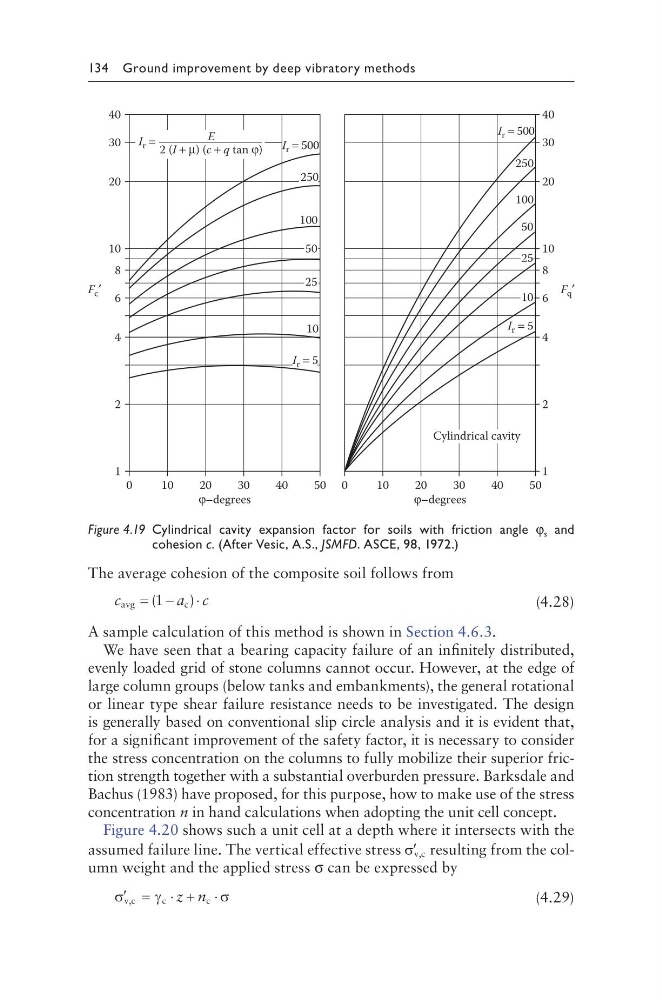
Figure 4.19 Cylindrical cavity expansion factor for soils with friction angle φ s and
cohesion c. (After Vesic, A.S., JSMFD. ASCE, 98, 1972.)
The average cohesion of the composite soil follows from
c
a c
avg
c
= − ⋅
(
)
1
(4.28)
A sample calculation of this method is shown in Section 4.6.3.
We have seen that a bearing capacity failure of an infinitely distributed,
evenly loaded grid of stone columns cannot occur. However, at the edge of
large column groups (below tanks and embankments), the general rotational
or linear type shear failure resistance needs to be investigated. The design
is generally based on conventional slip circle analysis and it is evident that,
for a significant improvement of the safety factor, it is necessary to consider
the stress concentration on the columns to fully mobilize their superior friction strength together with a substantial overburden pressure. Barksdale and
Bachus (1983) have proposed, for this purpose, how to make use of the stress
concentration n in hand calculations when adopting the unit cell concept.
Figure 4.20 shows such a unit cell at a depth where it intersects with the
assumed failure line. The vertical effective stress ′
σ v,c resulting from the column weight and the applied stress σ can be expressed by
′
⋅
⋅
σ
γ
σ
v,c
c
c
=
+
z n
(4.29)
φ–degrees
0
1 0
20
30
40
50
φ–degrees
0
1 0
20
30
40
50
Cylindrical cavity
250
100
50
25
I r = 5
I r = 5
250
100
50
25
10
10
2
4
6
8
1
10
20
30
40
2
4
6
8
1
10
20
30
40
F q ′
F c ′
I r =
E
2 (I + μ) (c + q tan φ)
I r = 500
I r = 500
Figure 4.19 Cylindrical cavity expansion factor for soils with friction angle φ s and
cohesion c. (After Vesic, A.S., JSMFD. ASCE, 98, 1972.)