

Improvement of fine-grained and cohesive soils 133
In this consideration, quick loading conditions are assumed with the
undrained shear strength c u prevailing in the soil (φ s = 0) and with no
cohesion for the stone column material. For the composite material of
soil and stone column, an average friction angle φ avg and a composite
cohesion c avg can be calculated using the Equations 4.26 and 4.28 below
with n c representing the stress concentration in the column. For simplicity, the stress concentration may be neglected with n c = 1 and tan φ avg
calculated as the weighted average of the stone column and soil areas.
However, this leads to conservative ultimate bearing capacities. With the
improvement factor β developed with the Priebe method at the average
depth of ½ · B · tan δ, the stress concentration factor n can be calculated
using Equation 4.12 and introduced into Equation 4.27.
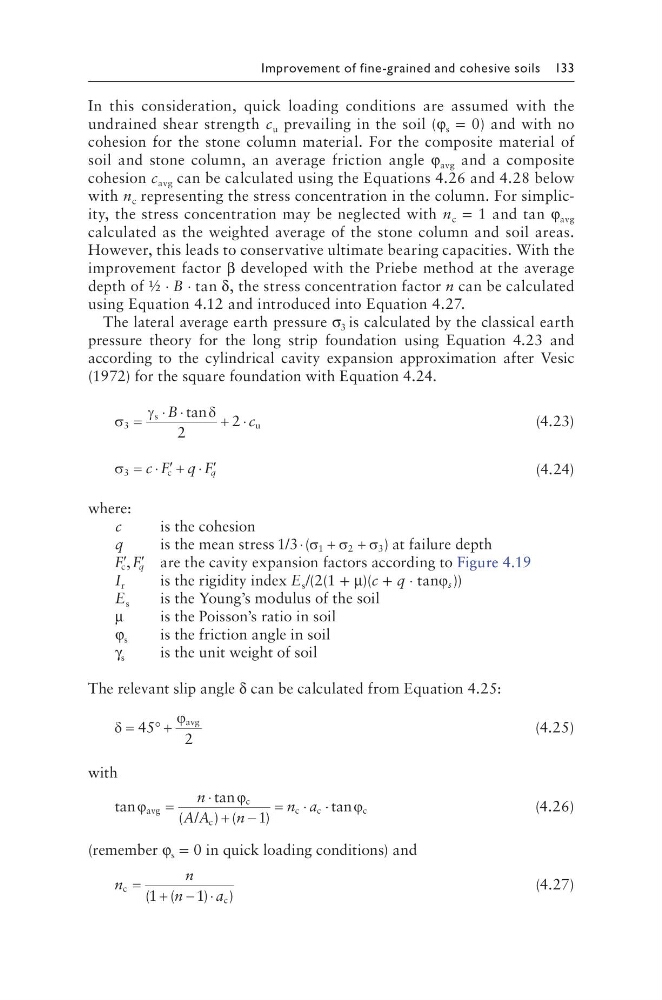
The lateral average earth pressure σ 3 is calculated by the classical earth
pressure theory for the long strip foundation using Equation 4.23 and
according to the cylindrical cavity expansion approximation after Vesic
(1972) for the square foundation with Equation 4.24.
σ
γ
δ
3
s
u
=
⋅ ⋅
+ ⋅
B
c
tan
2
2
(4.23)
σ 3
c
= ⋅ ′ + ⋅ ′
c F
F
q q
(4.24)
where:
c
is the cohesion
q
is the mean stress 1 3 1
2
3
/ ⋅
+ +
(
)
σ σ σ at failure depth
′ ′
F F q
c ,
are the cavity expansion factors according to Figure 4.19
I r
is the rigidity index E s /(2(1 + µ)(c + q · tanϕ s ))
E s
is the Young’s modulus of the soil
µ
is the Poisson’s ratio in soil
φ s
is the friction angle in soil
γ s
is the unit weight of soil
The relevant slip angle δ can be calculated from Equation 4.25:
δ
ϕ
=
+
45
2
°
avg
(4.25)
with
tan
tan
(
) (
)
tan
ϕ
ϕ
ϕ
avg
c
c
c
c
c
/
=
⋅
+ −
= ⋅ ⋅
n
A A
n
n a
1
(4.26)
(remember φ s = 0 in quick loading conditions) and
n
n
n
a
c
c
= + − ⋅
( (
) )
1
1
(4.27)
In this consideration, quick loading conditions are assumed with the
undrained shear strength c u prevailing in the soil (φ s = 0) and with no
cohesion for the stone column material. For the composite material of
soil and stone column, an average friction angle φ avg and a composite
cohesion c avg can be calculated using the Equations 4.26 and 4.28 below
with n c representing the stress concentration in the column. For simplicity, the stress concentration may be neglected with n c = 1 and tan φ avg
calculated as the weighted average of the stone column and soil areas.
However, this leads to conservative ultimate bearing capacities. With the
improvement factor β developed with the Priebe method at the average
depth of ½ · B · tan δ, the stress concentration factor n can be calculated
using Equation 4.12 and introduced into Equation 4.27.
The lateral average earth pressure σ 3 is calculated by the classical earth
pressure theory for the long strip foundation using Equation 4.23 and
according to the cylindrical cavity expansion approximation after Vesic
(1972) for the square foundation with Equation 4.24.
σ
γ
δ
3
s
u
=
⋅ ⋅
+ ⋅
B
c
tan
2
2
(4.23)
σ 3
c
= ⋅ ′ + ⋅ ′
c F
F
q q
(4.24)
where:
c
is the cohesion
q
is the mean stress 1 3 1
2
3
/ ⋅
+ +
(
)
σ σ σ at failure depth
′ ′
F F q
c ,
are the cavity expansion factors according to Figure 4.19
I r
is the rigidity index E s /(2(1 + µ)(c + q · tanϕ s ))
E s
is the Young’s modulus of the soil
µ
is the Poisson’s ratio in soil
φ s
is the friction angle in soil
γ s
is the unit weight of soil
The relevant slip angle δ can be calculated from Equation 4.25:
δ
ϕ
=
+
45
2
°
avg
(4.25)
with
tan
tan
(
) (
)
tan
ϕ
ϕ
ϕ
avg
c
c
c
c
c
/
=
⋅
+ −
= ⋅ ⋅
n
A A
n
n a
1
(4.26)
(remember φ s = 0 in quick loading conditions) and
n
n
n
a
c
c
= + − ⋅
( (
) )
1
1
(4.27)