

130 Ground improvement by deep vibratory methods
of particularly soft soil layers that are thick enough (say in excess of two
column diameters) to allow bulging to develop as shown in Figure 4.16d.
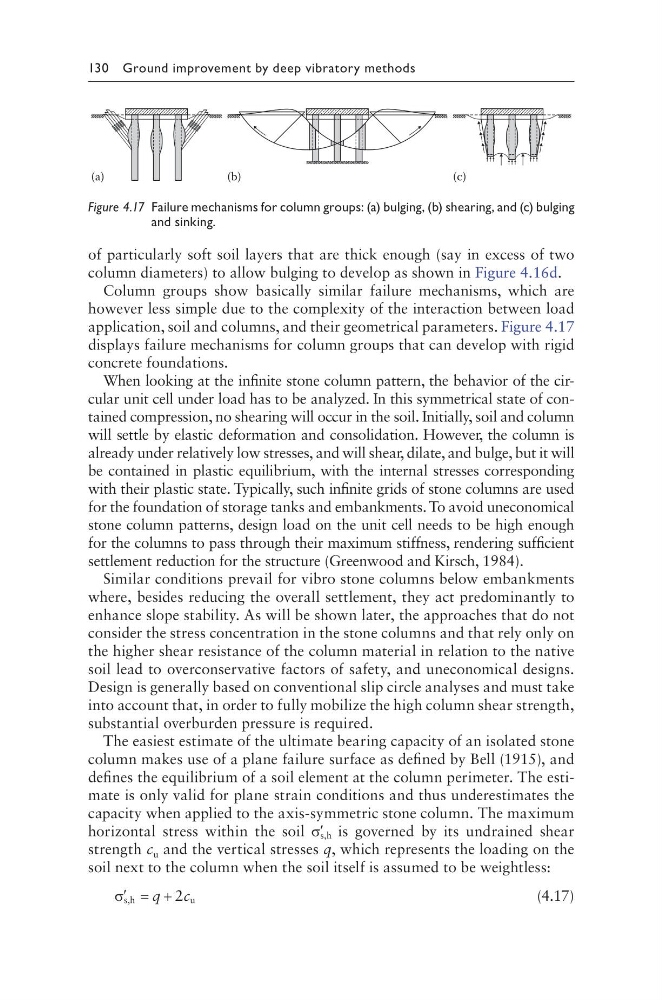
Column groups show basically similar failure mechanisms, which are
however less simple due to the complexity of the interaction between load
application, soil and columns, and their geometrical parameters. Figure 4.17
displays failure mechanisms for column groups that can develop with rigid
concrete foundations.
When looking at the infinite stone column pattern, the behavior of the circular unit cell under load has to be analyzed. In this symmetrical state of contained compression, no shearing will occur in the soil. Initially, soil and column
will settle by elastic deformation and consolidation. However, the column is
already under relatively low stresses, and will shear, dilate, and bulge, but it will
be contained in plastic equilibrium, with the internal stresses corresponding
with their plastic state. Typically, such infinite grids of stone columns are used
for the foundation of storage tanks and embankments. To avoid uneconomical
stone column patterns, design load on the unit cell needs to be high enough
for the columns to pass through their maximum stiffness, rendering sufficient
settlement reduction for the structure (Greenwood and Kirsch, 1984).
Similar conditions prevail for vibro stone columns below embankments
where, besides reducing the overall settlement, they act predominantly to
enhance slope stability. As will be shown later, the approaches that do not
consider the stress concentration in the stone columns and that rely only on
the higher shear resistance of the column material in relation to the native
soil lead to overconservative factors of safety, and uneconomical designs.
Design is generally based on conventional slip circle analyses and must take
into account that, in order to fully mobilize the high column shear strength,
substantial overburden pressure is required.
The easiest estimate of the ultimate bearing capacity of an isolated stone
column makes use of a plane failure surface as defined by Bell (1915), and
defines the equilibrium of a soil element at the column perimeter. The estimate is only valid for plane strain conditions and thus underestimates the
capacity when applied to the axis-symmetric stone column. The maximum
horizontal stress within the soil ′
σ s,h is governed by its undrained shear
strength c u and the vertical stresses q, which represents the loading on the
soil next to the column when the soil itself is assumed to be weightless:
′ = +
σ s,h
u
q
c
2
(4.17)
(a)
(b)
(c)
Figure 4.17 Failure mechanisms for column groups: (a) bulging, (b) shearing, and (c) bulging
and sinking.
of particularly soft soil layers that are thick enough (say in excess of two
column diameters) to allow bulging to develop as shown in Figure 4.16d.
Column groups show basically similar failure mechanisms, which are
however less simple due to the complexity of the interaction between load
application, soil and columns, and their geometrical parameters. Figure 4.17
displays failure mechanisms for column groups that can develop with rigid
concrete foundations.
When looking at the infinite stone column pattern, the behavior of the circular unit cell under load has to be analyzed. In this symmetrical state of contained compression, no shearing will occur in the soil. Initially, soil and column
will settle by elastic deformation and consolidation. However, the column is
already under relatively low stresses, and will shear, dilate, and bulge, but it will
be contained in plastic equilibrium, with the internal stresses corresponding
with their plastic state. Typically, such infinite grids of stone columns are used
for the foundation of storage tanks and embankments. To avoid uneconomical
stone column patterns, design load on the unit cell needs to be high enough
for the columns to pass through their maximum stiffness, rendering sufficient
settlement reduction for the structure (Greenwood and Kirsch, 1984).
Similar conditions prevail for vibro stone columns below embankments
where, besides reducing the overall settlement, they act predominantly to
enhance slope stability. As will be shown later, the approaches that do not
consider the stress concentration in the stone columns and that rely only on
the higher shear resistance of the column material in relation to the native
soil lead to overconservative factors of safety, and uneconomical designs.
Design is generally based on conventional slip circle analyses and must take
into account that, in order to fully mobilize the high column shear strength,
substantial overburden pressure is required.
The easiest estimate of the ultimate bearing capacity of an isolated stone
column makes use of a plane failure surface as defined by Bell (1915), and
defines the equilibrium of a soil element at the column perimeter. The estimate is only valid for plane strain conditions and thus underestimates the
capacity when applied to the axis-symmetric stone column. The maximum
horizontal stress within the soil ′
σ s,h is governed by its undrained shear
strength c u and the vertical stresses q, which represents the loading on the
soil next to the column when the soil itself is assumed to be weightless:
′ = +
σ s,h
u
q
c
2
(4.17)
(a)
(b)
(c)
Figure 4.17 Failure mechanisms for column groups: (a) bulging, (b) shearing, and (c) bulging
and sinking.