

Improvement of fine-grained and cohesive soils 131
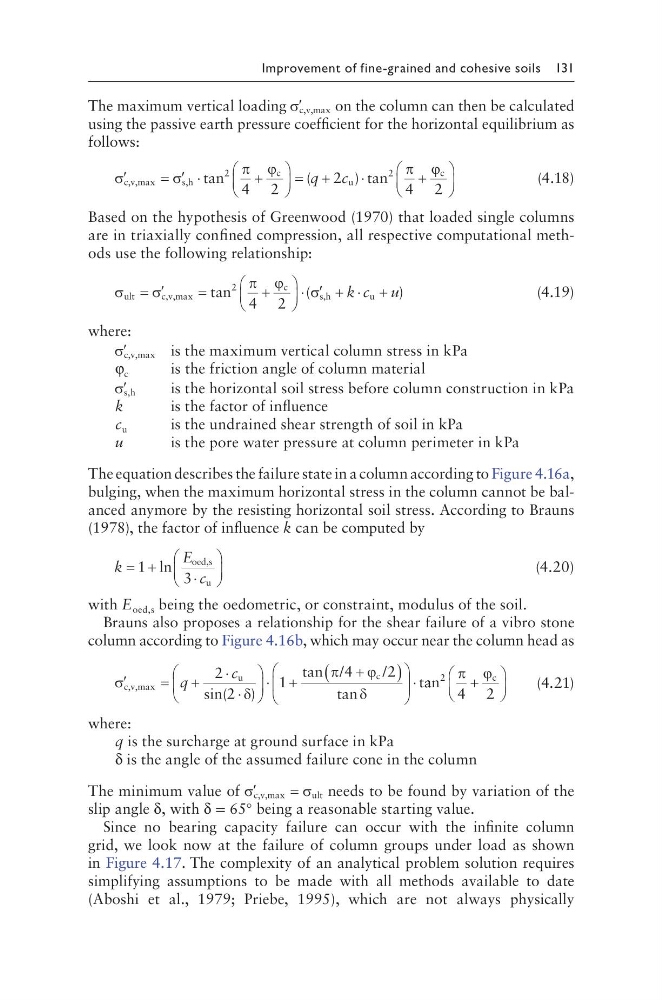
The maximum vertical loading ′
σ c,v,max on the column can then be calculated
using the passive earth pressure coefficient for the horizontal equilibrium as
follows:
′
= ′ ⋅
+
= +
⋅
+
σ
σ
π ϕ
π ϕ
c,v,max
s ,h
c
u
c
tan
(
) tan
2
2
4 2
2
4 2
q
c
(4.18)
Based on the hypothesis of Greenwood (1970) that loaded single columns
are in triaxially confined compression, all respective computational methods use the following relationship:
σ
σ
π ϕ
σ
ult
c ,v,max
c
s,h
u
= ′
=
+
⋅ ′ + ⋅ +
tan
(
)
2
4 2
k c u
(4.19)
where:
′
σ c,v,max is the maximum vertical column stress in kPa
φ c
is the friction angle of column material
′
σ s h
,
is the horizontal soil stress before column construction in kPa
k
is the factor of influence
c u
is the undrained shear strength of soil in kPa
u
is the pore water pressure at column perimeter in kPa
The equation describes the failure state in a column according to Figure 4.16a,
bulging, when the maximum horizontal stress in the column cannot be balanced anymore by the resisting horizontal soil stress. According to Brauns
(1978), the factor of influence k can be computed by
k = +
⋅
1 ln
oed,s
u
E
c
3
(4.20)
with E oed,s being the oedometric, or constraint, modulus of the soil.
Brauns also proposes a relationship for the shear failure of a vibro stone
column according to Figure 4.16b, which may occur near the column head as
′
= +
⋅
⋅
⋅ +
+
(
)
⋅
σ
δ
π
ϕ
δ
c,v,max
u
c
/
/
q
c
2
2
1
4
2
sin(
)
tan
tan
ta an
2
4 2
π ϕ
+
c
(4.21)
where:
q is the surcharge at ground surface in kPa
δ is the angle of the assumed failure cone in the column
The minimum value of ′
=
σ
σ
c,v,max
u lt needs to be found by variation of the
slip angle δ, with δ = 65° being a reasonable starting value.
Since no bearing capacity failure can occur with the infinite column
grid, we look now at the failure of column groups under load as shown
in Figure 4.17. The complexity of an analytical problem solution requires
simplifying assumptions to be made with all methods available to date
(Aboshi et al., 1979; Priebe, 1995), which are not always physically
The maximum vertical loading ′
σ c,v,max on the column can then be calculated
using the passive earth pressure coefficient for the horizontal equilibrium as
follows:
′
= ′ ⋅
+
= +
⋅
+
σ
σ
π ϕ
π ϕ
c,v,max
s ,h
c
u
c
tan
(
) tan
2
2
4 2
2
4 2
q
c
(4.18)
Based on the hypothesis of Greenwood (1970) that loaded single columns
are in triaxially confined compression, all respective computational methods use the following relationship:
σ
σ
π ϕ
σ
ult
c ,v,max
c
s,h
u
= ′
=
+
⋅ ′ + ⋅ +
tan
(
)
2
4 2
k c u
(4.19)
where:
′
σ c,v,max is the maximum vertical column stress in kPa
φ c
is the friction angle of column material
′
σ s h
,
is the horizontal soil stress before column construction in kPa
k
is the factor of influence
c u
is the undrained shear strength of soil in kPa
u
is the pore water pressure at column perimeter in kPa
The equation describes the failure state in a column according to Figure 4.16a,
bulging, when the maximum horizontal stress in the column cannot be balanced anymore by the resisting horizontal soil stress. According to Brauns
(1978), the factor of influence k can be computed by
k = +
⋅
1 ln
oed,s
u
E
c
3
(4.20)
with E oed,s being the oedometric, or constraint, modulus of the soil.
Brauns also proposes a relationship for the shear failure of a vibro stone
column according to Figure 4.16b, which may occur near the column head as
′
= +
⋅
⋅
⋅ +
+
(
)
⋅
σ
δ
π
ϕ
δ
c,v,max
u
c
/
/
q
c
2
2
1
4
2
sin(
)
tan
tan
ta an
2
4 2
π ϕ
+
c
(4.21)
where:
q is the surcharge at ground surface in kPa
δ is the angle of the assumed failure cone in the column
The minimum value of ′
=
σ
σ
c,v,max
u lt needs to be found by variation of the
slip angle δ, with δ = 65° being a reasonable starting value.
Since no bearing capacity failure can occur with the infinite column
grid, we look now at the failure of column groups under load as shown
in Figure 4.17. The complexity of an analytical problem solution requires
simplifying assumptions to be made with all methods available to date
(Aboshi et al., 1979; Priebe, 1995), which are not always physically