

Improvement of fine-grained and cohesive soils 129
From the relatively large number of methods proposed for the estimation
of settlements of soft soil improved by stone columns, those have been proposed that are widely used today, delivering reasonable results within the
normal accuracy bound of settlement calculations, provided that reasonable assumptions are made with regard to the shear strength of the column
material and in particular to the area ratio of the column grid.
Numerical calculations adopting the finite element method are recommended for major projects and in the presence of particularly soft soils, say
below c u = 20 kPa, provided that the elastic–plastic behavior of the unit
cell and the shear zones in the stone column can be modeled with sufficient
accuracy. For large foundations, two-dimensional calculations may suffice,
but other foundations may require the use of three-dimensional approaches.
4.3.3 Failure mechanism and bearing
capacity calculations
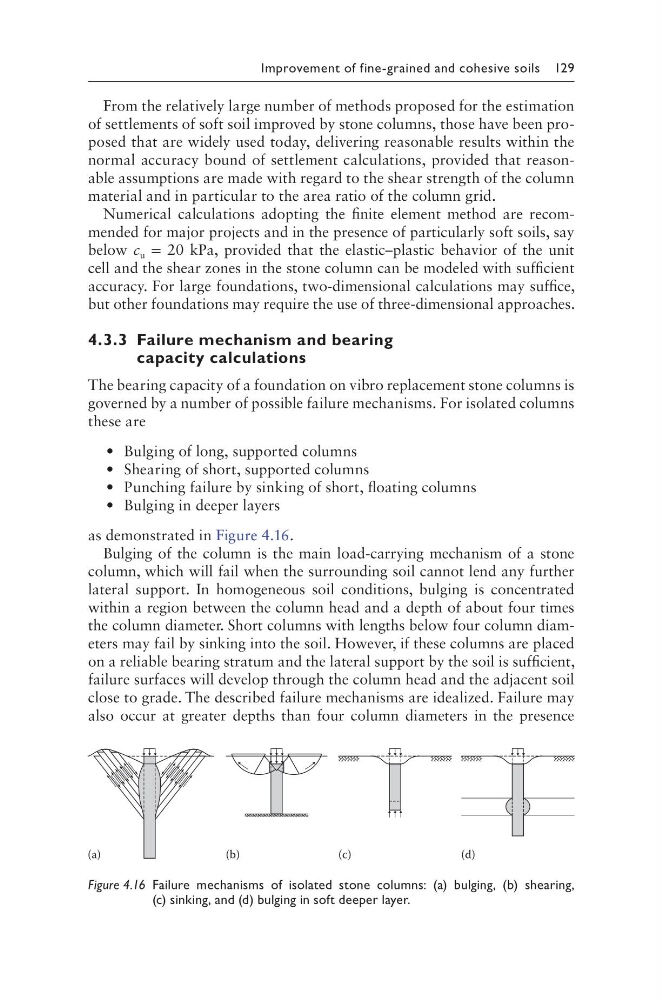
The bearing capacity of a foundation on vibro replacement stone columns is
governed by a number of possible failure mechanisms. For isolated columns
these are
• Bulging of long, supported columns
• Shearing of short, supported columns
• Punching failure by sinking of short, floating columns
• Bulging in deeper layers
as demonstrated in Figure 4.16.
Bulging of the column is the main load-carrying mechanism of a stone
column, which will fail when the surrounding soil cannot lend any further
lateral support. In homogeneous soil conditions, bulging is concentrated
within a region between the column head and a depth of about four times
the column diameter. Short columns with lengths below four column diameters may fail by sinking into the soil. However, if these columns are placed
on a reliable bearing stratum and the lateral support by the soil is sufficient,
failure surfaces will develop through the column head and the adjacent soil
close to grade. The described failure mechanisms are idealized. Failure may
also occur at greater depths than four column diameters in the presence
(a)
(b)
(c)
(d)
Figure 4.16 Failure mechanisms of isolated stone columns: (a) bulging, (b) shearing,
(c) sinking, and (d) bulging in soft deeper layer.
From the relatively large number of methods proposed for the estimation
of settlements of soft soil improved by stone columns, those have been proposed that are widely used today, delivering reasonable results within the
normal accuracy bound of settlement calculations, provided that reasonable assumptions are made with regard to the shear strength of the column
material and in particular to the area ratio of the column grid.
Numerical calculations adopting the finite element method are recommended for major projects and in the presence of particularly soft soils, say
below c u = 20 kPa, provided that the elastic–plastic behavior of the unit
cell and the shear zones in the stone column can be modeled with sufficient
accuracy. For large foundations, two-dimensional calculations may suffice,
but other foundations may require the use of three-dimensional approaches.
4.3.3 Failure mechanism and bearing
capacity calculations
The bearing capacity of a foundation on vibro replacement stone columns is
governed by a number of possible failure mechanisms. For isolated columns
these are
• Bulging of long, supported columns
• Shearing of short, supported columns
• Punching failure by sinking of short, floating columns
• Bulging in deeper layers
as demonstrated in Figure 4.16.
Bulging of the column is the main load-carrying mechanism of a stone
column, which will fail when the surrounding soil cannot lend any further
lateral support. In homogeneous soil conditions, bulging is concentrated
within a region between the column head and a depth of about four times
the column diameter. Short columns with lengths below four column diameters may fail by sinking into the soil. However, if these columns are placed
on a reliable bearing stratum and the lateral support by the soil is sufficient,
failure surfaces will develop through the column head and the adjacent soil
close to grade. The described failure mechanisms are idealized. Failure may
also occur at greater depths than four column diameters in the presence
(a)
(b)
(c)
(d)
Figure 4.16 Failure mechanisms of isolated stone columns: (a) bulging, (b) shearing,
(c) sinking, and (d) bulging in soft deeper layer.