

Improvement of fine-grained and cohesive soils 123
by numerical calculations (Balaam and Poulos, 1983) and by in-situ measurements (Gruber, 1994; Kirsch, 2004).
In contrast to the load-carrying mechanism of a rigid foundation element, such as a pile, where the load transfer into the ground is by toe resistance and friction at the pile perimeter, stone columns transmit their load
into the soil by stimulating its horizontal earth pressure without relative
displacement between column and soil. In this state of contained compression, the stone column, which is characterized by high density and stiffness,
will ultimately fail by bulging as a result of the high column load and the
minimal supporting capacity of the surrounding soil. Owing to its high
density, the column yields locally in its upper part under the shearing forces
by lateral bulging, counteracted by the surrounding soil, depending on its
stiffness and strength. This horizontal deformation is further increased by
the dilatancy of the column material. This volume increase was measured
to about 9%, albeit that there is considerable axial column compression
(Kirsch, 2004).
The hypothesis that a column is triaxially loaded in confined compression leading to the peculiar horizontal deformation, as described, has been
verified by numerous researchers (Greenwood, 1970; Hughes and Withers,
1974; Hughes et al., 1975; Brauns, 1980; Barksdale and Bachus, 1983;
Kirsch, 2004). This has been done theoretically, in model tests and in field
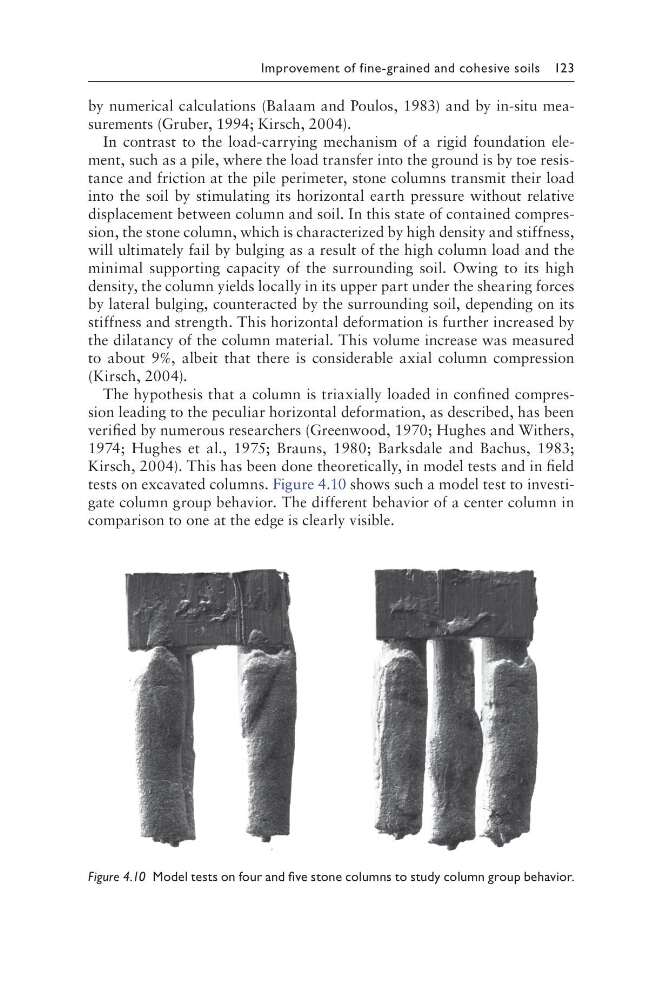
tests on excavated columns. Figure 4.10 shows such a model test to investigate column group behavior. The different behavior of a center column in
comparison to one at the edge is clearly visible.
Figure 4.10 Model tests on four and five stone columns to study column group behavior.
by numerical calculations (Balaam and Poulos, 1983) and by in-situ measurements (Gruber, 1994; Kirsch, 2004).
In contrast to the load-carrying mechanism of a rigid foundation element, such as a pile, where the load transfer into the ground is by toe resistance and friction at the pile perimeter, stone columns transmit their load
into the soil by stimulating its horizontal earth pressure without relative
displacement between column and soil. In this state of contained compression, the stone column, which is characterized by high density and stiffness,
will ultimately fail by bulging as a result of the high column load and the
minimal supporting capacity of the surrounding soil. Owing to its high
density, the column yields locally in its upper part under the shearing forces
by lateral bulging, counteracted by the surrounding soil, depending on its
stiffness and strength. This horizontal deformation is further increased by
the dilatancy of the column material. This volume increase was measured
to about 9%, albeit that there is considerable axial column compression
(Kirsch, 2004).
The hypothesis that a column is triaxially loaded in confined compression leading to the peculiar horizontal deformation, as described, has been
verified by numerous researchers (Greenwood, 1970; Hughes and Withers,
1974; Hughes et al., 1975; Brauns, 1980; Barksdale and Bachus, 1983;
Kirsch, 2004). This has been done theoretically, in model tests and in field
tests on excavated columns. Figure 4.10 shows such a model test to investigate column group behavior. The different behavior of a center column in
comparison to one at the edge is clearly visible.
Figure 4.10 Model tests on four and five stone columns to study column group behavior.