

122 Ground improvement by deep vibratory methods
are not yet state of the art in designing stone columns, since all methods are still based on far-reaching simplifying assumptions (Soyez, 1987;
Bergado et al., 1994; Kirsch, 2004).
4.3.2 Load-carrying mechanism and settlement
estimation
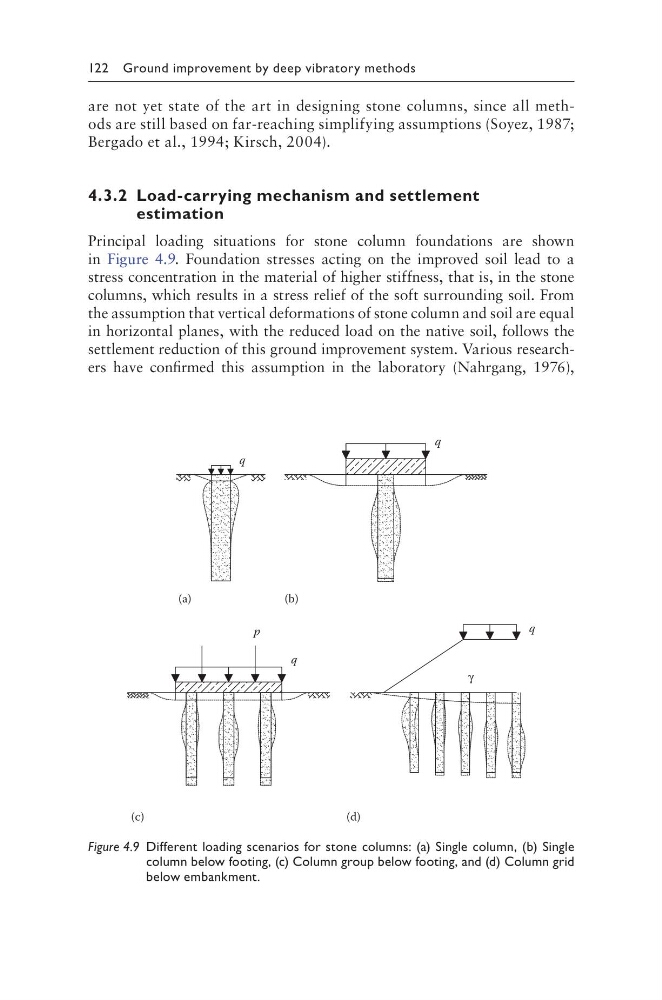
Principal loading situations for stone column foundations are shown
in Figure 4.9. Foundation stresses acting on the improved soil lead to a
stress concentration in the material of higher stiffness, that is, in the stone
columns, which results in a stress relief of the soft surrounding soil. From
the assumption that vertical deformations of stone column and soil are equal
in horizontal planes, with the reduced load on the native soil, follows the
settlement reduction of this ground improvement system. Various researchers have confirmed this assumption in the laboratory (Nahrgang, 1976),
(b)
(a)
q
q
(c)
(d)
q
q
γ
p
Figure 4.9 Different loading scenarios for stone columns: (a) Single column, (b) Single
column below footing, (c) Column group below footing, and (d) Column grid
below embankment.
are not yet state of the art in designing stone columns, since all methods are still based on far-reaching simplifying assumptions (Soyez, 1987;
Bergado et al., 1994; Kirsch, 2004).
4.3.2 Load-carrying mechanism and settlement
estimation
Principal loading situations for stone column foundations are shown
in Figure 4.9. Foundation stresses acting on the improved soil lead to a
stress concentration in the material of higher stiffness, that is, in the stone
columns, which results in a stress relief of the soft surrounding soil. From
the assumption that vertical deformations of stone column and soil are equal
in horizontal planes, with the reduced load on the native soil, follows the
settlement reduction of this ground improvement system. Various researchers have confirmed this assumption in the laboratory (Nahrgang, 1976),
(b)
(a)
q
q
(c)
(d)
q
q
γ
p
Figure 4.9 Different loading scenarios for stone columns: (a) Single column, (b) Single
column below footing, (c) Column group below footing, and (d) Column grid
below embankment.