

Improvement of fine-grained and cohesive soils 121
half space or introduce empirical parameters into their design concept. A more
recent group of methods develops design diagrams that are based on numerical
calculations.
Most design methods deal with the isolated column or the infinite grid
of vibro stone columns. Almost all methods apply the principle of the circular unit cell (Figure 4.8). Only a few methods consider the behavior of
column groups.
Settlement reduction is of particular practical importance for the design
of vibro stone columns, where the allowable bearing pressure needs to be
secured in a separate step by also determining the ultimate bearing capacity of the system. In addition, consolidation time or the reduction of the
liquefaction potential may also have to be determined.
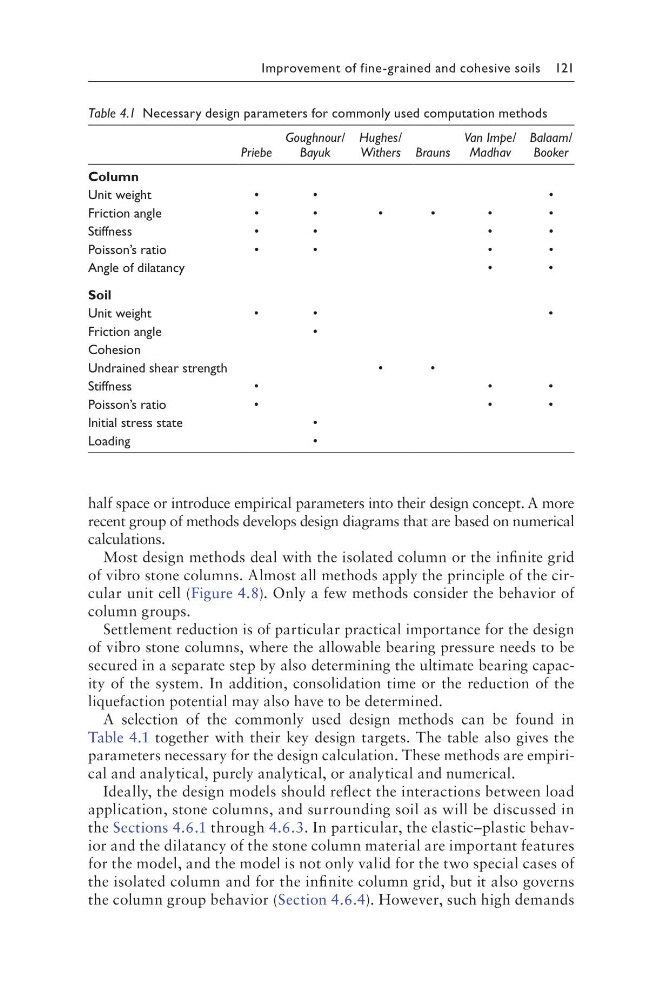
A selection of the commonly used design methods can be found in
Table 4.1 together with their key design targets. The table also gives the
parameters necessary for the design calculation. These methods are empirical and analytical, purely analytical, or analytical and numerical.
Ideally, the design models should reflect the interactions between load
application, stone columns, and surrounding soil as will be discussed in
the Sections 4.6.1 through 4.6.3. In particular, the elastic–plastic behavior and the dilatancy of the stone column material are important features
for the model, and the model is not only valid for the two special cases of
the isolated column and for the infinite column grid, but it also governs
the column group behavior (Section 4.6.4). However, such high demands
Table 4.1 Necessary design parameters for commonly used computation methods
Priebe
Goughnour/
Bayuk
Hughes/
Withers Brauns
Van Impe/
Madhav
Balaam/
Booker
Column
Unit weight
•
•
•
Friction angle
•
•
•
•
•
•
Stiffness
•
•
•
•
Poisson’s ratio
•
•
•
•
Angle of dilatancy
•
•
Soil
Unit weight
•
•
•
Friction angle
•
Cohesion
Undrained shear strength
•
•
Stiffness
•
•
•
Poisson’s ratio
•
•
•
Initial stress state
•
Loading
•
half space or introduce empirical parameters into their design concept. A more
recent group of methods develops design diagrams that are based on numerical
calculations.
Most design methods deal with the isolated column or the infinite grid
of vibro stone columns. Almost all methods apply the principle of the circular unit cell (Figure 4.8). Only a few methods consider the behavior of
column groups.
Settlement reduction is of particular practical importance for the design
of vibro stone columns, where the allowable bearing pressure needs to be
secured in a separate step by also determining the ultimate bearing capacity of the system. In addition, consolidation time or the reduction of the
liquefaction potential may also have to be determined.
A selection of the commonly used design methods can be found in
Table 4.1 together with their key design targets. The table also gives the
parameters necessary for the design calculation. These methods are empirical and analytical, purely analytical, or analytical and numerical.
Ideally, the design models should reflect the interactions between load
application, stone columns, and surrounding soil as will be discussed in
the Sections 4.6.1 through 4.6.3. In particular, the elastic–plastic behavior and the dilatancy of the stone column material are important features
for the model, and the model is not only valid for the two special cases of
the isolated column and for the infinite column grid, but it also governs
the column group behavior (Section 4.6.4). However, such high demands
Table 4.1 Necessary design parameters for commonly used computation methods
Priebe
Goughnour/
Bayuk
Hughes/
Withers Brauns
Van Impe/
Madhav
Balaam/
Booker
Column
Unit weight
•
•
•
Friction angle
•
•
•
•
•
•
Stiffness
•
•
•
•
Poisson’s ratio
•
•
•
•
Angle of dilatancy
•
•
Soil
Unit weight
•
•
•
Friction angle
•
Cohesion
Undrained shear strength
•
•
Stiffness
•
•
•
Poisson’s ratio
•
•
•
Initial stress state
•
Loading
•