

90 Ground improvement by deep vibratory methods
less than 10% and its clay content below 2%. The mean grain size D 50 was
0.1–0.5 mm with a maximum grain size of 10 mm.
The following describes the details of field trials using twin Keller
S700 vibrators with characteristics according to Table 3.1. The total weight
of the 32.1-m long set-up, consisting of a tandem beam, 500 kN pulley
head, extension tubes, water and power inlets and vibrators, was 31.1 tons.
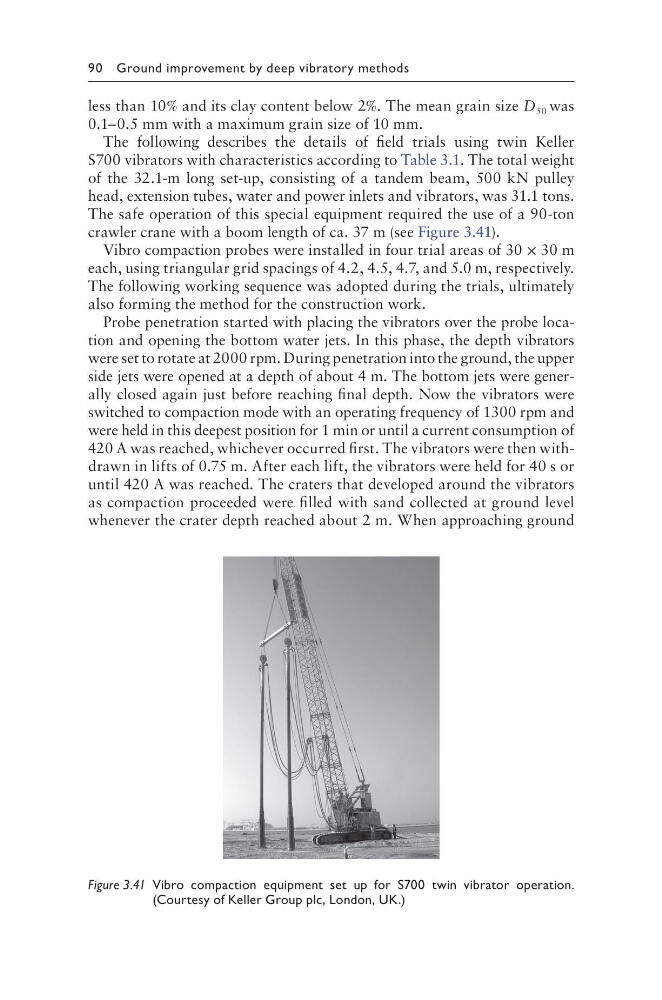
The safe operation of this special equipment required the use of a 90-ton
crawler crane with a boom length of ca. 37 m (see Figure 3.41).
Vibro compaction probes were installed in four trial areas of 30 × 30 m
each, using triangular grid spacings of 4.2, 4.5, 4.7, and 5.0 m, respectively.
The following working sequence was adopted during the trials, ultimately
also forming the method for the construction work.
Probe penetration started with placing the vibrators over the probe location and opening the bottom water jets. In this phase, the depth vibrators
were set to rotate at 2000 rpm. During penetration into the ground, the upper
side jets were opened at a depth of about 4 m. The bottom jets were generally closed again just before reaching final depth. Now the vibrators were
switched to compaction mode with an operating frequency of 1300 rpm and
were held in this deepest position for 1 min or until a current consumption of
420 A was reached, whichever occurred first. The vibrators were then withdrawn in lifts of 0.75 m. After each lift, the vibrators were held for 40 s or
until 420 A was reached. The craters that developed around the vibrators
as compaction proceeded were filled with sand collected at ground level
whenever the crater depth reached about 2 m. When approaching ground
Figure 3.41 Vibro compaction equipment set up for S700 twin vibrator operation.
(Courtesy of Keller Group plc, London, UK.)
less than 10% and its clay content below 2%. The mean grain size D 50 was
0.1–0.5 mm with a maximum grain size of 10 mm.
The following describes the details of field trials using twin Keller
S700 vibrators with characteristics according to Table 3.1. The total weight
of the 32.1-m long set-up, consisting of a tandem beam, 500 kN pulley
head, extension tubes, water and power inlets and vibrators, was 31.1 tons.
The safe operation of this special equipment required the use of a 90-ton
crawler crane with a boom length of ca. 37 m (see Figure 3.41).
Vibro compaction probes were installed in four trial areas of 30 × 30 m
each, using triangular grid spacings of 4.2, 4.5, 4.7, and 5.0 m, respectively.
The following working sequence was adopted during the trials, ultimately
also forming the method for the construction work.
Probe penetration started with placing the vibrators over the probe location and opening the bottom water jets. In this phase, the depth vibrators
were set to rotate at 2000 rpm. During penetration into the ground, the upper
side jets were opened at a depth of about 4 m. The bottom jets were generally closed again just before reaching final depth. Now the vibrators were
switched to compaction mode with an operating frequency of 1300 rpm and
were held in this deepest position for 1 min or until a current consumption of
420 A was reached, whichever occurred first. The vibrators were then withdrawn in lifts of 0.75 m. After each lift, the vibrators were held for 40 s or
until 420 A was reached. The craters that developed around the vibrators
as compaction proceeded were filled with sand collected at ground level
whenever the crater depth reached about 2 m. When approaching ground
Figure 3.41 Vibro compaction equipment set up for S700 twin vibrator operation.
(Courtesy of Keller Group plc, London, UK.)