

73
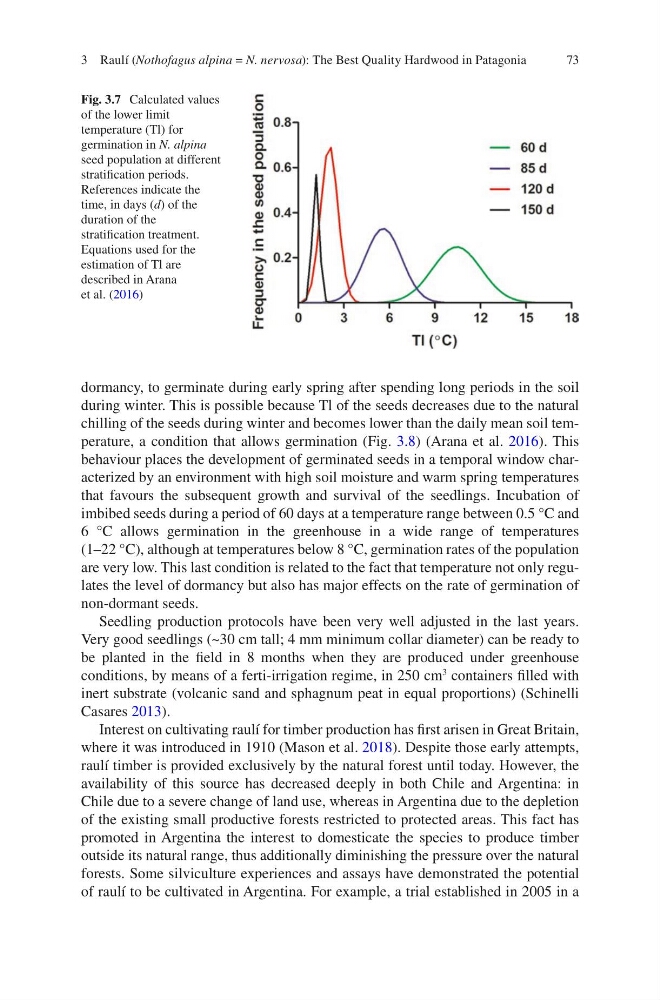
dormancy, to germinate during early spring after spending long periods in the soil
during winter. This is possible because Tl of the seeds decreases due to the natural
chilling of the seeds during winter and becomes lower than the daily mean soil temperature, a condition that allows germination (Fig. 3.8) (Arana et al. 2016). This
behaviour places the development of germinated seeds in a temporal window characterized by an environment with high soil moisture and warm spring temperatures
that favours the subsequent growth and survival of the seedlings. Incubation of
imbibed seeds during a period of 60 days at a temperature range between 0.5 °C and
6 °C allows germination in the greenhouse in a wide range of temperatures
(1–22 °C), although at temperatures below 8 °C, germination rates of the population
are very low. This last condition is related to the fact that temperature not only regulates the level of dormancy but also has major effects on the rate of germination of
non-dormant seeds.
Seedling production protocols have been very well adjusted in the last years.
Very good seedlings (~30 cm tall; 4 mm minimum collar diameter) can be ready to
be planted in the field in 8 months when they are produced under greenhouse
conditions, by means of a ferti-irrigation regime, in 250 cm
3
containers filled with
inert substrate (volcanic sand and sphagnum peat in equal proportions) (Schinelli
Casares 2013).
Interest on cultivating raulí for timber production has first arisen in Great Britain,
where it was introduced in 1910 (Mason et al. 2018). Despite those early attempts,
raulí timber is provided exclusively by the natural forest until today. However, the
availability of this source has decreased deeply in both Chile and Argentina: in
Chile due to a severe change of land use, whereas in Argentina due to the depletion
of the existing small productive forests restricted to protected areas. This fact has
promoted in Argentina the interest to domesticate the species to produce timber
outside its natural range, thus additionally diminishing the pressure over the natural
forests. Some silviculture experiences and assays have demonstrated the potential
of raulí to be cultivated in Argentina. For example, a trial established in 2005 in a
Fig. 3.7 Calculated values
of the lower limit
temperature (Tl) for
germination in N. alpina
seed population at different
stratification periods.
References indicate the
time, in days (d) of the
duration of the
stratification treatment.
Equations used for the
estimation of Tl are
described in Arana
et al. (2016)
3 Raulí (Nothofagus alpina = N. nervosa): The Best Quality Hardwood in Patagonia
dormancy, to germinate during early spring after spending long periods in the soil
during winter. This is possible because Tl of the seeds decreases due to the natural
chilling of the seeds during winter and becomes lower than the daily mean soil temperature, a condition that allows germination (Fig. 3.8) (Arana et al. 2016). This
behaviour places the development of germinated seeds in a temporal window characterized by an environment with high soil moisture and warm spring temperatures
that favours the subsequent growth and survival of the seedlings. Incubation of
imbibed seeds during a period of 60 days at a temperature range between 0.5 °C and
6 °C allows germination in the greenhouse in a wide range of temperatures
(1–22 °C), although at temperatures below 8 °C, germination rates of the population
are very low. This last condition is related to the fact that temperature not only regulates the level of dormancy but also has major effects on the rate of germination of
non-dormant seeds.
Seedling production protocols have been very well adjusted in the last years.
Very good seedlings (~30 cm tall; 4 mm minimum collar diameter) can be ready to
be planted in the field in 8 months when they are produced under greenhouse
conditions, by means of a ferti-irrigation regime, in 250 cm
3
containers filled with
inert substrate (volcanic sand and sphagnum peat in equal proportions) (Schinelli
Casares 2013).
Interest on cultivating raulí for timber production has first arisen in Great Britain,
where it was introduced in 1910 (Mason et al. 2018). Despite those early attempts,
raulí timber is provided exclusively by the natural forest until today. However, the
availability of this source has decreased deeply in both Chile and Argentina: in
Chile due to a severe change of land use, whereas in Argentina due to the depletion
of the existing small productive forests restricted to protected areas. This fact has
promoted in Argentina the interest to domesticate the species to produce timber
outside its natural range, thus additionally diminishing the pressure over the natural
forests. Some silviculture experiences and assays have demonstrated the potential
of raulí to be cultivated in Argentina. For example, a trial established in 2005 in a
Fig. 3.7 Calculated values
of the lower limit
temperature (Tl) for
germination in N. alpina
seed population at different
stratification periods.
References indicate the
time, in days (d) of the
duration of the
stratification treatment.
Equations used for the
estimation of Tl are
described in Arana
et al. (2016)
3 Raulí (Nothofagus alpina = N. nervosa): The Best Quality Hardwood in Patagonia