

72
of thermal time (degree days or hours) is required to be “accumulated” to complete
a given phenological stage (i.e. germination) (Garcia-Huidobro et al. 1982). Through
this approach, it is possible to predict the moment of germination in a complex
thermal environment (Batlla and Benech-Arnold 2003). The mathematical model
that best fitted with N. alpina seed behaviour in relation with environmental temperature establishes that the thermal time needed to complete germination is accumulated above a base temperature (Tb) when the environmental temperature is
higher than a lower temperature threshold (Tl). Therefore, Tl is the minimum limit
temperature permissive for germination (Arana et al. 2016). Experiments under
controlled conditions show that warm temperatures, in the range between 22 and
15 °C, promote the germination of a large proportion (more than 75%) of N. alpina
freshly harvested seeds. However, just a small fraction of the population (less than
1%) is able to germinate at 12 °C. Therefore, N. alpina seeds express dormancy at
low temperatures (Arana et al. 2016).
The exposure of the seeds to a treatment of cold stratification, this means the
incubation of imbibed seeds in a range between 0.5 °C and 6 °C, alleviates the
degree of dormancy. The decrease of dormancy with the cold stratification is evident
up to 100 days of treatment. After this period, the mean lower limit temperature for
germination remains constant in the range between 1.5 °C and 4 °C (Fig. 3.7). From
an ecological point of view, the alleviation of dormancy by low temperatures allows
N. alpina seeds, which are dispersed during fall with relatively high levels of
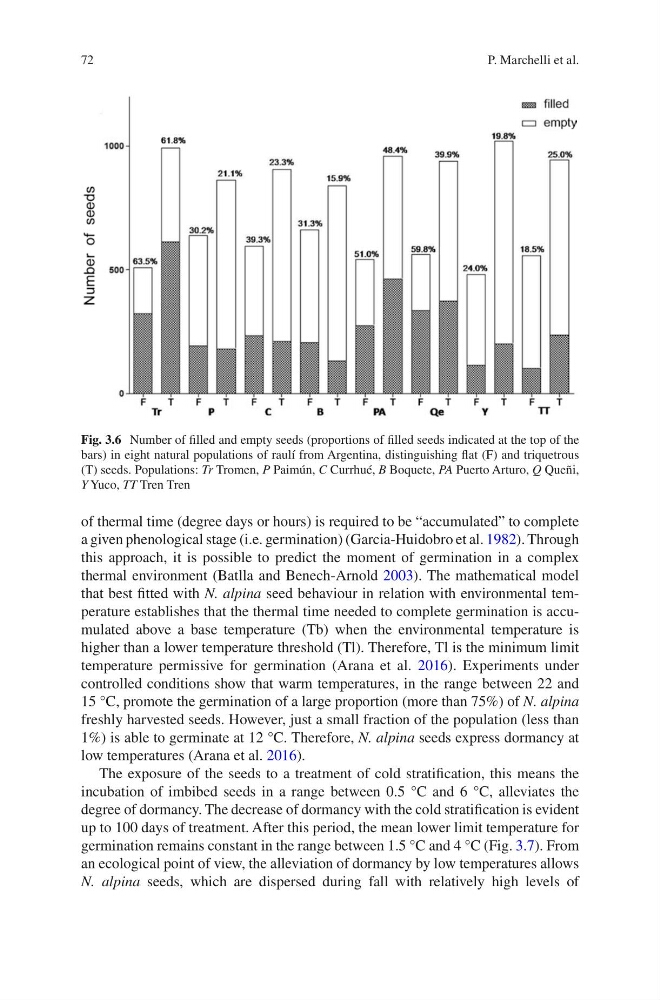
Fig. 3.6 Number of filled and empty seeds (proportions of filled seeds indicated at the top of the
bars) in eight natural populations of raulí from Argentina, distinguishing flat (F) and triquetrous
(T) seeds. Populations: Tr Tromen, P Paimún, C Currhué, B Boquete, PA Puerto Arturo, Q Queñi,
Y Yuco, TT Tren Tren
P. Marchelli et al.
of thermal time (degree days or hours) is required to be “accumulated” to complete
a given phenological stage (i.e. germination) (Garcia-Huidobro et al. 1982). Through
this approach, it is possible to predict the moment of germination in a complex
thermal environment (Batlla and Benech-Arnold 2003). The mathematical model
that best fitted with N. alpina seed behaviour in relation with environmental temperature establishes that the thermal time needed to complete germination is accumulated above a base temperature (Tb) when the environmental temperature is
higher than a lower temperature threshold (Tl). Therefore, Tl is the minimum limit
temperature permissive for germination (Arana et al. 2016). Experiments under
controlled conditions show that warm temperatures, in the range between 22 and
15 °C, promote the germination of a large proportion (more than 75%) of N. alpina
freshly harvested seeds. However, just a small fraction of the population (less than
1%) is able to germinate at 12 °C. Therefore, N. alpina seeds express dormancy at
low temperatures (Arana et al. 2016).
The exposure of the seeds to a treatment of cold stratification, this means the
incubation of imbibed seeds in a range between 0.5 °C and 6 °C, alleviates the
degree of dormancy. The decrease of dormancy with the cold stratification is evident
up to 100 days of treatment. After this period, the mean lower limit temperature for
germination remains constant in the range between 1.5 °C and 4 °C (Fig. 3.7). From
an ecological point of view, the alleviation of dormancy by low temperatures allows
N. alpina seeds, which are dispersed during fall with relatively high levels of
Fig. 3.6 Number of filled and empty seeds (proportions of filled seeds indicated at the top of the
bars) in eight natural populations of raulí from Argentina, distinguishing flat (F) and triquetrous
(T) seeds. Populations: Tr Tromen, P Paimún, C Currhué, B Boquete, PA Puerto Arturo, Q Queñi,
Y Yuco, TT Tren Tren
P. Marchelli et al.