

431
transferability as well as the clearness of resolution patterns and polymorphism levels was assessed on a sample of eight individuals randomly chosen, testing different
polymerase chain reaction (PCR) conditions. Finally, ten polymorphic markers
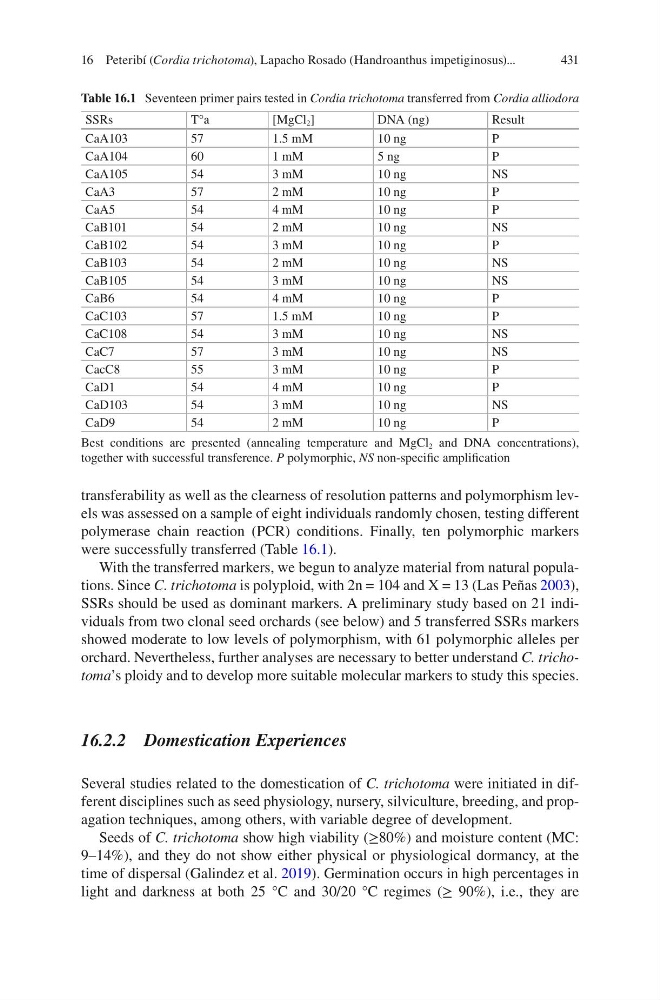
were successfully transferred (Table 16.1).
With the transferred markers, we begun to analyze material from natural populations. Since C. trichotoma is polyploid, with 2n = 104 and X = 13 (Las Peñas 2003),
SSRs should be used as dominant markers. A preliminary study based on 21 individuals from two clonal seed orchards (see below) and 5 transferred SSRs markers
showed moderate to low levels of polymorphism, with 61 polymorphic alleles per
orchard. Nevertheless, further analyses are necessary to better understand C. trichotoma’s ploidy and to develop more suitable molecular markers to study this species.
16.2.2 Domestication Experiences
Several studies related to the domestication of C. trichotoma were initiated in different disciplines such as seed physiology, nursery, silviculture, breeding, and propagation techniques, among others, with variable degree of development.
Seeds of C. trichotoma show high viability (≥80%) and moisture content (MC:
9–14%), and they do not show either physical or physiological dormancy, at the
time of dispersal (Galindez et al. 2019). Germination occurs in high percentages in
light and darkness at both 25 °C and 30/20 °C regimes (≥ 90%), i.e., they are
Table 16.1 Seventeen primer pairs tested in Cordia trichotoma transferred from Cordia alliodora
SSRs
T°a
[MgCl 2 ]
DNA (ng)
Result
CaA103
57
1.5 mM
10 ng
P
CaA104
60
1 mM
5 ng
P
CaA105
54
3 mM
10 ng
NS
CaA3
57
2 mM
10 ng
P
CaA5
54
4 mM
10 ng
P
CaB101
54
2 mM
10 ng
NS
CaB102
54
3 mM
10 ng
P
CaB103
54
2 mM
10 ng
NS
CaB105
54
3 mM
10 ng
NS
CaB6
54
4 mM
10 ng
P
CaC103
57
1.5 mM
10 ng
P
CaC108
54
3 mM
10 ng
NS
CaC7
57
3 mM
10 ng
NS
CacC8
55
3 mM
10 ng
P
CaD1
54
4 mM
10 ng
P
CaD103
54
3 mM
10 ng
NS
CaD9
54
2 mM
10 ng
P
Best conditions are presented (annealing temperature and MgCl 2 and DNA concentrations),
together with successful transference. P polymorphic, NS non-specific amplification
16 Peteribí (Cordia trichotoma), Lapacho Rosado (Handroanthus impetiginosus)...
transferability as well as the clearness of resolution patterns and polymorphism levels was assessed on a sample of eight individuals randomly chosen, testing different
polymerase chain reaction (PCR) conditions. Finally, ten polymorphic markers
were successfully transferred (Table 16.1).
With the transferred markers, we begun to analyze material from natural populations. Since C. trichotoma is polyploid, with 2n = 104 and X = 13 (Las Peñas 2003),
SSRs should be used as dominant markers. A preliminary study based on 21 individuals from two clonal seed orchards (see below) and 5 transferred SSRs markers
showed moderate to low levels of polymorphism, with 61 polymorphic alleles per
orchard. Nevertheless, further analyses are necessary to better understand C. trichotoma’s ploidy and to develop more suitable molecular markers to study this species.
16.2.2 Domestication Experiences
Several studies related to the domestication of C. trichotoma were initiated in different disciplines such as seed physiology, nursery, silviculture, breeding, and propagation techniques, among others, with variable degree of development.
Seeds of C. trichotoma show high viability (≥80%) and moisture content (MC:
9–14%), and they do not show either physical or physiological dormancy, at the
time of dispersal (Galindez et al. 2019). Germination occurs in high percentages in
light and darkness at both 25 °C and 30/20 °C regimes (≥ 90%), i.e., they are
Table 16.1 Seventeen primer pairs tested in Cordia trichotoma transferred from Cordia alliodora
SSRs
T°a
[MgCl 2 ]
DNA (ng)
Result
CaA103
57
1.5 mM
10 ng
P
CaA104
60
1 mM
5 ng
P
CaA105
54
3 mM
10 ng
NS
CaA3
57
2 mM
10 ng
P
CaA5
54
4 mM
10 ng
P
CaB101
54
2 mM
10 ng
NS
CaB102
54
3 mM
10 ng
P
CaB103
54
2 mM
10 ng
NS
CaB105
54
3 mM
10 ng
NS
CaB6
54
4 mM
10 ng
P
CaC103
57
1.5 mM
10 ng
P
CaC108
54
3 mM
10 ng
NS
CaC7
57
3 mM
10 ng
NS
CacC8
55
3 mM
10 ng
P
CaD1
54
4 mM
10 ng
P
CaD103
54
3 mM
10 ng
NS
CaD9
54
2 mM
10 ng
P
Best conditions are presented (annealing temperature and MgCl 2 and DNA concentrations),
together with successful transference. P polymorphic, NS non-specific amplification
16 Peteribí (Cordia trichotoma), Lapacho Rosado (Handroanthus impetiginosus)...