

403
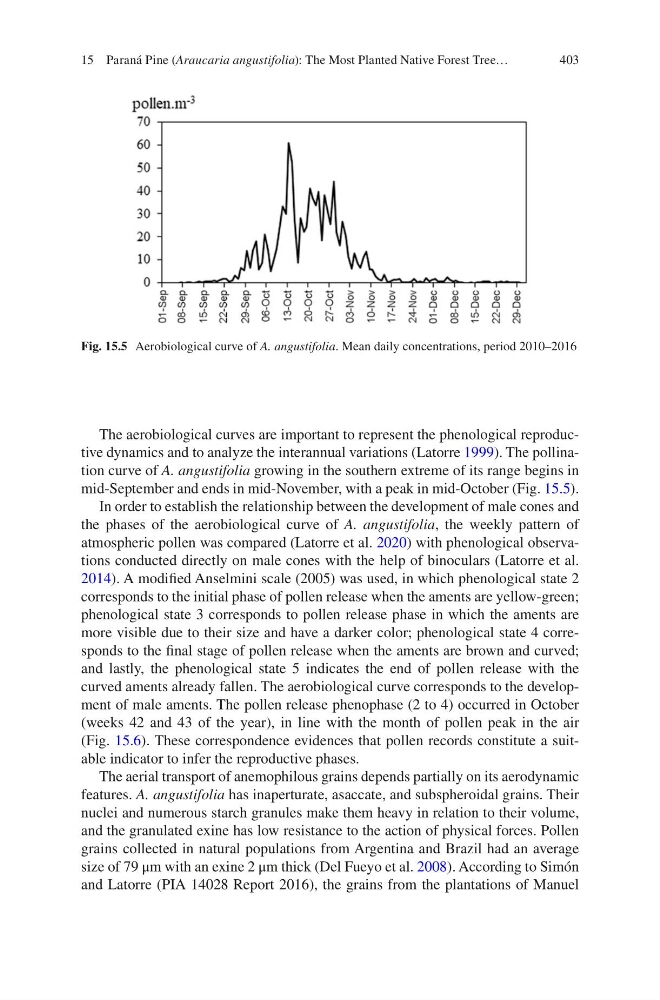
The aerobiological curves are important to represent the phenological reproductive dynamics and to analyze the interannual variations (Latorre 1999). The pollination curve of A. angustifolia growing in the southern extreme of its range begins in
mid-September and ends in mid-November, with a peak in mid-October (Fig. 15.5).
In order to establish the relationship between the development of male cones and
the phases of the aerobiological curve of A. angustifolia, the weekly pattern of
atmospheric pollen was compared (Latorre et al. 2020) with phenological observations conducted directly on male cones with the help of binoculars (Latorre et al.
2014). A modified Anselmini scale (2005) was used, in which phenological state 2
corresponds to the initial phase of pollen release when the aments are yellow-green;
phenological state 3 corresponds to pollen release phase in which the aments are
more visible due to their size and have a darker color; phenological state 4 corresponds to the final stage of pollen release when the aments are brown and curved;
and lastly, the phenological state 5 indicates the end of pollen release with the
curved aments already fallen. The aerobiological curve corresponds to the development of male aments. The pollen release phenophase (2 to 4) occurred in October
(weeks 42 and 43 of the year), in line with the month of pollen peak in the air
(Fig. 15.6). These correspondence evidences that pollen records constitute a suitable indicator to infer the reproductive phases.
The aerial transport of anemophilous grains depends partially on its aerodynamic
features. A. angustifolia has inaperturate, asaccate, and subspheroidal grains. Their
nuclei and numerous starch granules make them heavy in relation to their volume,
and the granulated exine has low resistance to the action of physical forces. Pollen
grains collected in natural populations from Argentina and Brazil had an average
size of 79 μm with an exine 2 μm thick (Del Fueyo et al. 2008). According to Simón
and Latorre (PIA 14028 Report 2016), the grains from the plantations of Manuel
Fig. 15.5 Aerobiological curve of A. angustifolia. Mean daily concentrations, period 2010–2016
15 Paraná Pine (Araucaria angustifolia): The Most Planted Native Forest Tree…
The aerobiological curves are important to represent the phenological reproductive dynamics and to analyze the interannual variations (Latorre 1999). The pollination curve of A. angustifolia growing in the southern extreme of its range begins in
mid-September and ends in mid-November, with a peak in mid-October (Fig. 15.5).
In order to establish the relationship between the development of male cones and
the phases of the aerobiological curve of A. angustifolia, the weekly pattern of
atmospheric pollen was compared (Latorre et al. 2020) with phenological observations conducted directly on male cones with the help of binoculars (Latorre et al.
2014). A modified Anselmini scale (2005) was used, in which phenological state 2
corresponds to the initial phase of pollen release when the aments are yellow-green;
phenological state 3 corresponds to pollen release phase in which the aments are
more visible due to their size and have a darker color; phenological state 4 corresponds to the final stage of pollen release when the aments are brown and curved;
and lastly, the phenological state 5 indicates the end of pollen release with the
curved aments already fallen. The aerobiological curve corresponds to the development of male aments. The pollen release phenophase (2 to 4) occurred in October
(weeks 42 and 43 of the year), in line with the month of pollen peak in the air
(Fig. 15.6). These correspondence evidences that pollen records constitute a suitable indicator to infer the reproductive phases.
The aerial transport of anemophilous grains depends partially on its aerodynamic
features. A. angustifolia has inaperturate, asaccate, and subspheroidal grains. Their
nuclei and numerous starch granules make them heavy in relation to their volume,
and the granulated exine has low resistance to the action of physical forces. Pollen
grains collected in natural populations from Argentina and Brazil had an average
size of 79 μm with an exine 2 μm thick (Del Fueyo et al. 2008). According to Simón
and Latorre (PIA 14028 Report 2016), the grains from the plantations of Manuel
Fig. 15.5 Aerobiological curve of A. angustifolia. Mean daily concentrations, period 2010–2016
15 Paraná Pine (Araucaria angustifolia): The Most Planted Native Forest Tree…