

402
regimes (Pérez et al. 2016). One is located in Manuel Belgrano Forest Station,
within the natural range of the species, with a humid subtropical climate, and the
other in 25 de Mayo Forest Station of INTA (35°28′ 45″ S; 60° 7′ 44″ W; 60 m asl:
25 M), Province of Buenos Aires (more than 1000 km south of the natural range)
where the climate is temperate. The aerobiological indicators were measured during
3 years (period 2014–2016) with Tauber traps (Tauber 1965) placed under the tree
canopy (Latorre et al. 2016). The annual mean pollen productivity in 25 M doubled
that of Manuel Belgrano Forest Station (9440 and 5291 pollen grains m
−2
.year
−1
). In
addition, low temperatures prior to pollination were reported to boost pollen productivity (as in temperate zones) and/or that high winter temperatures influenced
negatively (as in subtropical zones), determining low pollen production. According
to Caccavari et al. (2000), minimum temperatures should not exceed 10 °C during
pollen grain formation and maturation, due to their negative impact.
Another phenological stage to consider is the development of the reproductive
structures that in A. angustifolia starts on the summer before the pollination
(Anselmini et al. 2006). Latorre et al. (2020) studied the species growing in Misiones
during seven reproductive periods and noticed some climatic particularities of the
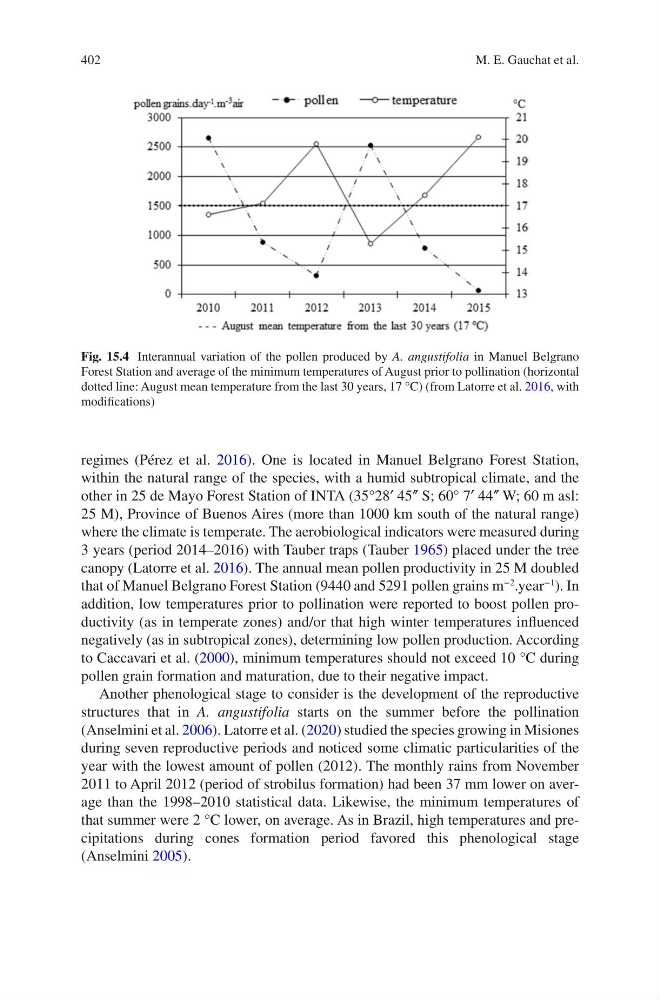
year with the lowest amount of pollen (2012). The monthly rains from November
2011 to April 2012 (period of strobilus formation) had been 37 mm lower on average than the 1998–2010 statistical data. Likewise, the minimum temperatures of
that summer were 2 °C lower, on average. As in Brazil, high temperatures and precipitations during cones formation period favored this phenological stage
(Anselmini 2005).
Fig. 15.4 Interannual variation of the pollen produced by A. angustifolia in Manuel Belgrano
Forest Station and average of the minimum temperatures of August prior to pollination (horizontal
dotted line: August mean temperature from the last 30 years, 17 °C) (from Latorre et al. 2016, with
modifications)
M. E. Gauchat et al.
regimes (Pérez et al. 2016). One is located in Manuel Belgrano Forest Station,
within the natural range of the species, with a humid subtropical climate, and the
other in 25 de Mayo Forest Station of INTA (35°28′ 45″ S; 60° 7′ 44″ W; 60 m asl:
25 M), Province of Buenos Aires (more than 1000 km south of the natural range)
where the climate is temperate. The aerobiological indicators were measured during
3 years (period 2014–2016) with Tauber traps (Tauber 1965) placed under the tree
canopy (Latorre et al. 2016). The annual mean pollen productivity in 25 M doubled
that of Manuel Belgrano Forest Station (9440 and 5291 pollen grains m
−2
.year
−1
). In
addition, low temperatures prior to pollination were reported to boost pollen productivity (as in temperate zones) and/or that high winter temperatures influenced
negatively (as in subtropical zones), determining low pollen production. According
to Caccavari et al. (2000), minimum temperatures should not exceed 10 °C during
pollen grain formation and maturation, due to their negative impact.
Another phenological stage to consider is the development of the reproductive
structures that in A. angustifolia starts on the summer before the pollination
(Anselmini et al. 2006). Latorre et al. (2020) studied the species growing in Misiones
during seven reproductive periods and noticed some climatic particularities of the
year with the lowest amount of pollen (2012). The monthly rains from November
2011 to April 2012 (period of strobilus formation) had been 37 mm lower on average than the 1998–2010 statistical data. Likewise, the minimum temperatures of
that summer were 2 °C lower, on average. As in Brazil, high temperatures and precipitations during cones formation period favored this phenological stage
(Anselmini 2005).
Fig. 15.4 Interannual variation of the pollen produced by A. angustifolia in Manuel Belgrano
Forest Station and average of the minimum temperatures of August prior to pollination (horizontal
dotted line: August mean temperature from the last 30 years, 17 °C) (from Latorre et al. 2016, with
modifications)
M. E. Gauchat et al.