

390
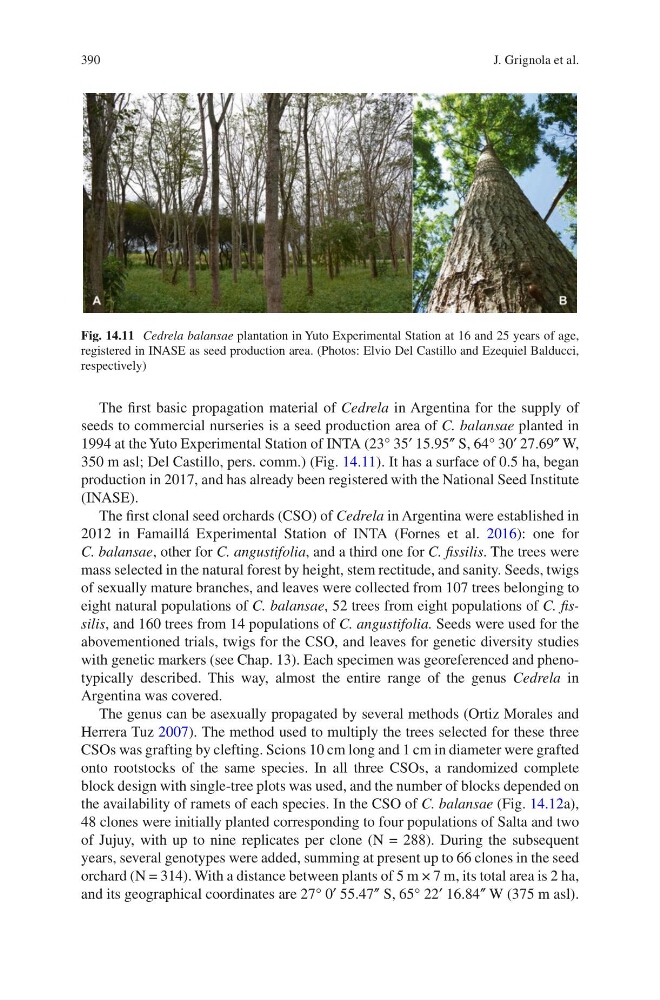
Fig. 14.11 Cedrela balansae plantation in Yuto Experimental Station at 16 and 25 years of age,
registered in INASE as seed production area. (Photos: Elvio Del Castillo and Ezequiel Balducci,
respectively)
The first basic propagation material of Cedrela in Argentina for the supply of
seeds to commercial nurseries is a seed production area of C. balansae planted in
1994 at the Yuto Experimental Station of INTA (23° 35′ 15.95″ S, 64° 30′ 27.69″ W,
350 m asl; Del Castillo, pers. comm.) (Fig. 14.11). It has a surface of 0.5 ha, began
production in 2017, and has already been registered with the National Seed Institute
(INASE).
The first clonal seed orchards (CSO) of Cedrela in Argentina were established in
2012 in Famaillá Experimental Station of INTA (Fornes et al. 2016): one for
C. balansae, other for C. angustifolia, and a third one for C. fissilis. The trees were
mass selected in the natural forest by height, stem rectitude, and sanity. Seeds, twigs
of sexually mature branches, and leaves were collected from 107 trees belonging to
eight natural populations of C. balansae, 52 trees from eight populations of C. fissilis, and 160 trees from 14 populations of C. angustifolia. Seeds were used for the
abovementioned trials, twigs for the CSO, and leaves for genetic diversity studies
with genetic markers (see Chap. 13). Each specimen was georeferenced and phenotypically described. This way, almost the entire range of the genus Cedrela in
Argentina was covered.
The genus can be asexually propagated by several methods (Ortiz Morales and
Herrera Tuz 2007). The method used to multiply the trees selected for these three
CSOs was grafting by clefting. Scions 10 cm long and 1 cm in diameter were grafted
onto rootstocks of the same species. In all three CSOs, a randomized complete
block design with single-tree plots was used, and the number of blocks depended on
the availability of ramets of each species. In the CSO of C. balansae (Fig. 14.12a),
48 clones were initially planted corresponding to four populations of Salta and two
of Jujuy, with up to nine replicates per clone (N = 288). During the subsequent
years, several genotypes were added, summing at present up to 66 clones in the seed
orchard (N = 314). With a distance between plants of 5 m × 7 m, its total area is 2 ha,
and its geographical coordinates are 27° 0′ 55.47″ S, 65° 22′ 16.84″ W (375 m asl).
J. Grignola et al.
Fig. 14.11 Cedrela balansae plantation in Yuto Experimental Station at 16 and 25 years of age,
registered in INASE as seed production area. (Photos: Elvio Del Castillo and Ezequiel Balducci,
respectively)
The first basic propagation material of Cedrela in Argentina for the supply of
seeds to commercial nurseries is a seed production area of C. balansae planted in
1994 at the Yuto Experimental Station of INTA (23° 35′ 15.95″ S, 64° 30′ 27.69″ W,
350 m asl; Del Castillo, pers. comm.) (Fig. 14.11). It has a surface of 0.5 ha, began
production in 2017, and has already been registered with the National Seed Institute
(INASE).
The first clonal seed orchards (CSO) of Cedrela in Argentina were established in
2012 in Famaillá Experimental Station of INTA (Fornes et al. 2016): one for
C. balansae, other for C. angustifolia, and a third one for C. fissilis. The trees were
mass selected in the natural forest by height, stem rectitude, and sanity. Seeds, twigs
of sexually mature branches, and leaves were collected from 107 trees belonging to
eight natural populations of C. balansae, 52 trees from eight populations of C. fissilis, and 160 trees from 14 populations of C. angustifolia. Seeds were used for the
abovementioned trials, twigs for the CSO, and leaves for genetic diversity studies
with genetic markers (see Chap. 13). Each specimen was georeferenced and phenotypically described. This way, almost the entire range of the genus Cedrela in
Argentina was covered.
The genus can be asexually propagated by several methods (Ortiz Morales and
Herrera Tuz 2007). The method used to multiply the trees selected for these three
CSOs was grafting by clefting. Scions 10 cm long and 1 cm in diameter were grafted
onto rootstocks of the same species. In all three CSOs, a randomized complete
block design with single-tree plots was used, and the number of blocks depended on
the availability of ramets of each species. In the CSO of C. balansae (Fig. 14.12a),
48 clones were initially planted corresponding to four populations of Salta and two
of Jujuy, with up to nine replicates per clone (N = 288). During the subsequent
years, several genotypes were added, summing at present up to 66 clones in the seed
orchard (N = 314). With a distance between plants of 5 m × 7 m, its total area is 2 ha,
and its geographical coordinates are 27° 0′ 55.47″ S, 65° 22′ 16.84″ W (375 m asl).
J. Grignola et al.