

391
In the CSO of C. angustifolia, 64 clones were initially planted, corresponding to
seven populations of Salta, three of Tucumán, and two of Jujuy, with five replicates
per clone (N = 320). Subsequent mortality reduced the number of clones to 44
(N = 85). The initial distance between plants was 4 m × 4 m, thus occupying an area
of 0.5 ha (27° 1′ 13.89″ S, 65° 22′ 53.66″ W, 375 m asl).
C. fissilis CSO initially had 42 clones from five populations of Misiones and
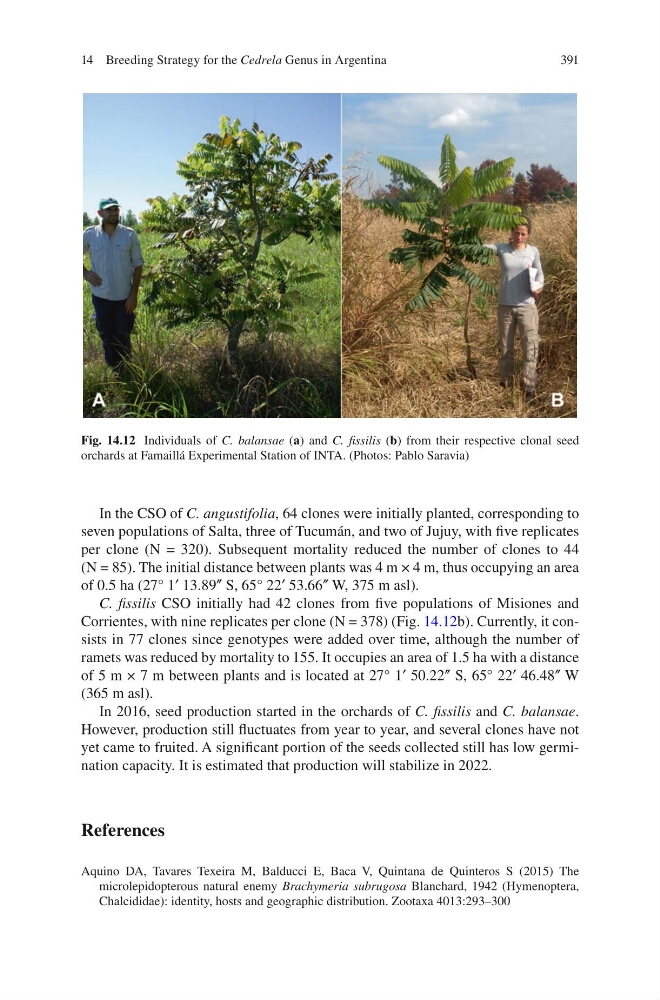
Corrientes, with nine replicates per clone (N = 378) (Fig. 14.12b). Currently, it consists in 77 clones since genotypes were added over time, although the number of
ramets was reduced by mortality to 155. It occupies an area of 1.5 ha with a distance
of 5 m × 7 m between plants and is located at 27° 1′ 50.22″ S, 65° 22′ 46.48″ W
(365 m asl).
In 2016, seed production started in the orchards of C. fissilis and C. balansae.
However, production still fluctuates from year to year, and several clones have not
yet came to fruited. A significant portion of the seeds collected still has low germination capacity. It is estimated that production will stabilize in 2022.
References
Aquino DA, Tavares Texeira M, Balducci E, Baca V, Quintana de Quinteros S (2015) The
microlepidopterous natural enemy Brachymeria subrugosa Blanchard, 1942 (Hymenoptera,
Chalcididae): identity, hosts and geographic distribution. Zootaxa 4013:293–300
Fig. 14.12 Individuals of C. balansae (a) and C. fissilis (b) from their respective clonal seed
orchards at Famaillá Experimental Station of INTA. (Photos: Pablo Saravia)
14 Breeding Strategy for the Cedrela Genus in Argentina
In the CSO of C. angustifolia, 64 clones were initially planted, corresponding to
seven populations of Salta, three of Tucumán, and two of Jujuy, with five replicates
per clone (N = 320). Subsequent mortality reduced the number of clones to 44
(N = 85). The initial distance between plants was 4 m × 4 m, thus occupying an area
of 0.5 ha (27° 1′ 13.89″ S, 65° 22′ 53.66″ W, 375 m asl).
C. fissilis CSO initially had 42 clones from five populations of Misiones and
Corrientes, with nine replicates per clone (N = 378) (Fig. 14.12b). Currently, it consists in 77 clones since genotypes were added over time, although the number of
ramets was reduced by mortality to 155. It occupies an area of 1.5 ha with a distance
of 5 m × 7 m between plants and is located at 27° 1′ 50.22″ S, 65° 22′ 46.48″ W
(365 m asl).
In 2016, seed production started in the orchards of C. fissilis and C. balansae.
However, production still fluctuates from year to year, and several clones have not
yet came to fruited. A significant portion of the seeds collected still has low germination capacity. It is estimated that production will stabilize in 2022.
References
Aquino DA, Tavares Texeira M, Balducci E, Baca V, Quintana de Quinteros S (2015) The
microlepidopterous natural enemy Brachymeria subrugosa Blanchard, 1942 (Hymenoptera,
Chalcididae): identity, hosts and geographic distribution. Zootaxa 4013:293–300
Fig. 14.12 Individuals of C. balansae (a) and C. fissilis (b) from their respective clonal seed
orchards at Famaillá Experimental Station of INTA. (Photos: Pablo Saravia)
14 Breeding Strategy for the Cedrela Genus in Argentina