

388
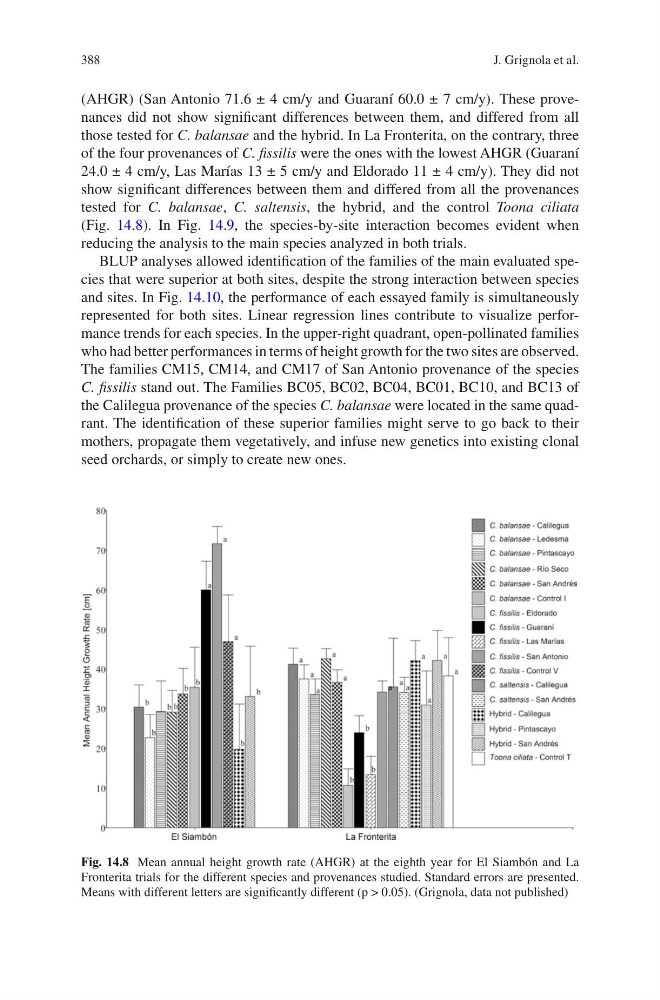
(AHGR) (San Antonio 71.6 ± 4 cm/y and Guaraní 60.0 ± 7 cm/y). These provenances did not show significant differences between them, and differed from all
those tested for C. balansae and the hybrid. In La Fronterita, on the contrary, three
of the four provenances of C. fissilis were the ones with the lowest AHGR (Guaraní
24.0 ± 4 cm/y, Las Marías 13 ± 5 cm/y and Eldorado 11 ± 4 cm/y). They did not
show significant differences between them and differed from all the provenances
tested for C. balansae, C. saltensis, the hybrid, and the control Toona ciliata
(Fig. 14.8). In Fig. 14.9, the species-by-site interaction becomes evident when
reducing the analysis to the main species analyzed in both trials.
BLUP analyses allowed identification of the families of the main evaluated species that were superior at both sites, despite the strong interaction between species
and sites. In Fig. 14.10, the performance of each essayed family is simultaneously
represented for both sites. Linear regression lines contribute to visualize performance trends for each species. In the upper-right quadrant, open-pollinated families
who had better performances in terms of height growth for the two sites are observed.
The families CM15, CM14, and CM17 of San Antonio provenance of the species
C. fissilis stand out. The Families BC05, BC02, BC04, BC01, BC10, and BC13 of
the Calilegua provenance of the species C. balansae were located in the same quadrant. The identification of these superior families might serve to go back to their
mothers, propagate them vegetatively, and infuse new genetics into existing clonal
seed orchards, or simply to create new ones.
Fig. 14.8 Mean annual height growth rate (AHGR) at the eighth year for El Siambón and La
Fronterita trials for the different species and provenances studied. Standard errors are presented.
Means with different letters are significantly different (p > 0.05). (Grignola, data not published)
J. Grignola et al.
(AHGR) (San Antonio 71.6 ± 4 cm/y and Guaraní 60.0 ± 7 cm/y). These provenances did not show significant differences between them, and differed from all
those tested for C. balansae and the hybrid. In La Fronterita, on the contrary, three
of the four provenances of C. fissilis were the ones with the lowest AHGR (Guaraní
24.0 ± 4 cm/y, Las Marías 13 ± 5 cm/y and Eldorado 11 ± 4 cm/y). They did not
show significant differences between them and differed from all the provenances
tested for C. balansae, C. saltensis, the hybrid, and the control Toona ciliata
(Fig. 14.8). In Fig. 14.9, the species-by-site interaction becomes evident when
reducing the analysis to the main species analyzed in both trials.
BLUP analyses allowed identification of the families of the main evaluated species that were superior at both sites, despite the strong interaction between species
and sites. In Fig. 14.10, the performance of each essayed family is simultaneously
represented for both sites. Linear regression lines contribute to visualize performance trends for each species. In the upper-right quadrant, open-pollinated families
who had better performances in terms of height growth for the two sites are observed.
The families CM15, CM14, and CM17 of San Antonio provenance of the species
C. fissilis stand out. The Families BC05, BC02, BC04, BC01, BC10, and BC13 of
the Calilegua provenance of the species C. balansae were located in the same quadrant. The identification of these superior families might serve to go back to their
mothers, propagate them vegetatively, and infuse new genetics into existing clonal
seed orchards, or simply to create new ones.
Fig. 14.8 Mean annual height growth rate (AHGR) at the eighth year for El Siambón and La
Fronterita trials for the different species and provenances studied. Standard errors are presented.
Means with different letters are significantly different (p > 0.05). (Grignola, data not published)
J. Grignola et al.