

387
with 8 repetitions in El Siambón. All trials were without coverage, with a distance
of 3 m × 3 m between plants. The number of provenances and families tested at each
site varied according to seedlings availability (Grignola 2014).
A strong mortality was observed at the third year (Grignola 2014), with greater
incidence in El Siambón, the site of highest altitude and lowest minimum temperatures. C. balansae, C. fissilis, and the hybrid did not differentiate, with survival
values between 20% and 32% depending on the trial. The highest survival rate in El
Siambón was for C. fissilis San Antonio provenance, with 43%. In La Moraleja (the
other altitudinal extreme), the highest survival rate was for C. balansae Ledesma
provenance, with 36%. The planting system without coverage was a determining
factor to explain this high mortality.
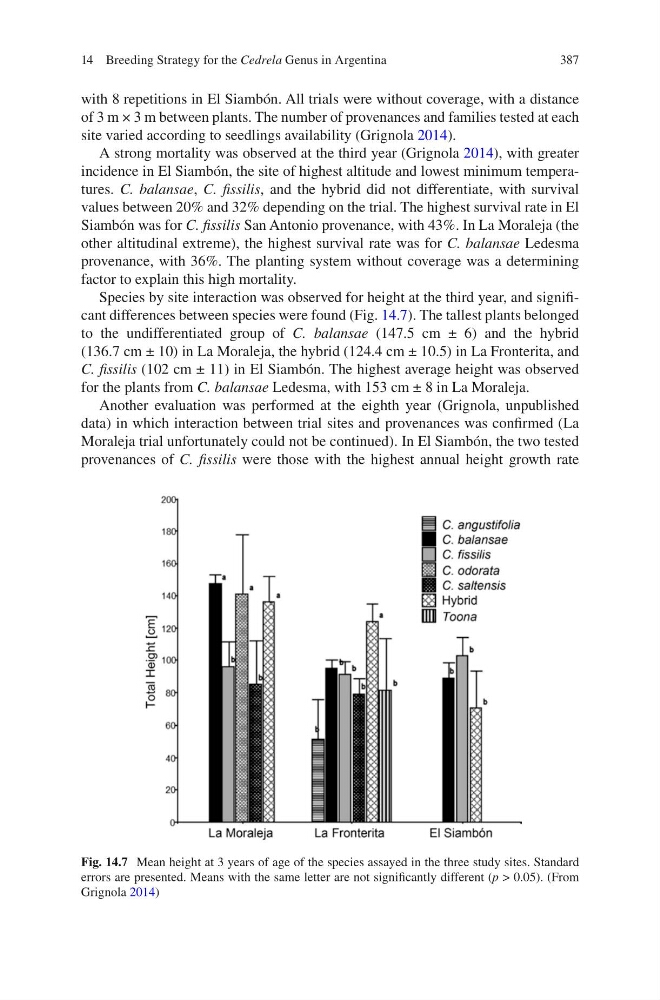
Species by site interaction was observed for height at the third year, and significant differences between species were found (Fig. 14.7). The tallest plants belonged
to the undifferentiated group of C. balansae (147.5 cm ± 6) and the hybrid
(136.7 cm ± 10) in La Moraleja, the hybrid (124.4 cm ± 10.5) in La Fronterita, and
C. fissilis (102 cm ± 11) in El Siambón. The highest average height was observed
for the plants from C. balansae Ledesma, with 153 cm ± 8 in La Moraleja.
Another evaluation was performed at the eighth year (Grignola, unpublished
data) in which interaction between trial sites and provenances was confirmed (La
Moraleja trial unfortunately could not be continued). In El Siambón, the two tested
provenances of C. fissilis were those with the highest annual height growth rate
Fig. 14.7 Mean height at 3 years of age of the species assayed in the three study sites. Standard
errors are presented. Means with the same letter are not significantly different (p > 0.05). (From
Grignola 2014)
14 Breeding Strategy for the Cedrela Genus in Argentina
with 8 repetitions in El Siambón. All trials were without coverage, with a distance
of 3 m × 3 m between plants. The number of provenances and families tested at each
site varied according to seedlings availability (Grignola 2014).
A strong mortality was observed at the third year (Grignola 2014), with greater
incidence in El Siambón, the site of highest altitude and lowest minimum temperatures. C. balansae, C. fissilis, and the hybrid did not differentiate, with survival
values between 20% and 32% depending on the trial. The highest survival rate in El
Siambón was for C. fissilis San Antonio provenance, with 43%. In La Moraleja (the
other altitudinal extreme), the highest survival rate was for C. balansae Ledesma
provenance, with 36%. The planting system without coverage was a determining
factor to explain this high mortality.
Species by site interaction was observed for height at the third year, and significant differences between species were found (Fig. 14.7). The tallest plants belonged
to the undifferentiated group of C. balansae (147.5 cm ± 6) and the hybrid
(136.7 cm ± 10) in La Moraleja, the hybrid (124.4 cm ± 10.5) in La Fronterita, and
C. fissilis (102 cm ± 11) in El Siambón. The highest average height was observed
for the plants from C. balansae Ledesma, with 153 cm ± 8 in La Moraleja.
Another evaluation was performed at the eighth year (Grignola, unpublished
data) in which interaction between trial sites and provenances was confirmed (La
Moraleja trial unfortunately could not be continued). In El Siambón, the two tested
provenances of C. fissilis were those with the highest annual height growth rate
Fig. 14.7 Mean height at 3 years of age of the species assayed in the three study sites. Standard
errors are presented. Means with the same letter are not significantly different (p > 0.05). (From
Grignola 2014)
14 Breeding Strategy for the Cedrela Genus in Argentina