

298
tle and goats, fruits and bark are rich in tannins, the flowers are useful in the perfume industry and also have importance for honey production, the seeds have
medicinal uses, and its wood has high density and durability (density 0.78 g/cm
3
),
which makes it appropriate to be used for floors, canes and charcoal production
(Pensiero and Gutiérrez 2005; Pometti et al. 2009).
Acacia visco Lor. ap. Griseb (syn. Senegalia visco, Seigler et al. 2006;
Parasenegalia visco (Lorentz ex Griseb.) Seigler & Ebinger) belongs to the subg.
Aculeiferum. It is native to Chile, Bolivia and Argentina, and it has been introduced
to Africa and naturalized in Europe. In this last continent, it was introduced as ornamental in roads, parks and gardens (Romero-Zarco and Tormo Molina 2016). In
Argentina it grows in the north-western provinces of Salta, Jujuy, Tucumán,
Catamarca, La Rioja, San Juan and San Luis (Fig. 11.1), where it is commonly
known as “viscote” or “arca”. It is used for ornamental purposes due to its abundant
and scented yellow flowers, and its wood is utilized in carpentry, bodywork and
parquet due to its hardness and durability (density 0.8 to 0.9 g/cm
3
), characteristics
for which it is also used for fence posts (Tortorelli 1956). The official statistics register for 2017 the commerce of 57 tonne of roundwood of this species and 15 tonne
of poles for rural fences (SGAyDS 2019). Methanol extracts of leaves and bark of
A. visco has been shown to have short- and long-term anti-inflammatory effects in
mice (Pedernera et al. 2007). Among the compounds identified from the leaves of
this 6 to 12 m tall tree, the triterpenoid lupeol, α-amyrin and β-amyrin may be
mainly responsible for the pharmacological activities (Pedernera et al. 2010).
Prosopis affinis Spreng., locally known as “ñandubay”, is a tree of 2.5 to 10 m in
height, 50 to 60 cm in diameter, and slow growth, native to Argentina, Brazil,
Uruguay and Paraguay (GBIF 2019). In Argentina, it is distributed in the northeastern part of the country (Fortunato et al. 2008) (Fig. 11.1) and defines a phytogeographic district of the Espinal ecoregion (Cabrera and Willink 1973). It differs
from other species of the genus by vegetative (flat topped tree, armed stems with
geminate spines, leaflets up to 2 mm long, opposite to imbricate, nerves of the hypophyllum prominent), floral (racemes mainly spiciform) and carpological traits
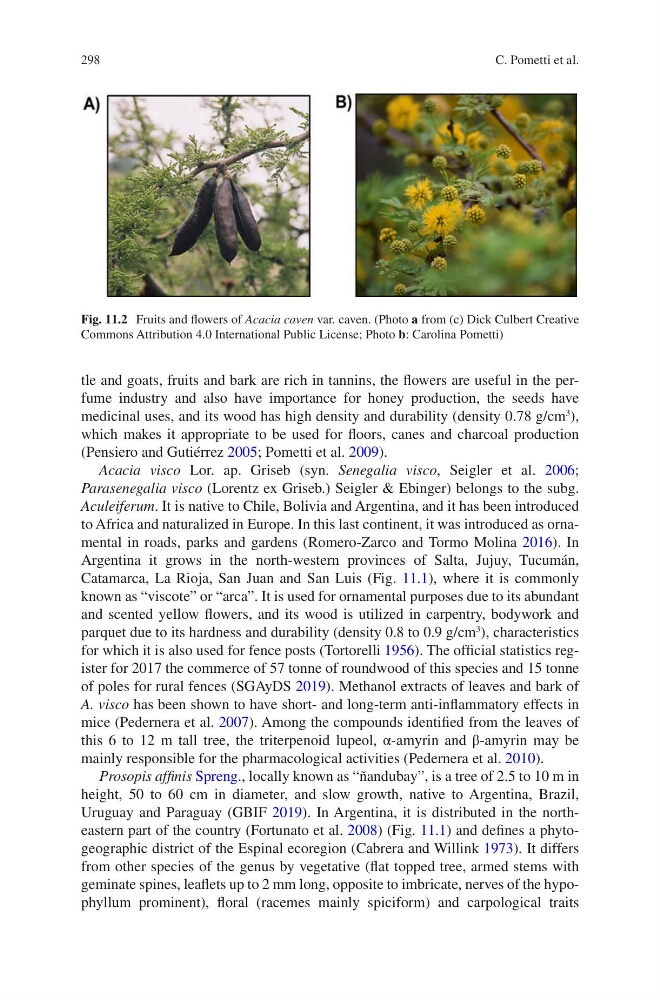
Fig. 11.2 Fruits and flowers of Acacia caven var. caven. (Photo a from (c) Dick Culbert Creative
Commons Attribution 4.0 International Public License; Photo b: Carolina Pometti)
C. Pometti et al.
tle and goats, fruits and bark are rich in tannins, the flowers are useful in the perfume industry and also have importance for honey production, the seeds have
medicinal uses, and its wood has high density and durability (density 0.78 g/cm
3
),
which makes it appropriate to be used for floors, canes and charcoal production
(Pensiero and Gutiérrez 2005; Pometti et al. 2009).
Acacia visco Lor. ap. Griseb (syn. Senegalia visco, Seigler et al. 2006;
Parasenegalia visco (Lorentz ex Griseb.) Seigler & Ebinger) belongs to the subg.
Aculeiferum. It is native to Chile, Bolivia and Argentina, and it has been introduced
to Africa and naturalized in Europe. In this last continent, it was introduced as ornamental in roads, parks and gardens (Romero-Zarco and Tormo Molina 2016). In
Argentina it grows in the north-western provinces of Salta, Jujuy, Tucumán,
Catamarca, La Rioja, San Juan and San Luis (Fig. 11.1), where it is commonly
known as “viscote” or “arca”. It is used for ornamental purposes due to its abundant
and scented yellow flowers, and its wood is utilized in carpentry, bodywork and
parquet due to its hardness and durability (density 0.8 to 0.9 g/cm
3
), characteristics
for which it is also used for fence posts (Tortorelli 1956). The official statistics register for 2017 the commerce of 57 tonne of roundwood of this species and 15 tonne
of poles for rural fences (SGAyDS 2019). Methanol extracts of leaves and bark of
A. visco has been shown to have short- and long-term anti-inflammatory effects in
mice (Pedernera et al. 2007). Among the compounds identified from the leaves of
this 6 to 12 m tall tree, the triterpenoid lupeol, α-amyrin and β-amyrin may be
mainly responsible for the pharmacological activities (Pedernera et al. 2010).
Prosopis affinis Spreng., locally known as “ñandubay”, is a tree of 2.5 to 10 m in
height, 50 to 60 cm in diameter, and slow growth, native to Argentina, Brazil,
Uruguay and Paraguay (GBIF 2019). In Argentina, it is distributed in the northeastern part of the country (Fortunato et al. 2008) (Fig. 11.1) and defines a phytogeographic district of the Espinal ecoregion (Cabrera and Willink 1973). It differs
from other species of the genus by vegetative (flat topped tree, armed stems with
geminate spines, leaflets up to 2 mm long, opposite to imbricate, nerves of the hypophyllum prominent), floral (racemes mainly spiciform) and carpological traits
Fig. 11.2 Fruits and flowers of Acacia caven var. caven. (Photo a from (c) Dick Culbert Creative
Commons Attribution 4.0 International Public License; Photo b: Carolina Pometti)
C. Pometti et al.