

299
(legume moniliform with margin undulate) (Palacios and Brizuela 2005). The ñandubay is a dominant species of the forest, since it determines its structure and functioning (SAyDS 2007). At the same time, it is an important resource for local
communities for its medicinal and chemical properties (i.e. dyes, tanning) and its
importance as a honey-bearing species. It has fruits (pods) of high nutritive value
and palatability that are used as fodder and food for humans, whereas its wood is
utilized in numerous applications, determining the possible use of the species in
silvopastoral and agroforestry systems (Roig 1993). P. affinis has significantly
decreased the size of its populations in Argentina due to deforestation and timber
overexploitation, especially in the easternmost part of its distribution, where it used
to be a widespread species and nowadays only remains as relict forests (SAyDS
2007; Matteucci 2012).
Prosopis caldenia L. is an endemic species from Argentina that characterizes the
phytogeographic district of the Espinal ecoregion known as the Caldenal (Fig. 11.1)
(Cabrera and Willink 1973), according to its common name: “caldén”. The present
state of this ecosystem is far from being a continuous forest. The current patches of
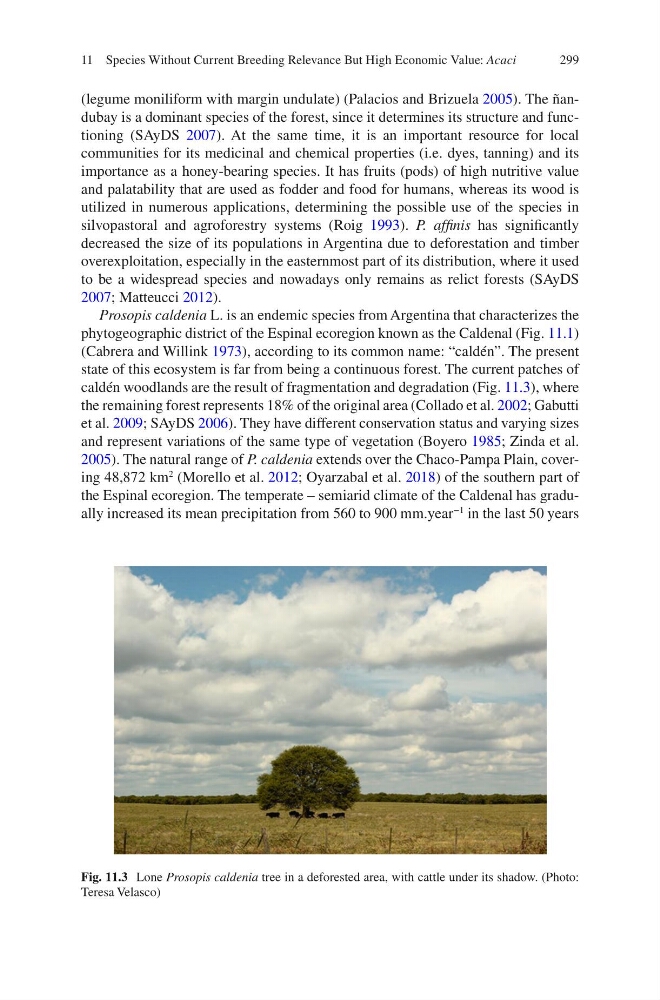
caldén woodlands are the result of fragmentation and degradation (Fig. 11.3), where
the remaining forest represents 18% of the original area (Collado et al. 2002; Gabutti
et al. 2009; SAyDS 2006). They have different conservation status and varying sizes
and represent variations of the same type of vegetation (Boyero 1985; Zinda et al.
2005). The natural range of P. caldenia extends over the Chaco-Pampa Plain, covering 48,872 km
2
(Morello et al. 2012; Oyarzabal et al. 2018) of the southern part of
the Espinal ecoregion. The temperate – semiarid climate of the Caldenal has gradually increased its mean precipitation from 560 to 900 mm.year
−1
in the last 50 years
Fig. 11.3 Lone Prosopis caldenia tree in a deforested area, with cattle under its shadow. (Photo:
Teresa Velasco)
11 Species Without Current Breeding Relevance But High Economic Value: Acaci
(legume moniliform with margin undulate) (Palacios and Brizuela 2005). The ñandubay is a dominant species of the forest, since it determines its structure and functioning (SAyDS 2007). At the same time, it is an important resource for local
communities for its medicinal and chemical properties (i.e. dyes, tanning) and its
importance as a honey-bearing species. It has fruits (pods) of high nutritive value
and palatability that are used as fodder and food for humans, whereas its wood is
utilized in numerous applications, determining the possible use of the species in
silvopastoral and agroforestry systems (Roig 1993). P. affinis has significantly
decreased the size of its populations in Argentina due to deforestation and timber
overexploitation, especially in the easternmost part of its distribution, where it used
to be a widespread species and nowadays only remains as relict forests (SAyDS
2007; Matteucci 2012).
Prosopis caldenia L. is an endemic species from Argentina that characterizes the
phytogeographic district of the Espinal ecoregion known as the Caldenal (Fig. 11.1)
(Cabrera and Willink 1973), according to its common name: “caldén”. The present
state of this ecosystem is far from being a continuous forest. The current patches of
caldén woodlands are the result of fragmentation and degradation (Fig. 11.3), where
the remaining forest represents 18% of the original area (Collado et al. 2002; Gabutti
et al. 2009; SAyDS 2006). They have different conservation status and varying sizes
and represent variations of the same type of vegetation (Boyero 1985; Zinda et al.
2005). The natural range of P. caldenia extends over the Chaco-Pampa Plain, covering 48,872 km
2
(Morello et al. 2012; Oyarzabal et al. 2018) of the southern part of
the Espinal ecoregion. The temperate – semiarid climate of the Caldenal has gradually increased its mean precipitation from 560 to 900 mm.year
−1
in the last 50 years
Fig. 11.3 Lone Prosopis caldenia tree in a deforested area, with cattle under its shadow. (Photo:
Teresa Velasco)
11 Species Without Current Breeding Relevance But High Economic Value: Acaci