

297
As in many Acacia species, their fruits have fodder aptitude. A common practice
in the north of Chile is to cut the branches to feed the cattle along the dry season,
meanwhile the remaining parts of the tree are used as fuel or to construct fences
(Karlin et al. 1997). Its wood is hard and heavy, being its density from 0.8 to 0.98 g/
cm
3
, providing material for charcoal, firewood and poles (Tortorelli 1956).
Acacia aroma Gillies ex Hook. & Arn. (syn. Vachellia aroma, Seigler and
Ebinger, 2006) also belongs to the subgenus Acacia and is distributed in Central and
Northern Argentina, Bolivia, Western Paraguay, Peru and Southern Ecuador
(Ebinger et al. 2000). This species grows as a tree or shrub 4–6 m in height, which
is not only ecologically but also economically important due to multiple uses and
functions. From an ecological point of view, it is a foundation species, and the roots
are good nitrogen fixers, what highlights the interest of the species to be used in
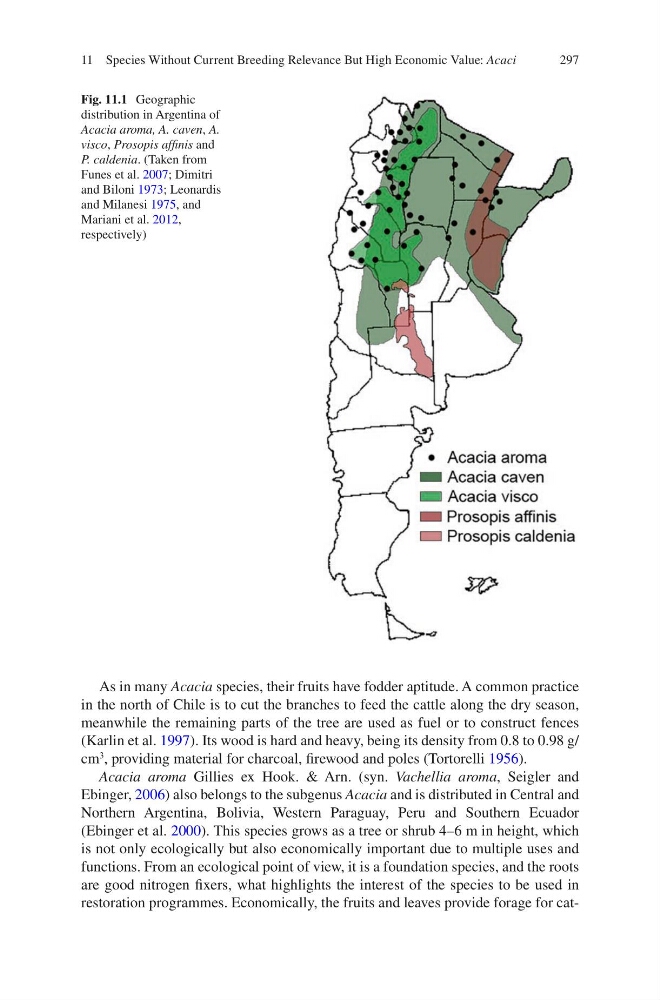
restoration programmes. Economically, the fruits and leaves provide forage for catFig. 11.1 Geographic
distribution in Argentina of
Acacia aroma, A. caven, A.
visco, Prosopis affinis and
P. caldenia. (Taken from
Funes et al. 2007; Dimitri
and Biloni 1973; Leonardis
and Milanesi 1975, and
Mariani et al. 2012,
respectively)
11 Species Without Current Breeding Relevance But High Economic Value: Acaci
As in many Acacia species, their fruits have fodder aptitude. A common practice
in the north of Chile is to cut the branches to feed the cattle along the dry season,
meanwhile the remaining parts of the tree are used as fuel or to construct fences
(Karlin et al. 1997). Its wood is hard and heavy, being its density from 0.8 to 0.98 g/
cm
3
, providing material for charcoal, firewood and poles (Tortorelli 1956).
Acacia aroma Gillies ex Hook. & Arn. (syn. Vachellia aroma, Seigler and
Ebinger, 2006) also belongs to the subgenus Acacia and is distributed in Central and
Northern Argentina, Bolivia, Western Paraguay, Peru and Southern Ecuador
(Ebinger et al. 2000). This species grows as a tree or shrub 4–6 m in height, which
is not only ecologically but also economically important due to multiple uses and
functions. From an ecological point of view, it is a foundation species, and the roots
are good nitrogen fixers, what highlights the interest of the species to be used in
restoration programmes. Economically, the fruits and leaves provide forage for catFig. 11.1 Geographic
distribution in Argentina of
Acacia aroma, A. caven, A.
visco, Prosopis affinis and
P. caldenia. (Taken from
Funes et al. 2007; Dimitri
and Biloni 1973; Leonardis
and Milanesi 1975, and
Mariani et al. 2012,
respectively)
11 Species Without Current Breeding Relevance But High Economic Value: Acaci