

276
composition of the stand, i.e., predominance of the target species; (2) morphological characteristics and health status of the trees; (3) accessibility of the stand and (4)
legal conditions and agreement of the landowner where the stand is located.
Considering the large interspecific hybridization rate of the genus and the need
for the highest degree of purity for each seed source (i.e., regarding the target species), the first step to define a SPA is the accurate identification of the taxonomic
status of the trees that compose the candidate stand. In this sense, there are two relatively simple and inexpensive methods to detect genetic variation of interspecific
origin in the Prosopis complex: leaf morphology of adults and isoenzymatic analysis of seeds using the allozyme marker alcohol dehydrogenase (ADH). Due to the
presence of species-specific alleles, the screening of the ADH isozyme in a sample
of seeds allows to determine the proportion of interspecific crosses between the
“white” algarrobos (P. alba, P. hassleri, P. fiebrigii, P. chilensis) and “black” algarrobos (P. nigra, P. flexuosa, P. ruscifolia) (Saidman 1986; Verga 1995). On the other
hand, through morphological analysis of the leaves, it is possible to identify those
algarrobos that are not the target species or that may presumably be of hybrid origin
(Verga 2014). Both methods can be applied because algarrobos have a very strong
correlation between their leaf morphological characteristics and their genetic basis,
particularly that related to their specific origin (Saidman 1986; Verga 1995; Verga
and Gregorius 2007; Ferreyra et al. 2013; Joseau et al. 2013).
The protocol establishes the sampling, at the selected stand, of all the Prosopis
individuals with a diameter at the base greater than 5 cm. Each tree is identified,
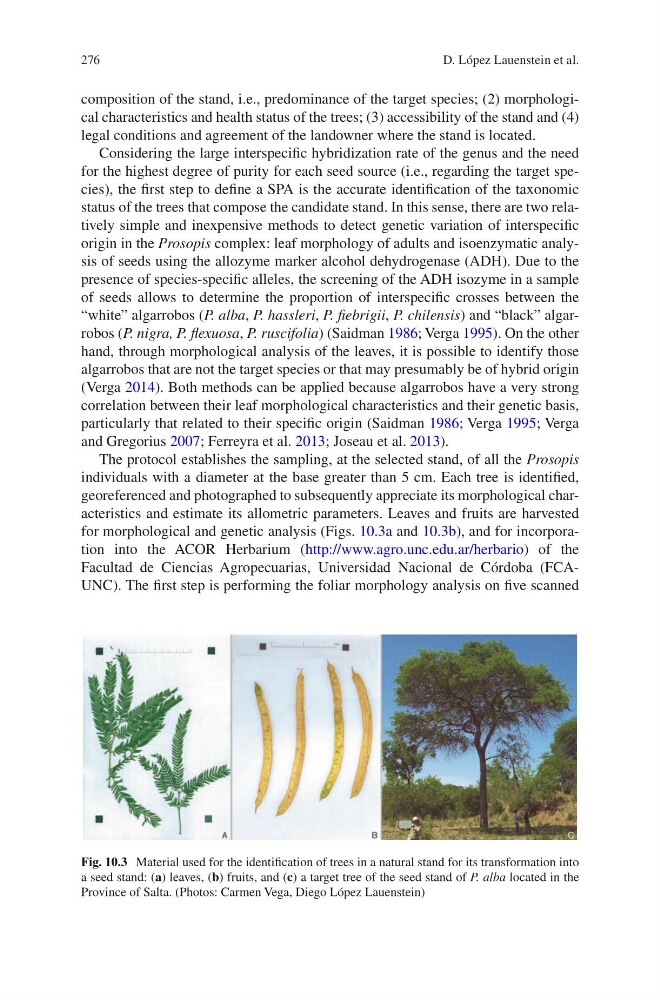
georeferenced and photographed to subsequently appreciate its morphological characteristics and estimate its allometric parameters. Leaves and fruits are harvested
for morphological and genetic analysis (Figs. 10.3a and 10.3b), and for incorporation into the ACOR Herbarium (http://www.agro.unc.edu.ar/herbario) of the
Facultad de Ciencias Agropecuarias, Universidad Nacional de Córdoba (FCAUNC). The first step is performing the foliar morphology analysis on five scanned
Fig. 10.3 Material used for the identification of trees in a natural stand for its transformation into
a seed stand: (a) leaves, (b) fruits, and (c) a target tree of the seed stand of P. alba located in the
Province of Salta. (Photos: Carmen Vega, Diego López Lauenstein)
D. López Lauenstein et al.
composition of the stand, i.e., predominance of the target species; (2) morphological characteristics and health status of the trees; (3) accessibility of the stand and (4)
legal conditions and agreement of the landowner where the stand is located.
Considering the large interspecific hybridization rate of the genus and the need
for the highest degree of purity for each seed source (i.e., regarding the target species), the first step to define a SPA is the accurate identification of the taxonomic
status of the trees that compose the candidate stand. In this sense, there are two relatively simple and inexpensive methods to detect genetic variation of interspecific
origin in the Prosopis complex: leaf morphology of adults and isoenzymatic analysis of seeds using the allozyme marker alcohol dehydrogenase (ADH). Due to the
presence of species-specific alleles, the screening of the ADH isozyme in a sample
of seeds allows to determine the proportion of interspecific crosses between the
“white” algarrobos (P. alba, P. hassleri, P. fiebrigii, P. chilensis) and “black” algarrobos (P. nigra, P. flexuosa, P. ruscifolia) (Saidman 1986; Verga 1995). On the other
hand, through morphological analysis of the leaves, it is possible to identify those
algarrobos that are not the target species or that may presumably be of hybrid origin
(Verga 2014). Both methods can be applied because algarrobos have a very strong
correlation between their leaf morphological characteristics and their genetic basis,
particularly that related to their specific origin (Saidman 1986; Verga 1995; Verga
and Gregorius 2007; Ferreyra et al. 2013; Joseau et al. 2013).
The protocol establishes the sampling, at the selected stand, of all the Prosopis
individuals with a diameter at the base greater than 5 cm. Each tree is identified,
georeferenced and photographed to subsequently appreciate its morphological characteristics and estimate its allometric parameters. Leaves and fruits are harvested
for morphological and genetic analysis (Figs. 10.3a and 10.3b), and for incorporation into the ACOR Herbarium (http://www.agro.unc.edu.ar/herbario) of the
Facultad de Ciencias Agropecuarias, Universidad Nacional de Córdoba (FCAUNC). The first step is performing the foliar morphology analysis on five scanned
Fig. 10.3 Material used for the identification of trees in a natural stand for its transformation into
a seed stand: (a) leaves, (b) fruits, and (c) a target tree of the seed stand of P. alba located in the
Province of Salta. (Photos: Carmen Vega, Diego López Lauenstein)
D. López Lauenstein et al.