

275
purity, avoiding hybridization between Prosopis species (Verga 2014 and see Chap.
9). At the same time, it seeks to respond to the suggestions of FAO (2014) to improve
the sustainable use and management of forest genetic resources. Despite the intense
degradation of Prosopis forests in Argentina, there are stands of good purity and
silvicultural quality that, with a proper management, can be used in the short term
as genetically stable seed stands. Accordingly, protocols were established together
with the Argentine National Seed Institute (INASE; Res. 374/14) in order to systematize seed harvest for seedling production of the main Prosopis species. These protocols involve the morphological analysis of leaves of adult individuals, and the
genetic analysis through biochemical markers (isoenzymes) of offspring (seeds) for
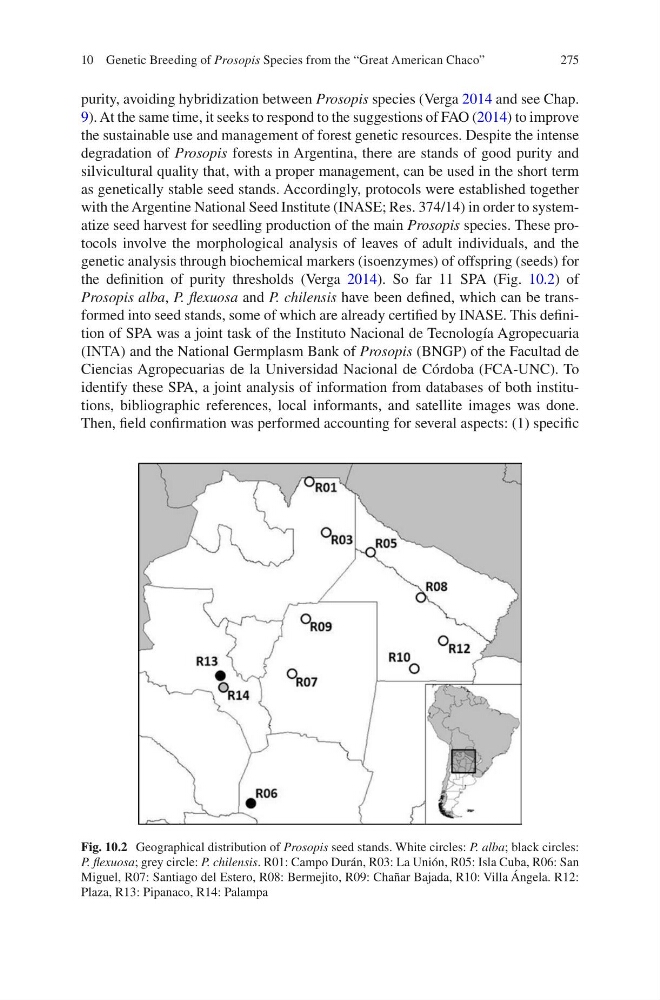
the definition of purity thresholds (Verga 2014). So far 11 SPA (Fig. 10.2) of
Prosopis alba, P. flexuosa and P. chilensis have been defined, which can be transformed into seed stands, some of which are already certified by INASE. This definition of SPA was a joint task of the Instituto Nacional de Tecnología Agropecuaria
(INTA) and the National Germplasm Bank of Prosopis (BNGP) of the Facultad de
Ciencias Agropecuarias de la Universidad Nacional de Córdoba (FCA-UNC). To
identify these SPA, a joint analysis of information from databases of both institutions, bibliographic references, local informants, and satellite images was done.
Then, field confirmation was performed accounting for several aspects: (1) specific
Fig. 10.2 Geographical distribution of Prosopis seed stands. White circles: P. alba; black circles:
P. flexuosa; grey circle: P. chilensis. R01: Campo Durán, R03: La Unión, R05: Isla Cuba, R06: San
Miguel, R07: Santiago del Estero, R08: Bermejito, R09: Chañar Bajada, R10: Villa Ángela. R12:
Plaza, R13: Pipanaco, R14: Palampa
10 Genetic Breeding of Prosopis Species from the “Great American Chaco”
purity, avoiding hybridization between Prosopis species (Verga 2014 and see Chap.
9). At the same time, it seeks to respond to the suggestions of FAO (2014) to improve
the sustainable use and management of forest genetic resources. Despite the intense
degradation of Prosopis forests in Argentina, there are stands of good purity and
silvicultural quality that, with a proper management, can be used in the short term
as genetically stable seed stands. Accordingly, protocols were established together
with the Argentine National Seed Institute (INASE; Res. 374/14) in order to systematize seed harvest for seedling production of the main Prosopis species. These protocols involve the morphological analysis of leaves of adult individuals, and the
genetic analysis through biochemical markers (isoenzymes) of offspring (seeds) for
the definition of purity thresholds (Verga 2014). So far 11 SPA (Fig. 10.2) of
Prosopis alba, P. flexuosa and P. chilensis have been defined, which can be transformed into seed stands, some of which are already certified by INASE. This definition of SPA was a joint task of the Instituto Nacional de Tecnología Agropecuaria
(INTA) and the National Germplasm Bank of Prosopis (BNGP) of the Facultad de
Ciencias Agropecuarias de la Universidad Nacional de Córdoba (FCA-UNC). To
identify these SPA, a joint analysis of information from databases of both institutions, bibliographic references, local informants, and satellite images was done.
Then, field confirmation was performed accounting for several aspects: (1) specific
Fig. 10.2 Geographical distribution of Prosopis seed stands. White circles: P. alba; black circles:
P. flexuosa; grey circle: P. chilensis. R01: Campo Durán, R03: La Unión, R05: Isla Cuba, R06: San
Miguel, R07: Santiago del Estero, R08: Bermejito, R09: Chañar Bajada, R10: Villa Ángela. R12:
Plaza, R13: Pipanaco, R14: Palampa
10 Genetic Breeding of Prosopis Species from the “Great American Chaco”