

277
leaves for each tree (Fig. 10.3a) using the software Hoja 3.4 (Verga 2015). The most
frequently used leaf traits are petiole length (PEL), number of pairs of pinnae (NPI),
pinna length (PIL), number of pairs of leaflets per pinna (NLP), leaflet length (LEL),
leaflet width (LEW), leaflet area (LEA), leaflet apex (LAPX), distance between
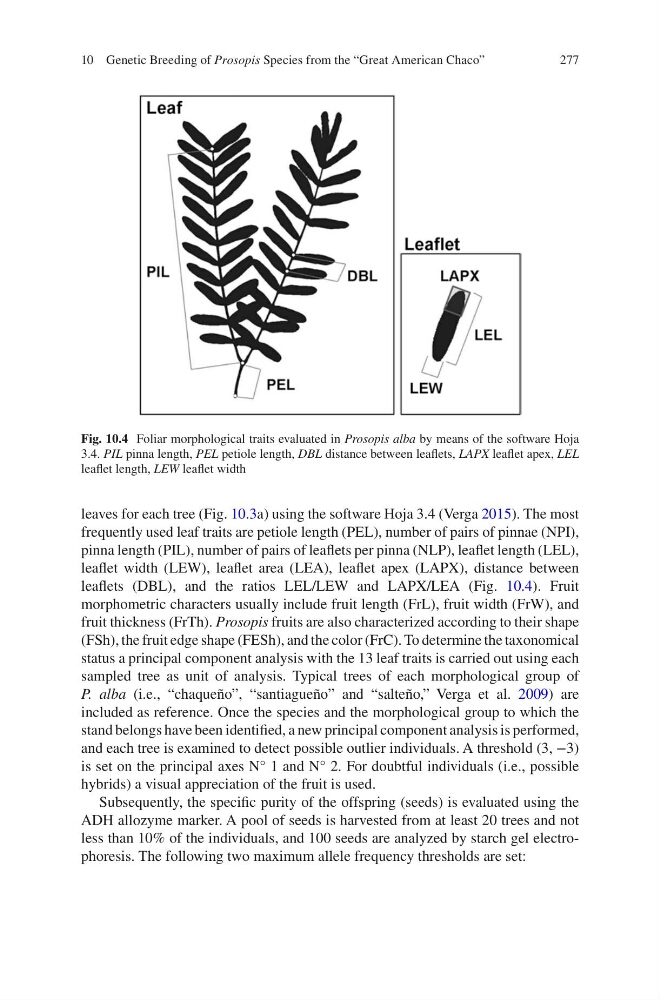
leaflets (DBL), and the ratios LEL/LEW and LAPX/LEA (Fig. 10.4). Fruit
morphometric characters usually include fruit length (FrL), fruit width (FrW), and
fruit thickness (FrTh). Prosopis fruits are also characterized according to their shape
(FSh), the fruit edge shape (FESh), and the color (FrC). To determine the taxonomical
status a principal component analysis with the 13 leaf traits is carried out using each
sampled tree as unit of analysis. Typical trees of each morphological group of
P. alba (i.e., “chaqueño”, “santiagueño” and “salteño,” Verga et al. 2009) are
included as reference. Once the species and the morphological group to which the
stand belongs have been identified, a new principal component analysis is performed,
and each tree is examined to detect possible outlier individuals. A threshold (3, −3)
is set on the principal axes N° 1 and N° 2. For doubtful individuals (i.e., possible
hybrids) a visual appreciation of the fruit is used.
Subsequently, the specific purity of the offspring (seeds) is evaluated using the
ADH allozyme marker. A pool of seeds is harvested from at least 20 trees and not
less than 10% of the individuals, and 100 seeds are analyzed by starch gel electrophoresis. The following two maximum allele frequency thresholds are set:
Fig. 10.4 Foliar morphological traits evaluated in Prosopis alba by means of the software Hoja
3.4. PIL pinna length, PEL petiole length, DBL distance between leaflets, LAPX leaflet apex, LEL
leaflet length, LEW leaflet width
10 Genetic Breeding of Prosopis Species from the “Great American Chaco”
leaves for each tree (Fig. 10.3a) using the software Hoja 3.4 (Verga 2015). The most
frequently used leaf traits are petiole length (PEL), number of pairs of pinnae (NPI),
pinna length (PIL), number of pairs of leaflets per pinna (NLP), leaflet length (LEL),
leaflet width (LEW), leaflet area (LEA), leaflet apex (LAPX), distance between
leaflets (DBL), and the ratios LEL/LEW and LAPX/LEA (Fig. 10.4). Fruit
morphometric characters usually include fruit length (FrL), fruit width (FrW), and
fruit thickness (FrTh). Prosopis fruits are also characterized according to their shape
(FSh), the fruit edge shape (FESh), and the color (FrC). To determine the taxonomical
status a principal component analysis with the 13 leaf traits is carried out using each
sampled tree as unit of analysis. Typical trees of each morphological group of
P. alba (i.e., “chaqueño”, “santiagueño” and “salteño,” Verga et al. 2009) are
included as reference. Once the species and the morphological group to which the
stand belongs have been identified, a new principal component analysis is performed,
and each tree is examined to detect possible outlier individuals. A threshold (3, −3)
is set on the principal axes N° 1 and N° 2. For doubtful individuals (i.e., possible
hybrids) a visual appreciation of the fruit is used.
Subsequently, the specific purity of the offspring (seeds) is evaluated using the
ADH allozyme marker. A pool of seeds is harvested from at least 20 trees and not
less than 10% of the individuals, and 100 seeds are analyzed by starch gel electrophoresis. The following two maximum allele frequency thresholds are set:
Fig. 10.4 Foliar morphological traits evaluated in Prosopis alba by means of the software Hoja
3.4. PIL pinna length, PEL petiole length, DBL distance between leaflets, LAPX leaflet apex, LEL
leaflet length, LEW leaflet width
10 Genetic Breeding of Prosopis Species from the “Great American Chaco”