

236
8.5.5 Handroanthus Heptaphyllus (Bignoniaceae)
In Argentina there are two species of the genus Handroanthus (Lozano and Zapater
Cano 2008), H. impetiginosus that is distributed in the Pedemontana Rainforest of
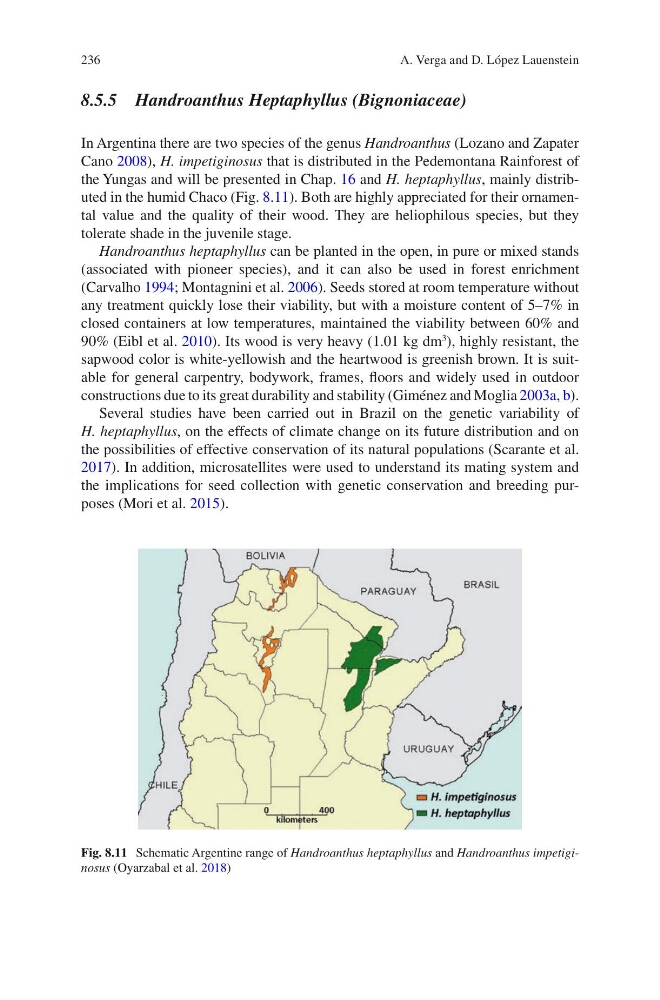
the Yungas and will be presented in Chap. 16 and H. heptaphyllus, mainly distributed in the humid Chaco (Fig. 8.11). Both are highly appreciated for their ornamental value and the quality of their wood. They are heliophilous species, but they
tolerate shade in the juvenile stage.
Handroanthus heptaphyllus can be planted in the open, in pure or mixed stands
(associated with pioneer species), and it can also be used in forest enrichment
(Carvalho 1994; Montagnini et al. 2006). Seeds stored at room temperature without
any treatment quickly lose their viability, but with a moisture content of 5–7% in
closed containers at low temperatures, maintained the viability between 60% and
90% (Eibl et al. 2010). Its wood is very heavy (1.01 kg dm
3
), highly resistant, the
sapwood color is white-yellowish and the heartwood is greenish brown. It is suitable for general carpentry, bodywork, frames, floors and widely used in outdoor
constructions due to its great durability and stability (Giménez and Moglia 2003a, b).
Several studies have been carried out in Brazil on the genetic variability of
H. heptaphyllus, on the effects of climate change on its future distribution and on
the possibilities of effective conservation of its natural populations (Scarante et al.
2017). In addition, microsatellites were used to understand its mating system and
the implications for seed collection with genetic conservation and breeding purposes (Mori et al. 2015).
Fig. 8.11 Schematic Argentine range of Handroanthus heptaphyllus and Handroanthus impetiginosus (Oyarzabal et al. 2018)
A. Verga and D. López Lauenstein
8.5.5 Handroanthus Heptaphyllus (Bignoniaceae)
In Argentina there are two species of the genus Handroanthus (Lozano and Zapater
Cano 2008), H. impetiginosus that is distributed in the Pedemontana Rainforest of
the Yungas and will be presented in Chap. 16 and H. heptaphyllus, mainly distributed in the humid Chaco (Fig. 8.11). Both are highly appreciated for their ornamental value and the quality of their wood. They are heliophilous species, but they
tolerate shade in the juvenile stage.
Handroanthus heptaphyllus can be planted in the open, in pure or mixed stands
(associated with pioneer species), and it can also be used in forest enrichment
(Carvalho 1994; Montagnini et al. 2006). Seeds stored at room temperature without
any treatment quickly lose their viability, but with a moisture content of 5–7% in
closed containers at low temperatures, maintained the viability between 60% and
90% (Eibl et al. 2010). Its wood is very heavy (1.01 kg dm
3
), highly resistant, the
sapwood color is white-yellowish and the heartwood is greenish brown. It is suitable for general carpentry, bodywork, frames, floors and widely used in outdoor
constructions due to its great durability and stability (Giménez and Moglia 2003a, b).
Several studies have been carried out in Brazil on the genetic variability of
H. heptaphyllus, on the effects of climate change on its future distribution and on
the possibilities of effective conservation of its natural populations (Scarante et al.
2017). In addition, microsatellites were used to understand its mating system and
the implications for seed collection with genetic conservation and breeding purposes (Mori et al. 2015).
Fig. 8.11 Schematic Argentine range of Handroanthus heptaphyllus and Handroanthus impetiginosus (Oyarzabal et al. 2018)
A. Verga and D. López Lauenstein