

235
8.5.4 Caesalpinia Paraguariensis (Fabaceae)
This is a tree species native to Argentina, Bolivia, Brazil, Paraguay, and Uruguay. In
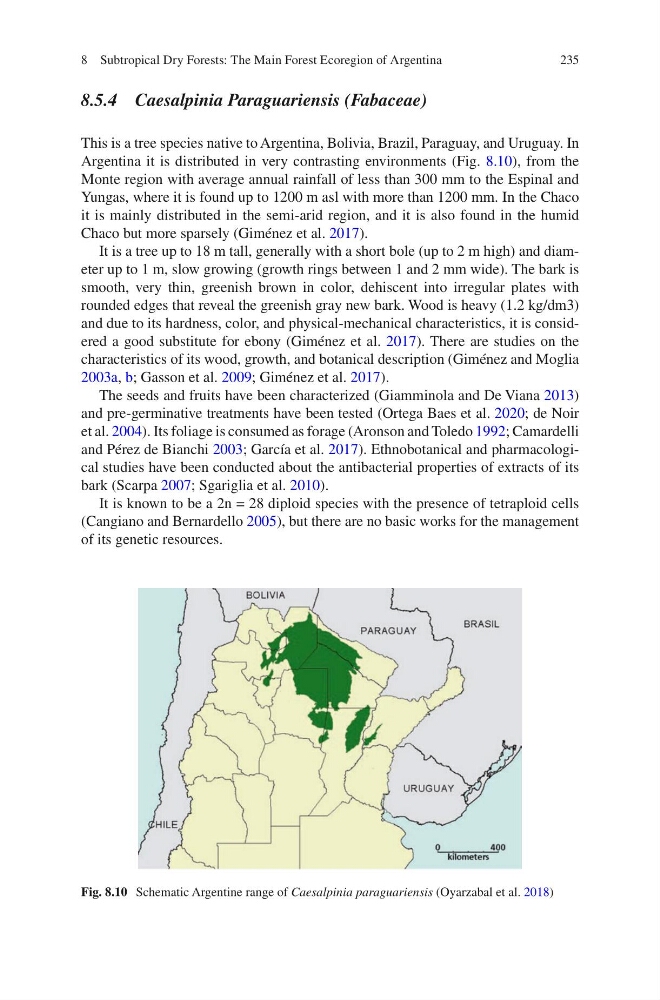
Argentina it is distributed in very contrasting environments (Fig. 8.10), from the
Monte region with average annual rainfall of less than 300 mm to the Espinal and
Yungas, where it is found up to 1200 m asl with more than 1200 mm. In the Chaco
it is mainly distributed in the semi-arid region, and it is also found in the humid
Chaco but more sparsely (Giménez et al. 2017).
It is a tree up to 18 m tall, generally with a short bole (up to 2 m high) and diameter up to 1 m, slow growing (growth rings between 1 and 2 mm wide). The bark is
smooth, very thin, greenish brown in color, dehiscent into irregular plates with
rounded edges that reveal the greenish gray new bark. Wood is heavy (1.2 kg/dm3)
and due to its hardness, color, and physical-mechanical characteristics, it is considered a good substitute for ebony (Giménez et al. 2017). There are studies on the
characteristics of its wood, growth, and botanical description (Giménez and Moglia
2003a, b; Gasson et al. 2009; Giménez et al. 2017).
The seeds and fruits have been characterized (Giamminola and De Viana 2013)
and pre-germinative treatments have been tested (Ortega Baes et al. 2020; de Noir
et al. 2004). Its foliage is consumed as forage (Aronson and Toledo 1992; Camardelli
and Pérez de Bianchi 2003; García et al. 2017). Ethnobotanical and pharmacological studies have been conducted about the antibacterial properties of extracts of its
bark (Scarpa 2007; Sgariglia et al. 2010).
It is known to be a 2n = 28 diploid species with the presence of tetraploid cells
(Cangiano and Bernardello 2005), but there are no basic works for the management
of its genetic resources.
Fig. 8.10 Schematic Argentine range of Caesalpinia paraguariensis (Oyarzabal et al. 2018)
8 Subtropical Dry Forests: The Main Forest Ecoregion of Argentina
8.5.4 Caesalpinia Paraguariensis (Fabaceae)
This is a tree species native to Argentina, Bolivia, Brazil, Paraguay, and Uruguay. In
Argentina it is distributed in very contrasting environments (Fig. 8.10), from the
Monte region with average annual rainfall of less than 300 mm to the Espinal and
Yungas, where it is found up to 1200 m asl with more than 1200 mm. In the Chaco
it is mainly distributed in the semi-arid region, and it is also found in the humid
Chaco but more sparsely (Giménez et al. 2017).
It is a tree up to 18 m tall, generally with a short bole (up to 2 m high) and diameter up to 1 m, slow growing (growth rings between 1 and 2 mm wide). The bark is
smooth, very thin, greenish brown in color, dehiscent into irregular plates with
rounded edges that reveal the greenish gray new bark. Wood is heavy (1.2 kg/dm3)
and due to its hardness, color, and physical-mechanical characteristics, it is considered a good substitute for ebony (Giménez et al. 2017). There are studies on the
characteristics of its wood, growth, and botanical description (Giménez and Moglia
2003a, b; Gasson et al. 2009; Giménez et al. 2017).
The seeds and fruits have been characterized (Giamminola and De Viana 2013)
and pre-germinative treatments have been tested (Ortega Baes et al. 2020; de Noir
et al. 2004). Its foliage is consumed as forage (Aronson and Toledo 1992; Camardelli
and Pérez de Bianchi 2003; García et al. 2017). Ethnobotanical and pharmacological studies have been conducted about the antibacterial properties of extracts of its
bark (Scarpa 2007; Sgariglia et al. 2010).
It is known to be a 2n = 28 diploid species with the presence of tetraploid cells
(Cangiano and Bernardello 2005), but there are no basic works for the management
of its genetic resources.
Fig. 8.10 Schematic Argentine range of Caesalpinia paraguariensis (Oyarzabal et al. 2018)
8 Subtropical Dry Forests: The Main Forest Ecoregion of Argentina