

237
8.5.6 Ziziphus mistol (Rhamnaceae)
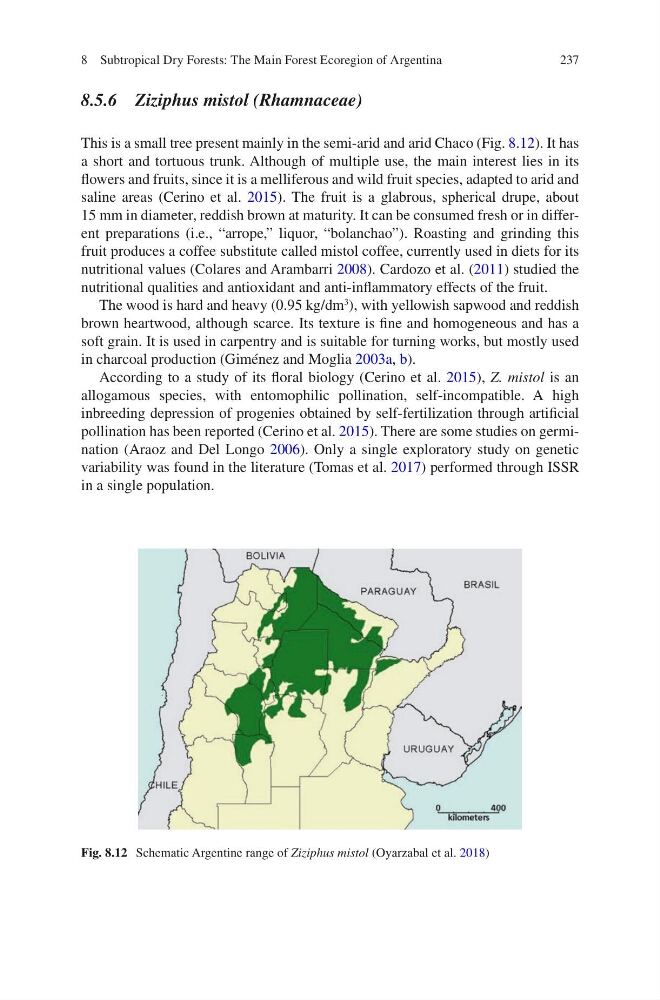
This is a small tree present mainly in the semi-arid and arid Chaco (Fig. 8.12). It has
a short and tortuous trunk. Although of multiple use, the main interest lies in its
flowers and fruits, since it is a melliferous and wild fruit species, adapted to arid and
saline areas (Cerino et al. 2015). The fruit is a glabrous, spherical drupe, about
15 mm in diameter, reddish brown at maturity. It can be consumed fresh or in different preparations (i.e., “arrope,” liquor, “bolanchao”). Roasting and grinding this
fruit produces a coffee substitute called mistol coffee, currently used in diets for its
nutritional values (Colares and Arambarri 2008). Cardozo et al. (2011) studied the
nutritional qualities and antioxidant and anti-inflammatory effects of the fruit.
The wood is hard and heavy (0.95 kg/dm
3
), with yellowish sapwood and reddish
brown heartwood, although scarce. Its texture is fine and homogeneous and has a
soft grain. It is used in carpentry and is suitable for turning works, but mostly used
in charcoal production (Giménez and Moglia 2003a, b).
According to a study of its floral biology (Cerino et al. 2015), Z. mistol is an
allogamous species, with entomophilic pollination, self-incompatible. A high
inbreeding depression of progenies obtained by self-fertilization through artificial
pollination has been reported (Cerino et al. 2015). There are some studies on germination (Araoz and Del Longo 2006). Only a single exploratory study on genetic
variability was found in the literature (Tomas et al. 2017) performed through ISSR
in a single population.
Fig. 8.12 Schematic Argentine range of Ziziphus mistol (Oyarzabal et al. 2018)
8 Subtropical Dry Forests: The Main Forest Ecoregion of Argentina
8.5.6 Ziziphus mistol (Rhamnaceae)
This is a small tree present mainly in the semi-arid and arid Chaco (Fig. 8.12). It has
a short and tortuous trunk. Although of multiple use, the main interest lies in its
flowers and fruits, since it is a melliferous and wild fruit species, adapted to arid and
saline areas (Cerino et al. 2015). The fruit is a glabrous, spherical drupe, about
15 mm in diameter, reddish brown at maturity. It can be consumed fresh or in different preparations (i.e., “arrope,” liquor, “bolanchao”). Roasting and grinding this
fruit produces a coffee substitute called mistol coffee, currently used in diets for its
nutritional values (Colares and Arambarri 2008). Cardozo et al. (2011) studied the
nutritional qualities and antioxidant and anti-inflammatory effects of the fruit.
The wood is hard and heavy (0.95 kg/dm
3
), with yellowish sapwood and reddish
brown heartwood, although scarce. Its texture is fine and homogeneous and has a
soft grain. It is used in carpentry and is suitable for turning works, but mostly used
in charcoal production (Giménez and Moglia 2003a, b).
According to a study of its floral biology (Cerino et al. 2015), Z. mistol is an
allogamous species, with entomophilic pollination, self-incompatible. A high
inbreeding depression of progenies obtained by self-fertilization through artificial
pollination has been reported (Cerino et al. 2015). There are some studies on germination (Araoz and Del Longo 2006). Only a single exploratory study on genetic
variability was found in the literature (Tomas et al. 2017) performed through ISSR
in a single population.
Fig. 8.12 Schematic Argentine range of Ziziphus mistol (Oyarzabal et al. 2018)
8 Subtropical Dry Forests: The Main Forest Ecoregion of Argentina