

141
greenhouse progeny trial was established with 60 seedlings per open-pollinated
family randomly ordered in three repetitions (N = 2340). At the end of the first
growing season, the total height (H) of each seedling was measured, and they were
categorized in three shape types (S): straight, crooked, or decumbent. Differences
between the progeny of plus and general mother trees were shown for the proportion
of S (Fig. 5.9), but not for H. Plus trees had a progeny with a greater proportion of
straight seedlings. On the contrary, when testing the family factor, it was not significant for the proportion of S but for H, and in fact a high heritability was estimated
(h
2
= 82%). We still do not know the evolution of these traits at older ages, but it
seems wise to select mother trees in the natural forest according to their shape. On
the other hand, the selection according to the growth in height would also be quite
convenient. However, this could hardly be done in the natural forest, since it is
ignored if the higher relative height of a tree is due to a better growth or an older age.
After these preliminary results, a low-intensity breeding strategy was planned by
INTA for N. antarctica, based on the establishment of progeny seed orchards with
seedlings obtained from seeds of good forestry shape individuals selected in the
natural forest. Thus, 40 trees with monopodial and straight stems were selected in
two natural populations of the Province of Chubut (Trevelin and Lake Rosario). In
2009, open-pollinated seeds were collected from those trees, expecting a greater
proportion of good shape seedlings in the nursery production, which was conducted
by INTA. Finally, in 2011, two seed orchards were established with 2-year-old seedlings. The first one was settled in Trevelin Forest Station of INTA (43° 05′ 29″S, 71°
32′ 21″W, 450 m asl; Fig. 5.9), with 1750 seedlings and without irrigation, and the
second in a nearby private property (43° 7′ 6″S, 71° 27′ 30″W, 360 m asl), with 400
seedlings and furrow irrigation. In order to perform a preliminary evaluation, the
height of the saplings was measured in 2015 in both orchards, together with a
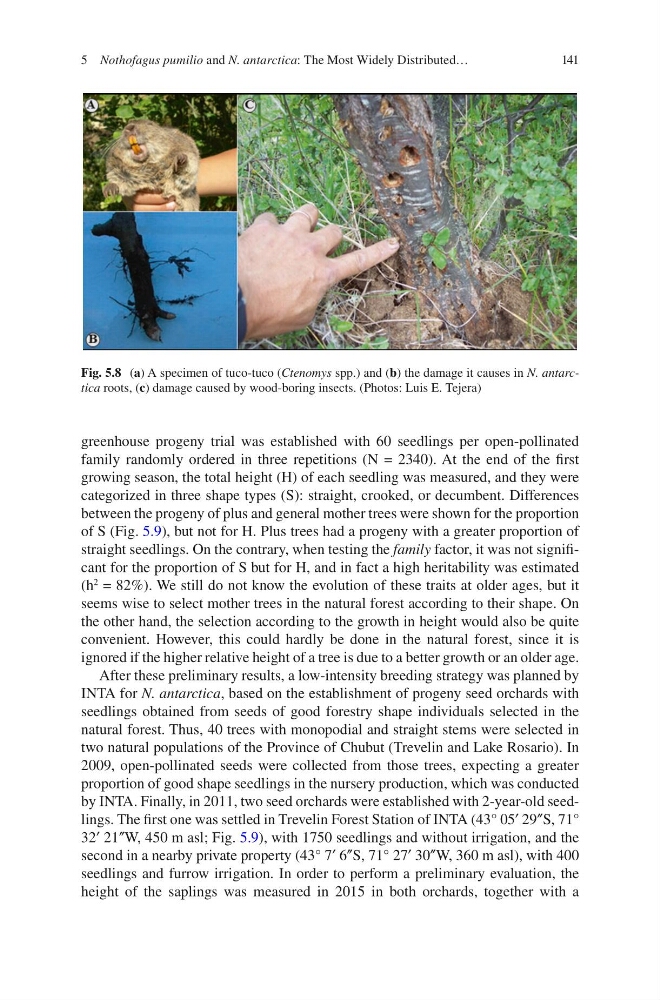
Fig. 5.8 (a) A specimen of tuco-tuco (Ctenomys spp.) and (b) the damage it causes in N. antarctica roots, (c) damage caused by wood-boring insects. (Photos: Luis E. Tejera)
5 Nothofagus pumilio and N. antarctica: The Most Widely Distributed…
greenhouse progeny trial was established with 60 seedlings per open-pollinated
family randomly ordered in three repetitions (N = 2340). At the end of the first
growing season, the total height (H) of each seedling was measured, and they were
categorized in three shape types (S): straight, crooked, or decumbent. Differences
between the progeny of plus and general mother trees were shown for the proportion
of S (Fig. 5.9), but not for H. Plus trees had a progeny with a greater proportion of
straight seedlings. On the contrary, when testing the family factor, it was not significant for the proportion of S but for H, and in fact a high heritability was estimated
(h
2
= 82%). We still do not know the evolution of these traits at older ages, but it
seems wise to select mother trees in the natural forest according to their shape. On
the other hand, the selection according to the growth in height would also be quite
convenient. However, this could hardly be done in the natural forest, since it is
ignored if the higher relative height of a tree is due to a better growth or an older age.
After these preliminary results, a low-intensity breeding strategy was planned by
INTA for N. antarctica, based on the establishment of progeny seed orchards with
seedlings obtained from seeds of good forestry shape individuals selected in the
natural forest. Thus, 40 trees with monopodial and straight stems were selected in
two natural populations of the Province of Chubut (Trevelin and Lake Rosario). In
2009, open-pollinated seeds were collected from those trees, expecting a greater
proportion of good shape seedlings in the nursery production, which was conducted
by INTA. Finally, in 2011, two seed orchards were established with 2-year-old seedlings. The first one was settled in Trevelin Forest Station of INTA (43° 05′ 29″S, 71°
32′ 21″W, 450 m asl; Fig. 5.9), with 1750 seedlings and without irrigation, and the
second in a nearby private property (43° 7′ 6″S, 71° 27′ 30″W, 360 m asl), with 400
seedlings and furrow irrigation. In order to perform a preliminary evaluation, the
height of the saplings was measured in 2015 in both orchards, together with a
Fig. 5.8 (a) A specimen of tuco-tuco (Ctenomys spp.) and (b) the damage it causes in N. antarctica roots, (c) damage caused by wood-boring insects. (Photos: Luis E. Tejera)
5 Nothofagus pumilio and N. antarctica: The Most Widely Distributed…