

140
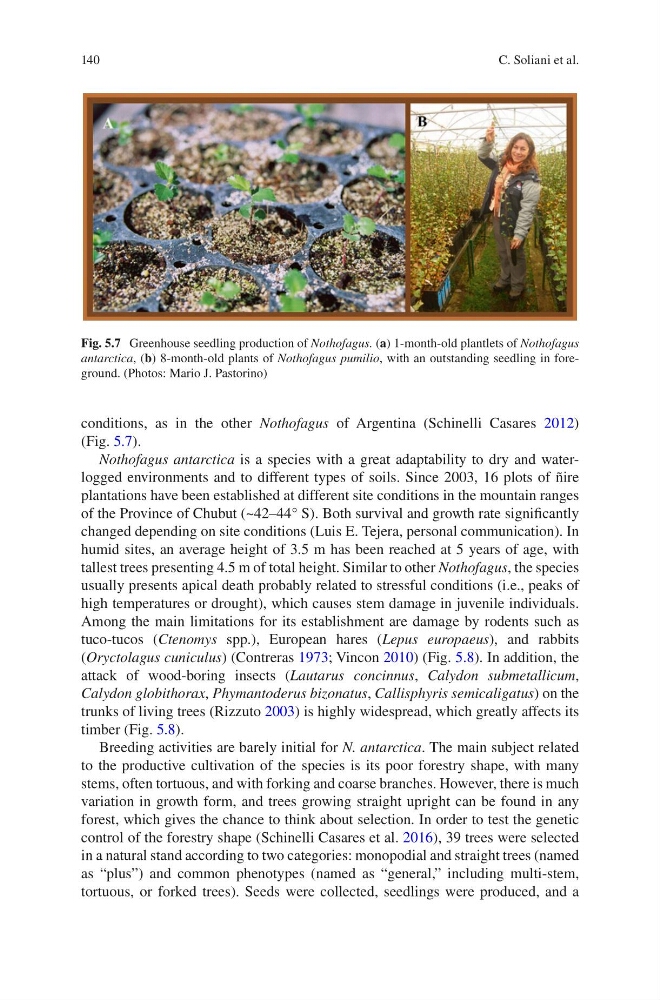
conditions, as in the other Nothofagus of Argentina (Schinelli Casares 2012)
(Fig. 5.7).
Nothofagus antarctica is a species with a great adaptability to dry and waterlogged environments and to different types of soils. Since 2003, 16 plots of ñire
plantations have been established at different site conditions in the mountain ranges
of the Province of Chubut (~42–44° S). Both survival and growth rate significantly
changed depending on site conditions (Luis E. Tejera, personal communication). In
humid sites, an average height of 3.5 m has been reached at 5 years of age, with
tallest trees presenting 4.5 m of total height. Similar to other Nothofagus, the species
usually presents apical death probably related to stressful conditions (i.e., peaks of
high temperatures or drought), which causes stem damage in juvenile individuals.
Among the main limitations for its establishment are damage by rodents such as
tuco-tucos (Ctenomys spp.), European hares (Lepus europaeus), and rabbits
(Oryctolagus cuniculus) (Contreras 1973; Vincon 2010) (Fig. 5.8). In addition, the
attack of wood-boring insects (Lautarus concinnus, Calydon submetallicum,
Calydon globithorax, Phymantoderus bizonatus, Callisphyris semicaligatus) on the
trunks of living trees (Rizzuto 2003) is highly widespread, which greatly affects its
timber (Fig. 5.8).
Breeding activities are barely initial for N. antarctica. The main subject related
to the productive cultivation of the species is its poor forestry shape, with many
stems, often tortuous, and with forking and coarse branches. However, there is much
variation in growth form, and trees growing straight upright can be found in any
forest, which gives the chance to think about selection. In order to test the genetic
control of the forestry shape (Schinelli Casares et al. 2016), 39 trees were selected
in a natural stand according to two categories: monopodial and straight trees (named
as “plus”) and common phenotypes (named as “general,” including multi-stem,
tortuous, or forked trees). Seeds were collected, seedlings were produced, and a
Fig. 5.7 Greenhouse seedling production of Nothofagus. (a) 1-month-old plantlets of Nothofagus
antarctica, (b) 8-month-old plants of Nothofagus pumilio, with an outstanding seedling in foreground. (Photos: Mario J. Pastorino)
C. Soliani et al.
conditions, as in the other Nothofagus of Argentina (Schinelli Casares 2012)
(Fig. 5.7).
Nothofagus antarctica is a species with a great adaptability to dry and waterlogged environments and to different types of soils. Since 2003, 16 plots of ñire
plantations have been established at different site conditions in the mountain ranges
of the Province of Chubut (~42–44° S). Both survival and growth rate significantly
changed depending on site conditions (Luis E. Tejera, personal communication). In
humid sites, an average height of 3.5 m has been reached at 5 years of age, with
tallest trees presenting 4.5 m of total height. Similar to other Nothofagus, the species
usually presents apical death probably related to stressful conditions (i.e., peaks of
high temperatures or drought), which causes stem damage in juvenile individuals.
Among the main limitations for its establishment are damage by rodents such as
tuco-tucos (Ctenomys spp.), European hares (Lepus europaeus), and rabbits
(Oryctolagus cuniculus) (Contreras 1973; Vincon 2010) (Fig. 5.8). In addition, the
attack of wood-boring insects (Lautarus concinnus, Calydon submetallicum,
Calydon globithorax, Phymantoderus bizonatus, Callisphyris semicaligatus) on the
trunks of living trees (Rizzuto 2003) is highly widespread, which greatly affects its
timber (Fig. 5.8).
Breeding activities are barely initial for N. antarctica. The main subject related
to the productive cultivation of the species is its poor forestry shape, with many
stems, often tortuous, and with forking and coarse branches. However, there is much
variation in growth form, and trees growing straight upright can be found in any
forest, which gives the chance to think about selection. In order to test the genetic
control of the forestry shape (Schinelli Casares et al. 2016), 39 trees were selected
in a natural stand according to two categories: monopodial and straight trees (named
as “plus”) and common phenotypes (named as “general,” including multi-stem,
tortuous, or forked trees). Seeds were collected, seedlings were produced, and a
Fig. 5.7 Greenhouse seedling production of Nothofagus. (a) 1-month-old plantlets of Nothofagus
antarctica, (b) 8-month-old plants of Nothofagus pumilio, with an outstanding seedling in foreground. (Photos: Mario J. Pastorino)
C. Soliani et al.