

112
this regard, self-pollinated flowers presented low pollen germination in the stigmas
and produced few viable seeds. When mixed pollinations were applied, selfinterference was confirmed for those cases in which self-pollination preceded crosspollination; in such cases the probability of compatible pollen-tube formation was
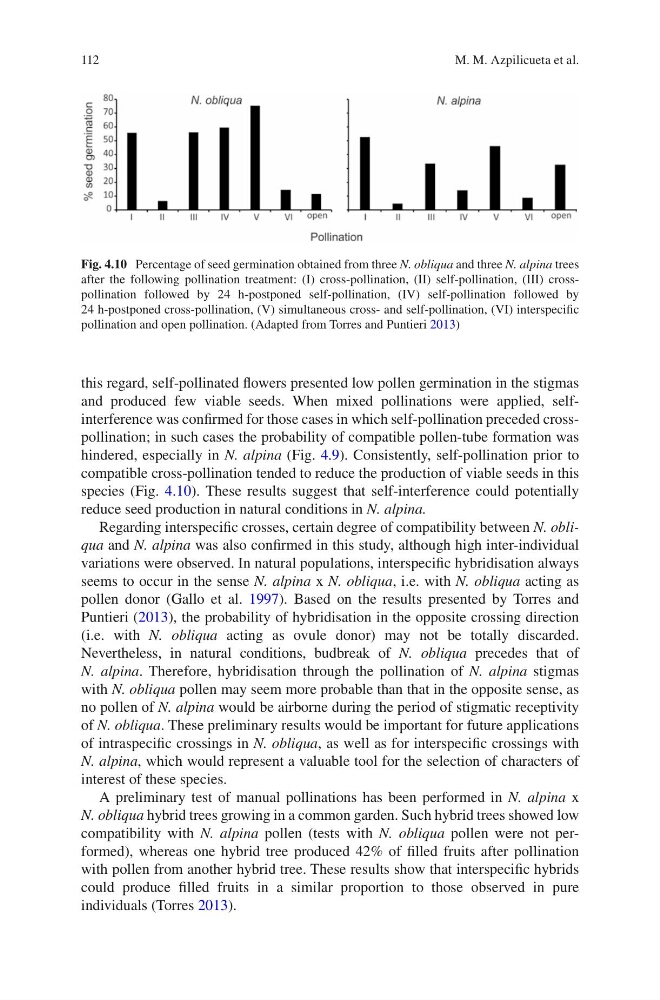
hindered, especially in N. alpina (Fig. 4.9). Consistently, self-pollination prior to
compatible cross-pollination tended to reduce the production of viable seeds in this
species (Fig. 4.10). These results suggest that self-interference could potentially
reduce seed production in natural conditions in N. alpina.
Regarding interspecific crosses, certain degree of compatibility between N. obliqua and N. alpina was also confirmed in this study, although high inter-individual
variations were observed. In natural populations, interspecific hybridisation always
seems to occur in the sense N. alpina x N. obliqua, i.e. with N. obliqua acting as
pollen donor (Gallo et al. 1997). Based on the results presented by Torres and
Puntieri (2013), the probability of hybridisation in the opposite crossing direction
(i.e. with N. obliqua acting as ovule donor) may not be totally discarded.
Nevertheless, in natural conditions, budbreak of N. obliqua precedes that of
N. alpina. Therefore, hybridisation through the pollination of N. alpina stigmas
with N. obliqua pollen may seem more probable than that in the opposite sense, as
no pollen of N. alpina would be airborne during the period of stigmatic receptivity
of N. obliqua. These preliminary results would be important for future applications
of intraspecific crossings in N. obliqua, as well as for interspecific crossings with
N. alpina, which would represent a valuable tool for the selection of characters of
interest of these species.
A preliminary test of manual pollinations has been performed in N. alpina x
N. obliqua hybrid trees growing in a common garden. Such hybrid trees showed low
compatibility with N. alpina pollen (tests with N. obliqua pollen were not performed), whereas one hybrid tree produced 42% of filled fruits after pollination
with pollen from another hybrid tree. These results show that interspecific hybrids
could produce filled fruits in a similar proportion to those observed in pure
individuals (Torres 2013).
Fig. 4.10 Percentage of seed germination obtained from three N. obliqua and three N. alpina trees
after the following pollination treatment: (I) cross-pollination, (II) self-pollination, (III) crosspollination followed by 24 h-postponed self-pollination, (IV) self-pollination followed by
24 h-postponed cross-pollination, (V) simultaneous cross- and self-pollination, (VI) interspecific
pollination and open pollination. (Adapted from Torres and Puntieri 2013)
M. M. Azpilicueta et al.
this regard, self-pollinated flowers presented low pollen germination in the stigmas
and produced few viable seeds. When mixed pollinations were applied, selfinterference was confirmed for those cases in which self-pollination preceded crosspollination; in such cases the probability of compatible pollen-tube formation was
hindered, especially in N. alpina (Fig. 4.9). Consistently, self-pollination prior to
compatible cross-pollination tended to reduce the production of viable seeds in this
species (Fig. 4.10). These results suggest that self-interference could potentially
reduce seed production in natural conditions in N. alpina.
Regarding interspecific crosses, certain degree of compatibility between N. obliqua and N. alpina was also confirmed in this study, although high inter-individual
variations were observed. In natural populations, interspecific hybridisation always
seems to occur in the sense N. alpina x N. obliqua, i.e. with N. obliqua acting as
pollen donor (Gallo et al. 1997). Based on the results presented by Torres and
Puntieri (2013), the probability of hybridisation in the opposite crossing direction
(i.e. with N. obliqua acting as ovule donor) may not be totally discarded.
Nevertheless, in natural conditions, budbreak of N. obliqua precedes that of
N. alpina. Therefore, hybridisation through the pollination of N. alpina stigmas
with N. obliqua pollen may seem more probable than that in the opposite sense, as
no pollen of N. alpina would be airborne during the period of stigmatic receptivity
of N. obliqua. These preliminary results would be important for future applications
of intraspecific crossings in N. obliqua, as well as for interspecific crossings with
N. alpina, which would represent a valuable tool for the selection of characters of
interest of these species.
A preliminary test of manual pollinations has been performed in N. alpina x
N. obliqua hybrid trees growing in a common garden. Such hybrid trees showed low
compatibility with N. alpina pollen (tests with N. obliqua pollen were not performed), whereas one hybrid tree produced 42% of filled fruits after pollination
with pollen from another hybrid tree. These results show that interspecific hybrids
could produce filled fruits in a similar proportion to those observed in pure
individuals (Torres 2013).
Fig. 4.10 Percentage of seed germination obtained from three N. obliqua and three N. alpina trees
after the following pollination treatment: (I) cross-pollination, (II) self-pollination, (III) crosspollination followed by 24 h-postponed self-pollination, (IV) self-pollination followed by
24 h-postponed cross-pollination, (V) simultaneous cross- and self-pollination, (VI) interspecific
pollination and open pollination. (Adapted from Torres and Puntieri 2013)
M. M. Azpilicueta et al.